Why Choose Minimally Invasive Podiatry?
Minimally invasive podiatry relies on tiny incisions—often less than 5 mm—so tissue disruption is minimal. This translates into lower infection risk, less postoperative pain, reduced swelling, and virtually scar‑less results. Patients typically experience a quicker return to light activity, often within days, and many can resume normal footwear within two to four weeks. The most common conditions treated with these techniques include bunions (hallux valgus), hammertoes, plantar fasciitis, heel spurs, and flat‑foot reconstructions. Advanced imaging such as fluoroscopy, real‑time ultrasound, and high‑definition endoscopic cameras guide the surgeon’s instruments through the small portals. Some clinics also employ robotic‑assisted platforms that provide a 3‑D magnified view and steady instrument control, while others use specialized burrs, percutaneous osteotomes, and zero‑profile fixation devices. Together, these technologies enable precise correction while preserving surrounding soft tissue, making minimally invasive podiatry a reliable, patient‑friendly option for most patients seeking effective foot care.
Understanding Minimally Invasive Foot Surgery
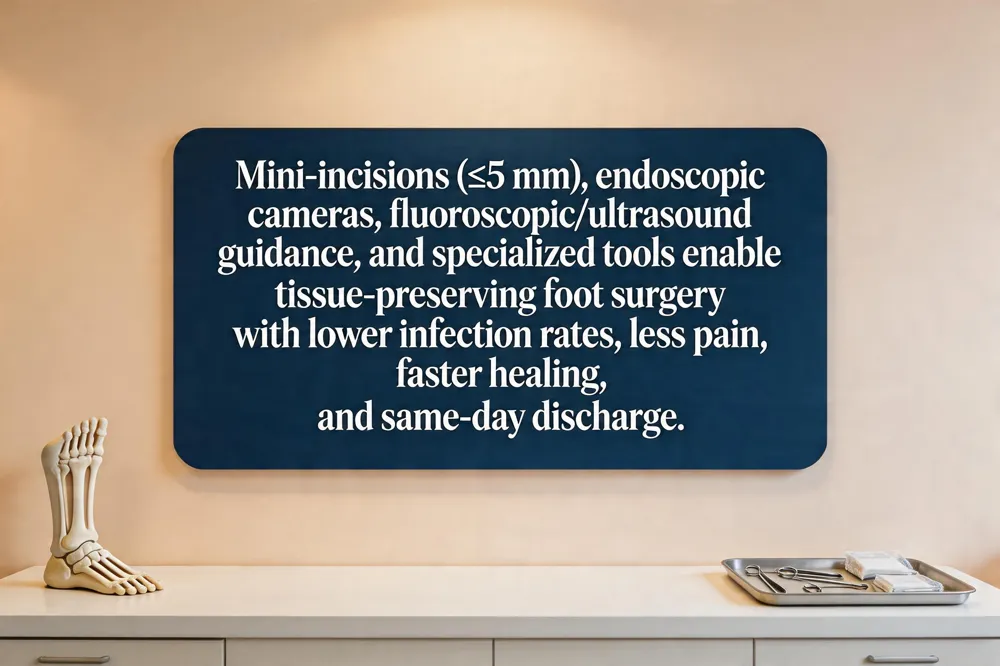 Minimally invasive foot surgery (MIS) employs tiny (≤5 mm) incisions, endoscopic cameras, fluoroscopic or ultrasound guidance, and specialized tools such as burrs, percutaneous osteotomes, and robotic‑assisted instruments. By preserving surrounding soft tissue, MIS reduces trauma, postoperative pain, swelling, and scarring while allowing patients to stay awake under local anesthesia and return home the same day (North Texas Podiatry Associates, Jan 2026).
Advantages over traditional open surgery include lower infection rates (often <2 % vs. 5‑10 % in open procedures), faster healing (light activities within days, full return to work in 2‑4 weeks), smaller scars, and reduced need for narcotic pain medication. Outpatient settings and shorter operative times (15‑30 min) also lower overall costs.
Common minimally invasive procedures are percutaneous bunionectomy, endoscopic plantar‑fasciotomy for chronic plantar fasciitis, arthroscopic ankle debridement, percutaneous hammertoe correction, and subchondroplasty for bone lesions. These techniques are supported by evidence showing high patient satisfaction, minimal complications, and quicker functional recovery.
While MIS offers many benefits, risks—infection, nerve or vascular injury, tendon‑bone delayedunion—remain and require careful patient selection and surgeon expertise.
Preparing for the Procedure & Selecting the Right Candidate
 When deciding who should perform the surgery, many patients prefer a board‑certified podiatrist because these specialists focus exclusively on foot and ankle pathology, offering both non‑surgical expertise and specialized surgical training. Orthopedic surgeons can also operate on the foot, but their broader musculoskeletal focus may not provide the same depth of foot‑specific experience. Yes, a board‑certified podiatrist can repair an Achilles tendon, using open or endoscopic techniques, after evaluating the injury severity and determining the most appropriate treatment plan.
Step‑by‑Step Walk‑through of Common Procedures
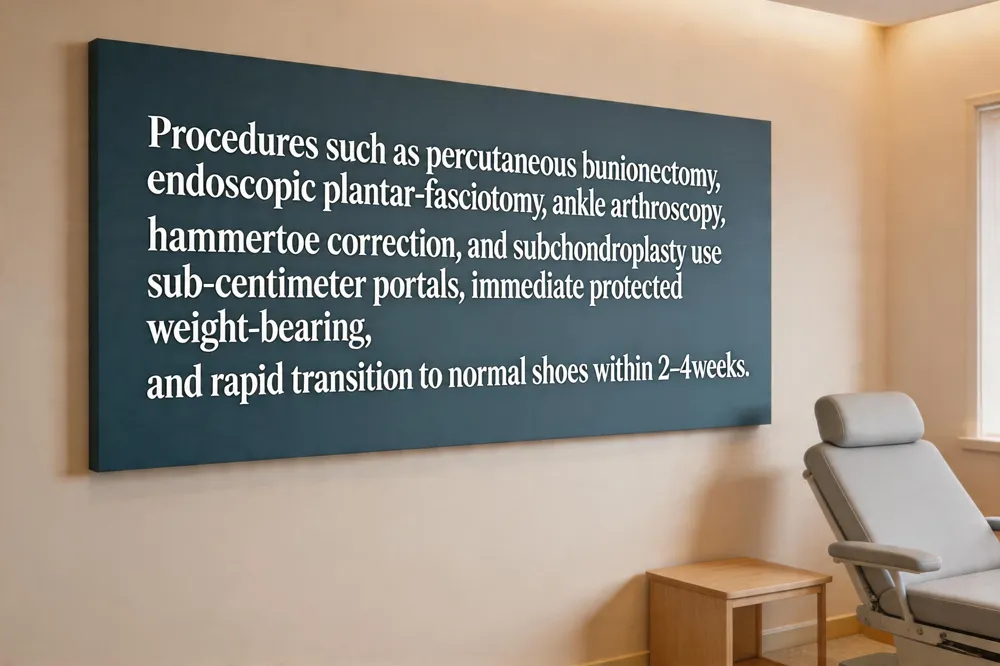 Minimally invasive podiatric surgery lets patients walk soon after the operation. Because incisions are often only ⅛‑½ inch, most people can bear weight in a protective boot the same day and transition to comfortable shoes within 2‑4 weeks; full activity usually resumes around 4‑6 weeks once the surgeon confirms proper bone healing.
A bunionette (fifth‑metatarsal) correction follows the same principle: a sub‑centimeter skin opening, a burr to reshape the bone, and often no hardware. Patients typically weight‑bear immediately in a boot and move to regular supportive footwear within a few weeks, experiencing less swelling and faster healing than with traditional surgery.
Ankle arthroscopy uses a tiny camera (arthroscope) and one‑to‑two 1‑cm portals to diagnose and treat cartilage damage, ligament tears, or loose bodies. The small incisions reduce tissue trauma, allow same‑day discharge, and speed return to normal activities.
For those seeking these procedures, Advanced Foot Care – with board‑certified surgeons in Northwest Chicago and South Florida – offers state‑of‑the‑art minimally invasive techniques. Contact the clinic or visit its website to locate the nearest office, verify insurance, and schedule a consultation.
Post‑Operative Care, Recovery, and Insurance Considerations
 After a minimally invasive foot or ankle procedure, patients receive clear after‑care instructions: keep the incision clean and dry, elevate the foot for the first 24‑48 hours, apply ice as tolerated, and take prescribed analgesics—usually non‑opioid—to control mild swelling and soreness. Weight‑bearing progression is gradual; most surgeons allow protected weight‑bearing in a rigid postoperative shoe or boot immediately after surgery, advancing to normal shoes within 1‑2 weeks and full activity by 4‑6 weeks, depending on the specific procedure. Medicare does not cover routine or cosmetic pedicures, even for diabetic patients; however, medically necessary foot care—such as therapeutic debridement of a callus that threatens an ulcer, ulcer treatment, or custom shoe fittings—may be reimbursed under Part B after the deductible is met. Minimally invasive ankle surgery employs 5‑mm or smaller incisions, percutaneous burrs, and fluoroscopic guidance to correct bone and soft‑tissue problems while preserving surrounding structures, resulting in less pain, scarring, and a faster return to mobility. Podiatrists also use localized cryotherapy to alleviate pain and inflammation from neuromas, bursitis, and tendonitis, offering a non‑invasive adjunct to surgical or conservative management.
Advanced Technologies and Clinical Outcomes
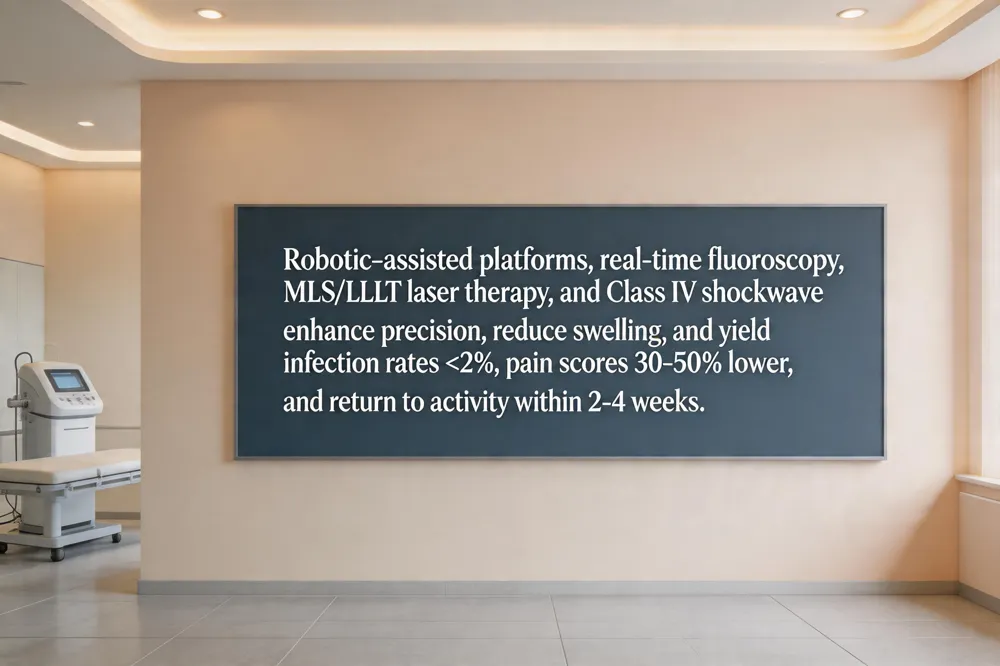 Robotic‑assisted surgery and real‑time fluoroscopic guidance have become cornerstones of modern minimally invasive podiatry. At North Texas Podiatry Associates, a robotic platform provides a 3‑D magnified view and steadies instruments, while fluoroscopy confirms precise bone cuts and hardware placement, reducing the risk of mal‑alignment. Complementary adjuncts such as MLS laser therapy , low‑level laser (LLLT) and Class IV shockwave treatment further diminish postoperative swelling, pain, and inflammation, allowing many patients to bear weight within 24‑48 hours. Evidence‑based studies across the United States consistently report high patient satisfaction: infection rates below 2 %, pain scores 30‑50 % lower than open surgery, and faster returns to work or sport—often within 2‑4 weeks for bunions and hammertoes.
What is minimally invasive ankle surgery? It treats ankle pathology through incisions smaller than 5 mm, using percutaneous burrs, needles, and arthroscopic cameras to reshape bone or repair soft tissue while preserving surrounding structures. The technique yields minimal scarring, reduced pain, and quicker weight‑bearing compared with traditional open ankle surgery.
Can a podiatrist do cryotherapy? Yes. Podiatrists apply localized cryotherapy to neuromas, bursitis, and tendonitis, delivering targeted pain relief and inflammation control as part of a comprehensive, minimally invasive treatment plan.
Your Path Forward
Review benefits, stay informed, attend follow‑ups, and maintain proactive foot health for long‑term.