Introduction to Flat Feet and Arch Collapse
Flat feet (pes planus) describe a condition in which the medial longitudinal arch of the foot is absent or collapsed, causing the sole to touch the ground when standing. The arch can be flexible (appearing when the foot is non‑weight‑bearing) or rigid (absent in any position), and may be present from birth or develop later due to injury, obesity, aging, or posterior tibial tendon dysfunction. Estimates suggest that up to 30 % of the population has flat feet, with about one in ten experiencing symptoms such as foot or ankle pain, shin splints, and secondary knee, hip, or lower‑back discomfort. Early evaluation is crucial because untreated arch collapse can lead to biomechanical imbalances, progressive deformities, and chronic joint pain. A timely clinical assessment—including gait analysis, shoe‑wear inspection, and weight‑bearing imaging—allows clinicians to intervene with conservative measures (orthotics, stretching, strengthening) or, when necessary, minimally invasive surgical options before the condition progresses to more severe deformities.
Anatomy, Causes, and Risks of Flat Feet
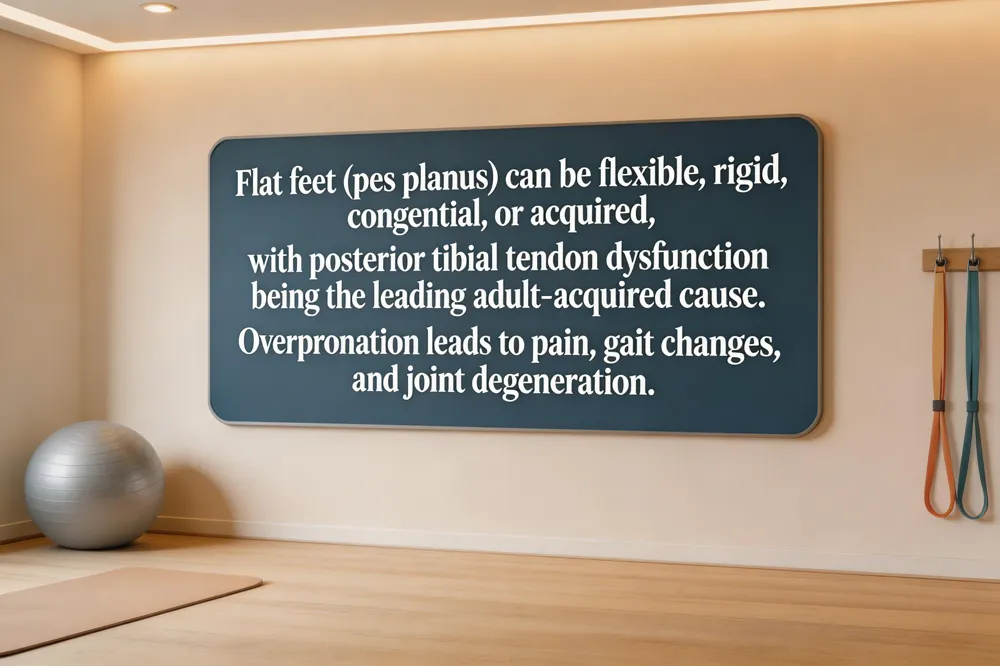 Flat feet (pes planus) describe a foot with little‑to‑no medial arch when weight‑bearing. They can be flexible (arch appears off‑weight‑bearing), rigid (no arch in any position), congenital (present at birth, often genetic or related to connective‑tissue disorders such as Ehlers‑Danlos), or acquired (develop later due to structural wear).
Posterior tibial tendon dysfunction(PTTD) is the most common cause of adult‑acquired flatfoot. The tibialis posterior stabilizes the arch; chronic tendonitis, degeneration, or rupture lets the arch collapse, producing pain, swelling, and difficulty standing on tiptoes.
Other acquired causes include arthritis (especially rheumatoid arthritis), obesity (which increases mechanical load), diabetes‑related Charcot foot, ligament injuries, and fractures. Neuromuscular conditions (cerebral palsy, muscular dystrophy, spina bifida) and genetic predisposition also contribute to arch loss.
Flat foot disadvantages stem from loss of the shock‑absorbing arch. Overpronation stresses heels, ankles, knees, and lower back, leading to chronic pain, shin splints, sprains, bunions, calluses, and early joint arthritis. Gait alterations can accelerate knee osteoarthritis and hip discomfort, limiting activity and mobility.
Collapsed arch vs. flat feet – flat feet may be painless and present from childhood; a collapsed arch is an acquired, progressive flattening often linked to PTTD, obesity, or trauma, showing difficulty with heel‑rise tests and uneven shoe wear.
Fallen arches vs. plantar fasciitis – fallen arches are a structural arch collapse affecting the whole foot and lower‑extremity chain; plantar fasciitis is inflammation of the plantar fascia, causing sharp heel pain after rest. Treatment differs: orthotics, tendon strengthening, and possibly minimally invasive surgery for arches; stretching, NSAIDs, night splints, and supportive shoes for fasciitis.
Red‑flag symptoms to never ignore include persistent foot/ankle ache, numbness/tingling, skin or nail changes, uneven shoe wear, and recurrent ankle instability. Early podiatric evaluation and targeted therapy—conservative (orthotics, exercises, weight control) or, when needed, minimally invasive surgery—can prevent long‑term complications.
Diagnosis, Clinical Evaluation, and Specialist Care
 Flat feet (pes planus) are first evaluated with a thorough physical exam and gait analysis. The clinician observes the foot from the front, side, and back, checks arch height while standing and non‑weight‑bearing, and looks for the “too many toes” sign, heel valgus, or abnormal shoe wear. Imaging—weight‑bearing X‑rays, MRI, or ultrasound helps identify tendon degeneration (especially posterior tibial tendon), spring‑ligament tears, or arthritis and guides treatment planning.
A podiatrist will perform this assessment and prescribe custom orthotics, and teach stretching (Achilles, calf) and strengthening (short‑foot, tibialis posterior) exercises. For children, supportive shoes, activity modification, and orthotics are usually sufficient; surgery is rarely needed. Adults start with conservative care—arch‑support shoes, NSAIDs, physical therapy, and weight management—and progress to minimally invasive procedures (percutaneous osteotomies, tendon transfers, ligament augmentation) if pain persists or deformity advances.
Specialist care is essential when symptoms are severe, progressive, or accompanied by tendon rupture. Board‑certified podiatrists and foot‑ankle orthopaedic surgeons in California’s Inland Empire (Advanced Care Foot and Ankle, locations in Corona, Ontario, Perris) and Arizona offer comprehensive services, including diagnostic imaging, custom orthotic fabrication, and state‑of‑the‑art minimally invasive surgery. Early referral to these experts ensures accurate diagnosis, individualized treatment, and optimal functional outcomes.
Conservative Management: Orthotics, Footwear, and Targeted Exercise
 Arch support for flat feet
Flat feet benefit from devices that maintain medial arch height and limit overpronation. Custom‑made orthotics are molded after a podiatric gait analysis and provide individualized arch reinforcement, often using semi‑rigid materials with cushioning. Over‑the‑counter (OTC) supports such as PowerStep Pinnacle or ProTech offer firm midsoles, supportive heel cups, and heat‑moldable options for mild‑to‑moderate cases. Both should fill the shoe interior without pressure points and be paired with shoes that accommodate them comfortably.
Supportive shoe features
Ideal footwear includes a structured midsole, reinforced heel counter, and a wide toe box. Stability or motion‑control platforms are preferred for daily wear and high‑impact activities; avoid flat‑sole flip‑flops or minimalist sneakers. Shoes that distribute load evenly reduce strain on the posterior tibial tendon and adjacent joints.
Exercise programs for arch strengthening
A targeted regimen improves intrinsic foot muscles and calf flexibility. Begin with short‑foot (foot‑doming) drills: draw the metatarsal heads toward the heel while keeping toes flat, holding 2‑3 seconds, 10‑15 reps. Add towel scrunches or marble pickups to activate intrinsic muscles. Perform calf raises (2‑legged and single‑leg) and resisted ankle eversion with a band to strengthen the tibialis posterior and peroneals. Stretch the Achilles and calf 10‑15 seconds each day. Aim for 3‑4 sessions per week, progressing resistance as strength improves.
Weight management and activity modification
Excess body weight increases load on the arch; modest weight loss can markedly reduce pain. Replace high‑impact activities (long‑distance running) with low‑impact options (walking, swimming, biking). Use the RICE protocol (rest, ice, compression, elevation) for flare‑ups and NSAIDs for inflammation. Early intervention with orthotics, supportive shoes, and consistent exercise often prevents progression to surgical intervention.
When to seek professional care
Persistent pain, swelling, or difficulty walking despite OTC measures warrants a podiatrist evaluation. A specialist can assess for posterior tibial tendon dysfunction, arthritis, or other underlying pathology and prescribe custom orthotics or, if needed, minimally invasive surgical options.
Minimally Invasive Surgery, Recovery, and Long‑Term Outcomes
 What is minimally invasive foot surgery?
Minimally invasive foot surgery (MIS) treats foot and ankle deformities through incisions typically ≤5 mm, using specialized instruments and real‑time X‑ray or fluoroscopic guidance. The tiny portals preserve soft‑tissue, resulting in smaller scars, less postoperative pain, reduced infection risk, and a faster return to weight‑bearing compared with traditional open surgery.
What is minimally invasive foot surgery?
Minimally invasive foot surgery (MIS) treats foot and ankle deformities through incisions typically ≤5 mm, using specialized instruments and real‑time X‑ray or fluoroscopic guidance. The tiny portals preserve soft‑tissue, resulting in smaller scars, less postoperative pain, reduced infection risk, and a faster return to weight‑bearing compared with traditional open surgery.
Flat‑feet surgery MIS for flat feet restores a functional arch by correcting bone, tendon, and ligament pathology. Common percutaneous procedures include a medializing calcaneal osteotomy (heel‑slide) and tendon transfers such as flexor digitorum longus augmentation of the posterior tibial tendon. For flexible flatfoot, subtalar extra‑articular screw arthroereisis or percutaneous osteotomies achieve alignment with minimal tissue disruption.
Minimally invasive bunion surgery procedure Through several <1 cm incisions, a burr or percutaneous instrument reshapes the first metatarsal (and, if needed, the proximal phalanx) under fluoroscopic control. Small screws or pins hold the corrected position. Patients usually wear a postoperative shoe and can bear weight immediately.
Recovery timelines and rehabilitation
- Bunion surgery: 1–2 weeks protected weight‑bearing, followed by light walking and physical‑therapy exercises. Regular footwear is usually resumed by 6–7 weeks; full activities by 8–12 weeks.
- Flat‑foot reconstruction: Early partial weight‑bearing is allowed; full weight‑bearing typically achieved within 4–6 weeks. Structured gait‑retraining and progressive strengthening continue for 3–6 months to maintain arch height.
Patient selection and candidacy Ideal candidates have persistent pain or functional limitation despite conservative care, a deformity that is mild‑to‑moderate (flexible) and without severe arthritis, and are medically cleared for outpatient anesthesia. Imaging (weight‑bearing X‑ray, MRI/ultrasound) confirms tendon or ligament involvement and helps tailor the MIS technique.
Overall, MIS offers a less traumatic, cost‑effective pathway to correct flat‑foot and bunion deformities while preserving function and enabling a rapid return to daily activities.
Key Takeaways and Next Steps
Flat feet (pes planus) arise from a mix of genetic, biomechanical, and acquired factors—most commonly posterior tibial tendon dysfunction, obesity, arthritis, injury, or neuromuscular disorders. Diagnosis starts with a visual gait and foot‑posture exam, often supplemented by weight‑bearing X‑rays or ultrasound to assess tendon and ligament integrity. Initial treatment is conservative: custom orthotics, supportive footwear, NSAIDs, and targeted stretching/strengthening (e.g., calf stretches, short‑foot exercises). Patients should seek a podiatrist when pain interferes with daily activities, when swelling or deformity progresses, or when conservative measures fail to provide relief. Modern podiatry emphasizes personalized care—selecting orthotics and therapy based on each patient’s anatomy—and, when needed, minimally invasive surgery (percutaneous osteotomies, tendon transfers) that restores arch stability with smaller incisions, faster recovery, and lower complication rates. Early intervention and individualized plans are key to preserving function and preventing secondary joint problems.