Why Foot & Ankle Health Matters for Athletes
Foot and ankle injuries account for up to 25 % of all athletic injuries in the United States, with ankle sprains alone occurring as often as 25 000 times daily. Improper footwear that lacks adequate arch support, cushioning, or a stable heel counter amplifies forces on the plantar fascia, Achilles tendon, and ankle ligaments, making sprains, plantar fasciitis, and stress fractures more likely. Biomechanical abnormalities such as overpronation, high arches, or flat feet alter gait mechanics, increasing abnormal loading on soft tissues and bones. Early detection of pain, swelling, or skin changes—through daily foot inspection and proper hygiene—allows athletes to seek podiatric care before minor issues become chronic. Maintaining dry, clean feet, wearing moisture‑wicking socks, and rotating shoes each 300‑500 miles further reduces fungal infections and the secondary injuries they can provoke. Prompt evaluation and targeted interventions keep athletes on the field and protect long‑term joint health, athletic performance, and career longevity.
Fundamentals of Injury Prevention
Quick‑Reference Table for Injury Prevention
| Element | What to Do | Key Details |
|---|---|---|
| Dynamic Warm‑up | 5‑10 min light cardio + ankle circles, calf stretches, leg swings | Prepares ligaments & muscles; improves range of motion |
| Cool‑down | Static stretches for calves, Achilles, plantar fascia | Restores flexibility & reduces stiffness |
| Footwear | Sport‑specific shoes matching foot type | Supportive heel counter, adequate arch support, proper cushioning; replace when tread/heel worn |
| Custom Orthotics | Use for flat feet, high arches, overpronation | Redistribute pressure, correct alignment, lower stress on plantar fascia, Achilles, ankle ligaments |
| Training Volume | Increase duration/intensity ≤10 % per week | Allows bones, tendons, muscles to adapt without overuse |
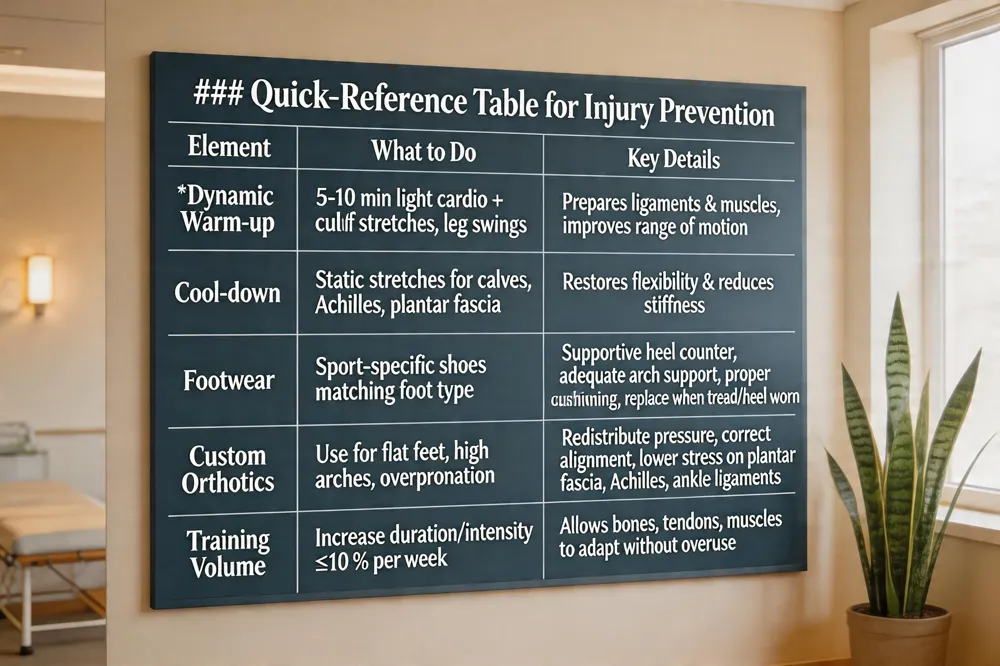 A proper dynamic warm‑up (5‑10 minutes of light cardio, ankle circles, calf stretches, and leg swings) prepares the ligaments and muscles, while a cool‑down with static stretches restores flexibility and reduces stiffness. Choose sport‑specific shoes that match your foot type—supportive heel counters, adequate arch support, and appropriate cushioning—and replace them when the tread or heel is worn. For athletes with flat feet, high arches, or overpronation, custom orthotics redistribute pressure and correct alignment, lowering stress on the plantar fascia, Achilles tendon, and ankle ligaments. Gradually increase training duration and intensity (no more than a 10 % weekly rise) to let bones, tendons, and muscles adapt without overuse.
What are 5 ways to help prevent ankle injuries?
- Warm‑up with dynamic ankle motions.
- Strengthen calves, peroneals, and tibialis anterior via raises and resisted eversion/inversion.
- Wear properly fitted, sport‑specific footwear with good arch support.
- Use ankle braces or taping after prior sprains or in high‑risk sports.
- Train balance and proprioception with single‑leg stands or wobble‑board drills (see dynamic warm‑up and cool‑down for more details).
Why do ankle injuries happen so often in sports? Rapid direction changes, jumps, and landings load the ankle beyond its natural range, especially when dorsiflexion is limited, peroneal strength is weak, or proprioception is poor. Improper warm‑up, sudden training spikes, and unsuitable shoes further compromise stability, making inversion sprains common on uneven or slippery surfaces.
How to prevent ankle sprains? Begin with a dynamic warm‑up, then perform calf raises, resisted eversion/inversion, and single‑leg balance drills. Wear sport‑appropriate shoes with a firm heel counter and replace them regularly. Apply a brace or tape if you have a sprain history, progress training volume gradually, avoid uneven terrain, and stop activity at the first sign of pain.
Targeted Strength & Balance Programs
Core Exercises & Progression
| Exercise | Target Muscle(s) | Frequency | Progression Tips |
|---|---|---|---|
| Single‑leg calf raises | Gastrocnemius, Soleus | 3 × 10 reps per leg, 3‑4 ×/week | Add weight or elevated surface |
| Banded eversion/inversion | Peroneals, tibialis anterior | 2‑3 × 15 reps each direction | Increase band resistance |
| Resisted dorsiflexion | Tibialis anterior | 2‑3 × 12 reps | Use heavier resistance or longer ROM |
| Single‑leg stance (firm) | Proprioception | 30 s per leg, 3 ×/day | Close eyes, then unstable surface |
| Wobble‑board / BOSU | Dynamic balance | 2‑3 min per session | Add lunges, ball tosses, sport‑specific cuts |
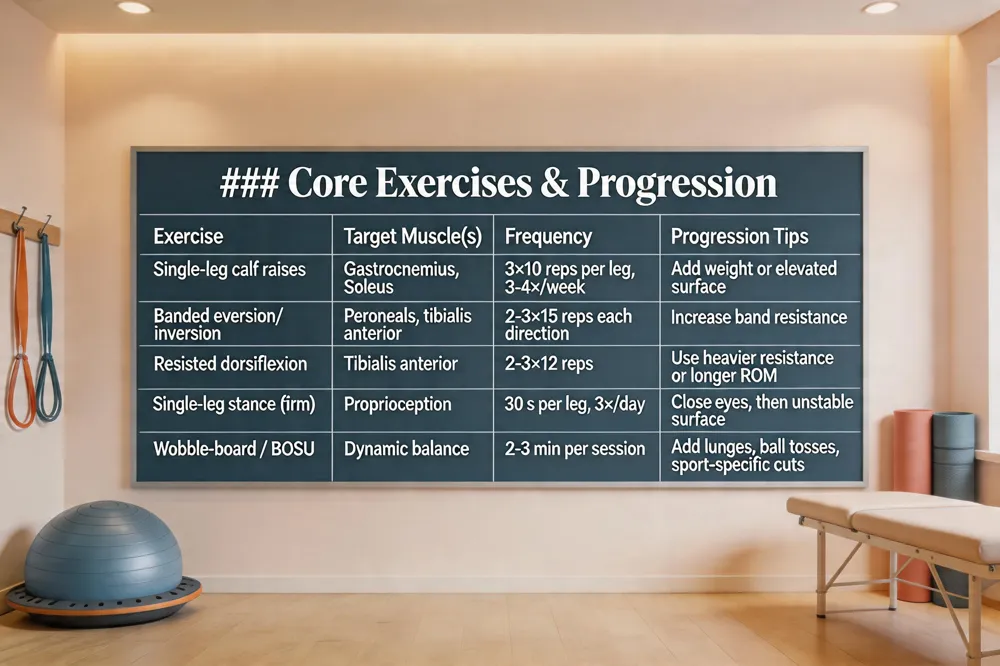 A comprehensive ankle‑injury prevention plan starts with calf and peroneal strengthening—single‑leg calf raises, banded eversion/inversion, and resisted dorsiflexion build the gastrocnemius, soleus, and lateral stabilizers that protect against inversion sprains. Proprioceptive training follows: begin with a 30‑second single‑leg stance on firm ground, progress to eyes‑closed, then to wobble‑board or BOSU work for 2‑3 minutes, adding dynamic moves such as lunges, step‑ups, or ball‑control tasks to challenge neuromuscular control. Sport‑specific drills translate these gains into performance: for basketball, incorporate single‑leg hops, lateral shuffles, and low‑profile ankle braces during cutting; for soccer, use resisted eversion, single‑leg balance with ball‑tosses, and hip‑stability exercises; for volleyball, practice landing with bent knees, single‑leg wobble‑board stands, and ankle‑circle mobility. Consistently performing these exercises 3‑4 times per week reduces re‑sprain risk, restores joint‑position sense, and supports safe return to play.
Combatting Overuse Conditions & Fungal Infections
Overuse & Fungal Conditions – Prevention & Treatment
| Condition | Prevention Strategies | First‑line Treatment |
|---|---|---|
| Plantar fasciitis | Calf & plantar‑fascia stretches, eccentric heel‑drops, gradual mileage increase, orthotics | Stretching, night splints, NSAIDs, orthotics |
| Achilles tendinitis | Eccentric heel‑drops, proper footwear, controlled load progression | PRP or Amnio‑, anti‑inflammatory meds, gradual rehab |
| Stress fracture | Adequate calcium/Vit D, cross‑training, avoid sudden mileage spikes | Imaging confirmation, rest, gradual return, nutrition support |
| Athlete’s foot (tinea pedis) | Keep feet dry, wear moisture‑wicking socks, rotate shoes, antifungal powder in shoes | Topical terbinafine 1 % cream twice daily 2‑4 weeks + hygiene; no instant cure |
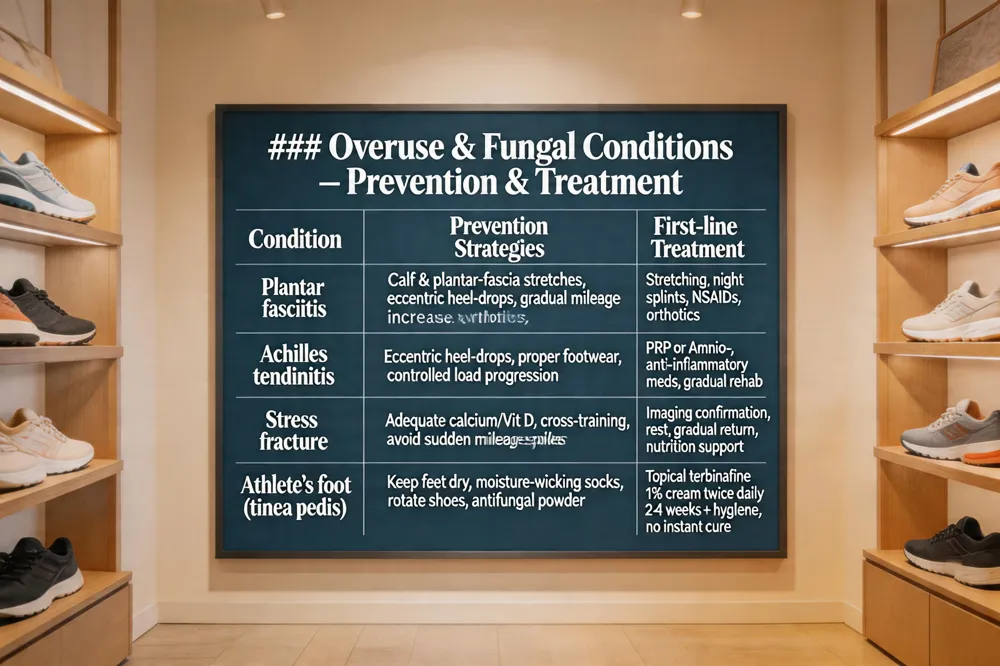 Plantar fasciitis, Achilles tendinitis, and stress fractures are common overuse injuries. Calf and plantar‑fascia stretches, eccentric heel‑drops, and gradual training reduce strain; orthotics correct pronation. Achilles tendinitis may improve with PRP/AmnioFix; stress fractures need imaging and calcium‑vitamin D. Athlete’s foot (tinea pedis) isn’t life‑threatening but can cause cellulitis or nail infection in diabetics. Treat with 2‑4 weeks of topical terbinafine or clotrimazole and hygiene. Spray antifungal powder in shoes, dry, rotate, and wear socks. Q: Is athlete's foot dangerous? A: It can cause infections in diabetics. Q: How to cure athlete's foot in one day? A: No cure; needs 2‑4 weeks antifungal. Q: Athlete's foot shoe treatment? A: Spray antifungal, dry, rotate, use silica. Q: Best athlete's foot treatment? A: Topical terbinafine 1 % cream twice daily for 2 weeks, hygiene. Q: What kills athlete's foot instantly? A: None; all agents need days. Q: How to prevent rolling ankle? A: Strengthen peroneals, shoes, brace.
Clinical Interventions & When to Seek Professional Care
Rehab Phases & Return‑to‑Play Criteria
| Phase | Approx. Duration | Primary Focus | Advance When |
|---|---|---|---|
| 1 – Protection | 0‑2 weeks | RICE, gentle ROM, pain control | Pain‑free ROM, minimal swelling |
| 2 – Strength | 2‑6 weeks | Calf raises, resistance bands, low‑impact cardio | ≥70 % strength of uninjured side, no pain |
| 3 – Functional | 6‑12 weeks | Sport‑specific drills, plyometrics, proprioception | ≥90 % strength, successful single‑leg hop & agility tests |
| 4 – Return | 12+ weeks | Full sport participation, unrestricted training | Pain‑free, strength ≥90 % of opposite limb, passed functional tests |
| When to see a podiatrist | — | Persistent pain >2 weeks, instability, inability to bear weight, recurrent sprains, chronic ankle instability | Prompt evaluation, imaging, custom orthotics, PRP or surgery if needed |
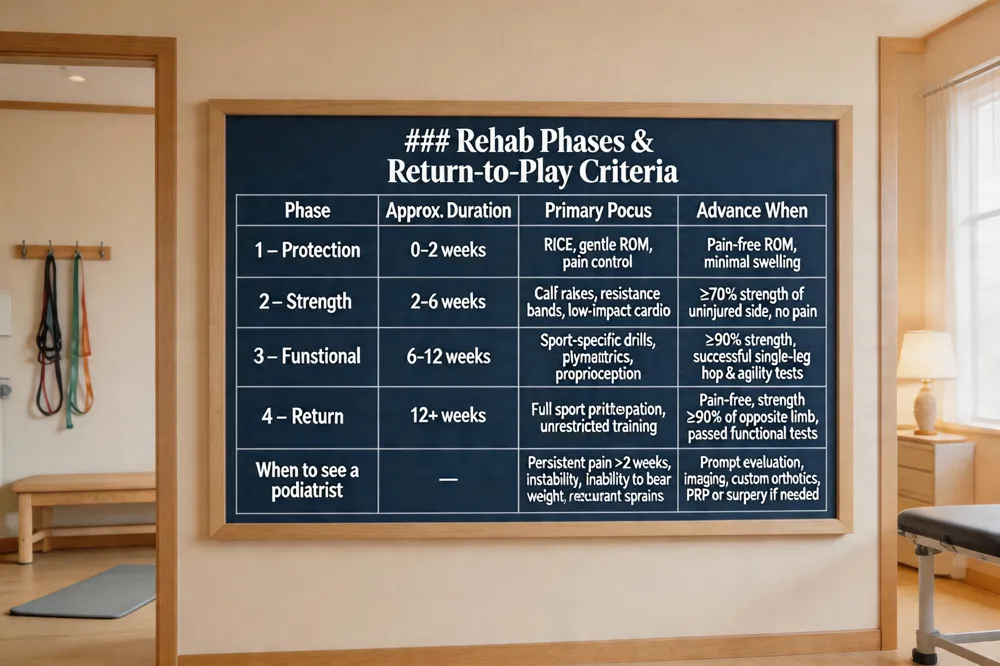 Athletes with ankle sprains should follow a structured rehab program. Phase 1 (0‑2 weeks) focuses on protection, RICE, and gentle ROM drills. Phase 2 (2‑6 weeks) adds calf‑raise and resistance‑band strengthening plus low‑impact cardio. Phase 3 (6‑12 weeks) introduces sport‑specific drills, plyometrics and proprioceptive balance work. Phase 4 (12+ weeks) permits full return when pain‑free, strength ≥90 % of the uninjured side, and functional tests (single‑leg hops, 20‑second balance, agility runs) are passed.
Bracing vs. taping: both reduce recurrence of lateral sprains; semi‑rigid braces offer consistent inversion control and less skin irritation, while taping provides a low‑profile feel and is useful when rapid removal is needed. Choice depends on sport, preference and injury history.
When to see a podiatrist: persistent pain or swelling >2 weeks, instability, inability to bear weight, recurrent sprains, or any signs of chronic ankle instability warrant professional evaluation for imaging, custom orthotics, or advanced interventions such as PRP or minimally invasive surgery.
Lifestyle & Daily Habits for Long‑Term Foot Health
Daily Habits Checklist
| Habit | Why It Matters | Practical Tips |
|---|---|---|
| Foot hygiene | Prevents fungal growth & skin issues | Wash daily, dry between toes, use antifungal powder if prone |
| Nutrition & hydration | Supports bone & tissue health | Adequate calcium, vitamin D, magnesium; drink 2‑3 L water daily |
| Sleep | Enables tissue repair & reduces inflammation | 7‑9 h/night, consistent schedule |
| Cross‑training | Reduces repetitive loading | Alternate running with swimming, cycling, yoga |
| Orthotics & shoe care | Maintains proper alignment & pressure distribution | Use custom orthotics if indicated; replace shoes when tread worn |
| Routine podiatrist visits | Early detection of problems | At least twice yearly or sooner for pain/swelling/skin changes |
 Consistent foot hygiene is the foundation of injury prevention. Washing your feet daily and drying them completely, especially between the toes, helps prevent fungal infections such as athlete's foot (tinea pedis). For athlete’s foot, keep feet covered and dry; walking barefoot spreads spores and creates a warm, moist environment conducive to fungal growth.
Nutrition, hydration, and sleep support bone and tissue health. Adequate calcium, vitamin D, and magnesium strengthen the metatarsals and ankle bones, while staying well‑hydrated maintains muscle elasticity. Aim for 7‑9 hours of sleep each night to allow tissue repair and reduce inflammation.
Cross‑training, orthotics, and routine podiatrist visits round out a preventive program. Alternate high‑impact running with low‑impact activities (swimming, cycling) to limit repetitive loading. Custom orthotics correct foot alignment and redistribute pressure. Schedule a podiatrist check‑up at least twice yearly, or sooner if pain, swelling, or skin changes persist.
Q&A
- Should I wear socks or go barefoot with an athlete’s foot? Wear moisture‑wicking socks and breathable shoes; never walk barefoot.
- Athlete’s foot symptoms include itching, burning between the toes, red scaly skin, peeling, and possible blisters or fissures.
- Fastest way to heal is a proven topical antifungal (e.g., terbinafine) applied twice daily, combined with diligent drying and sock changes for 2‑4 weeks.
- What kills athlete’s foot instantly? No product eradicates the fungus instantly; the quickest‑acting agents start relief in 48‑72 hours, but full clearance still requires a multi‑week regimen.
Putting It All Together for Injury‑Free Performance
Begin session with a jog or 2‑3 minutes of aerobic activity, then perform ankle circles, calf stretches, and dorsiflexion drills to boost mobility. Follow with strength work—single‑leg calf raises, eversion bands, and toe‑scrunches—and finish with balance challenges such as single‑leg stance on a wobble board. Choose shoes that match your arch type and replace them every 300‑500 miles; consider orthotics for overpronation. Keep feet clean, dry, and change socks. If pain, swelling, or instability persists beyond two weeks, see a podiatrist for imaging, PRP or AmnioFix therapy, and tailored rehab. Support recovery with vitamin D, calcium, and 7‑9 hours of sleep, cross‑training.