Why Ankle Health Matters for Every Athlete
Ankle sprains affect roughly 25,000–28,000 athletes in the United States each day, making them one of the most common sport‑related injuries. When a sprain does not heal fully, it can progress to chronic ankle instability, a condition linked to recurrent givingains, reduced performance, and a higher risk of post‑traumatic osteoarthritis. The most effective way to protect athletes is a three‑pillar approach: (1) regular dynamic warm‑up and calf/soleus stretching to maintain flexibility; (2) targeted strengthening of the peroneals, tibialis anterior, and calf muscles combined with balance and proprioceptive drills (e.g., wobble‑board or Star Excursion Balance Test); and (3) external support such as semi‑rigid ankle bracing or taping during high‑risk activities. Together, these strategies dramatically lower sprain incidence and help preserve long‑term ankle function.
Core Prevention Principles and Quick‑Start Answers
Core Prevention Principles – Five Key Actions
| # | Preventive Action | Details |
|---|---|---|
| 1 | Dynamic Warm‑up | Calf, Achilles, dorsiflexor stretches; ankle circles; ankle alphabet. |
| 2 | Strengthening | Peroneals, tibialis anterior, calf muscles – 2‑3 sets × 10‑15 reps (band or weight). |
| 3 | Supportive Footwear | Sport‑specific shoes with firm heel counter, lateral support, snug fit. |
| 4 | Balance & Proprioception | Single‑leg stance → wobble‑board/foam pad (30‑60 s), eyes‑closed or sport‑specific perturbations. |
| 5 | Brace or Taping | Semi‑rigid brace or lace‑up taping during high‑risk activities. |
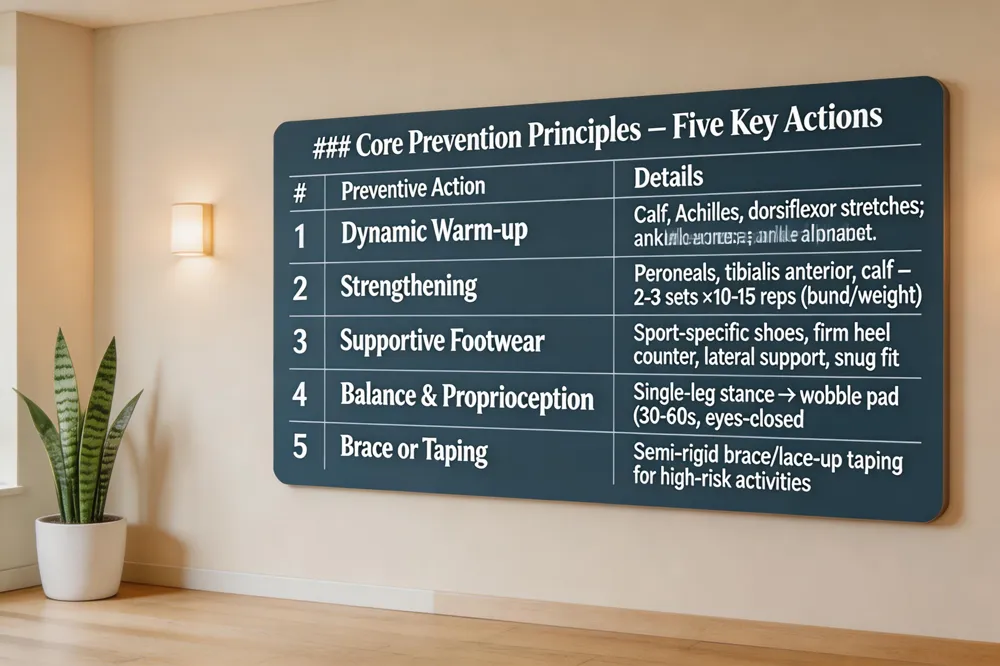 Ankle sprains are most common in sports that demand rapid stop‑and‑go movements; basketball tops the list because frequent jumping and sudden direction changes repeatedly stress the lateral ligaments. The first line of defense is a structured warm‑up that includes dynamic calf, Achilles, and dorsiflexor stretches to improve muscle elasticity and joint range of motion. Proper footwear—sport‑specific shoes with a firm heel counter, adequate lateral support, and a snug fit—provides the mechanical base for stability, while semirigid braces or lace‑up taping add external restriction of excessive inversion and boost proprioceptive feedback for athletes with prior sprains. Immediate self‑care follows the PRICE protocol (protect, rest, ice 15‑20 min every 2‑3 hr, compress, elevate) applied within the first hour and continued through the night, supplemented by an OTC NSAID for pain control. Full healing is achievable: Grade I injuries often resolve in two weeks, whereas Grade II–III may require several weeks to months of progressive rehab to avoid chronic instability. Five key preventive actions are: 1) thorough dynamic warm‑up; 2) regular strengthening of peroneals, tibialis anterior, and calf muscles; 3) wearing supportive, sport‑specific shoes; 4) routine balance and proprioceptive drills; and 5) using an ankle brace or taping during high‑risk activities.
Targeted Exercises for Home and Clinic
Targeted Exercise Program Overview
| Category | Example Exercise | Sets × Reps | Frequency |
|---|---|---|---|
| ROM / Mobility | Ankle alphabet, ankle circles | 1‑2 min each | Daily |
| Stretching | Wall heel‑cord stretch, towel pull‑back | 3 × 30 s each leg | 3‑5 × week |
| Strengthening | Towel‑scrunches, seated heel raises, resisted eversion/inversion (Theraband) | 2‑3 × 10‑15 | 3‑5 × week |
| Advanced Strength | Single‑leg calf raises (add weight) | 3 × 8‑12 | 3‑5 × week |
| Balance | Single‑leg stance (firm), wobble‑board/foam pad holds | 30‑60 s, 2‑3 × sets | 3‑5 × week |
| Progression | Add eyes‑closed, sport‑specific perturbations | – | As tolerated |
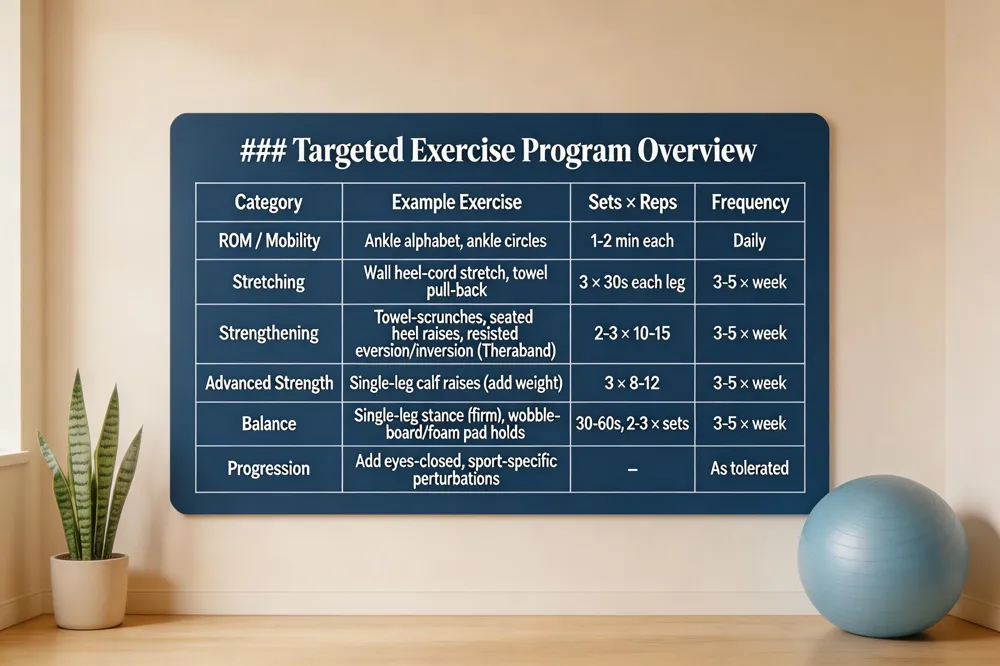 A practical home program starts with gentle range‑of‑motion drills such as the “ankle alphabet” and ankle circles, followed by calf and Achilles stretches (wall heel‑cord stretch, towel pull‑back). Strengthening protocols progress from towel‑scrunches and seated heel raises to resisted eversion/inversion with a Theraband (2‑3 sets × 10‑15 reps) and single‑leg calf raises, adding external weight as tolerated. Balance and proprioception training begins with static single‑leg stance on a firm surface, then advances to wobble‑board or foam‑pad holds for 30‑60 seconds, incorporating eyes‑closed or sport‑specific perturbations. Visual guides for each movement are available in reputable PDFs from MyHealth.Alberta, AAOS, and NHS, showing the ankle alphabet, side‑to‑side knee swings, banded eversion, and heel‑cord stretch. For athletes needing a structured plan, the “Advanced Ankle Rehab” PDF outlines a three‑phase protocol (early ROM, intermediate strengthening, late plyometrics) with detailed sets, reps, and progression cues. A separate lateral‑ankle‑sprain PDF mirrors this structure, emphasizing protected weight‑bearing, resisted eversion, and brace‑supported return‑to‑play drills. All programs recommend 3‑5 sessions per week for 4‑8 weeks, stopping if pain increases.
Bracing, Taping, and External Supports
Bracing & Taping – Summary of Evidence & Guidelines
| Support Type | Example | Risk‑Reduction Ratio (RR) | Cost‑Effectiveness | Application Note |
|---|---|---|---|---|
| Semi‑rigid Brace | Bauerfeind MalleoTrain, DonJoy Velocity ES | 0.15‑0.50 | High (durable for long‑term) | Measure narrowest point above malleoli; figure‑8 strap. |
| Rigid Brace | (various) | 0.15‑0.50 (similar) | Moderate | Used for post‑injury immobilisation. |
| Elastic Athletic Tape | Figure‑8 taping | 0.29‑0.31 | Low (single‑session) | Re‑apply every 10‑30 min; loses effect after 30 min. |
| Combined | Brace + tape | Potential additive effect | Variable | Consider for high‑risk matches. |
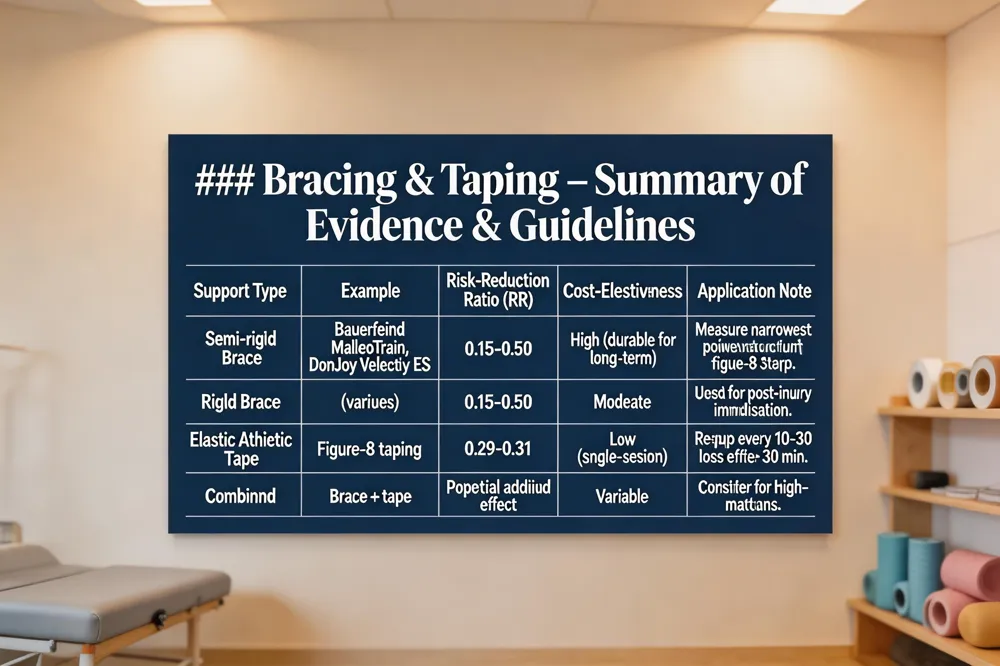 Effective ankle‑sprain prevention hinges on external supports that limit excessive inversion while preserving functional motion. Types of braces and taping – Semi‑rigid or rigid ankle braces (e.g., Bauerfeind MalleoTrain, DonJoy Velocity ES) provide continuous mechanical restriction and proprioceptive feedback; elastic athletic tape offers short‑term protection and heightened cutaneous sensation but loses effect after 10‑30 minutes. Evidence for risk reduction – Systematic reviews report risk ratios of 0.15‑0.50 for bracing and 0.29‑0.31 for taping, translating to a 70 % reduction in recurrent sprains for semirigid braces. Bracing is generally more cost‑effective for long‑term use, while taping may be preferred for single‑session support. Fit and application guidelines – Measure the narrowest point above the malleoli, select the appropriate size, and apply with figure‑8 straps to maintain comfort during high‑risk activities and early rehabilitation.
FAQs
- Ankle sprain prevention brace: Stabilizes the joint by limiting risky inversion/eversion while allowing normal motion; semirigid designs with hinged straps are optimal.
- Taping and bracing in prevention: Both cut initial and recurrent sprains; braces are favored for durability, taping for brief proprioceptive enhancement.
- How to never roll your ankle again?: Emphasize calf and peroneal strengthening, daily stretching, proprioception drills, and supportive footwear or brace during sport.
- How do athletes take care of their feet?: Maintain hygiene, trim nails, replace shoes every 300‑500 miles, use moisture‑wicking socks, and address blisters promptly.
- How do I make my ankles stronger?: Perform toe‑walks, heel‑walks, calf raises, and banded eversion/inversion regularly.
- Has Messi ever sprained his ankle?: He suffered a typical lateral ligament sprain, reflecting the common injury pattern in elite athletes.
Sport‑Specific Prevention Programs
Sport‑Specific Prevention Checklist
| Sport | Warm‑up Focus | Primary Strength Targets | Balance / Proprioception | External Support |
|---|---|---|---|---|
| Football | Mobility drills, light jog, short sprints | Calf, peroneal, hip‑abductor | Single‑leg wobble‑board (2 × week) | Lace‑up brace or tape during games |
| Soccer | Dynamic ankle‑mobility, sport‑specific warm‑up | Peroneal resistance‑band work | Single‑leg on unstable surface while catching a ball | Supportive cleats + brace/tape |
| Basketball | Ankle circles, calf stretches, brief jog | Calf, peroneal, landing muscles | Wobble‑board balance, plyometric landing drills | Brace or tape for prior sprains; dry court |
| Volleyball | Ankle alphabet, rolls, banded inversion/eversion | Calf, peroneal, landing muscles | Balance board drills | Shoes with strong ankle/arch support; brace/tape for high‑intensity matches |
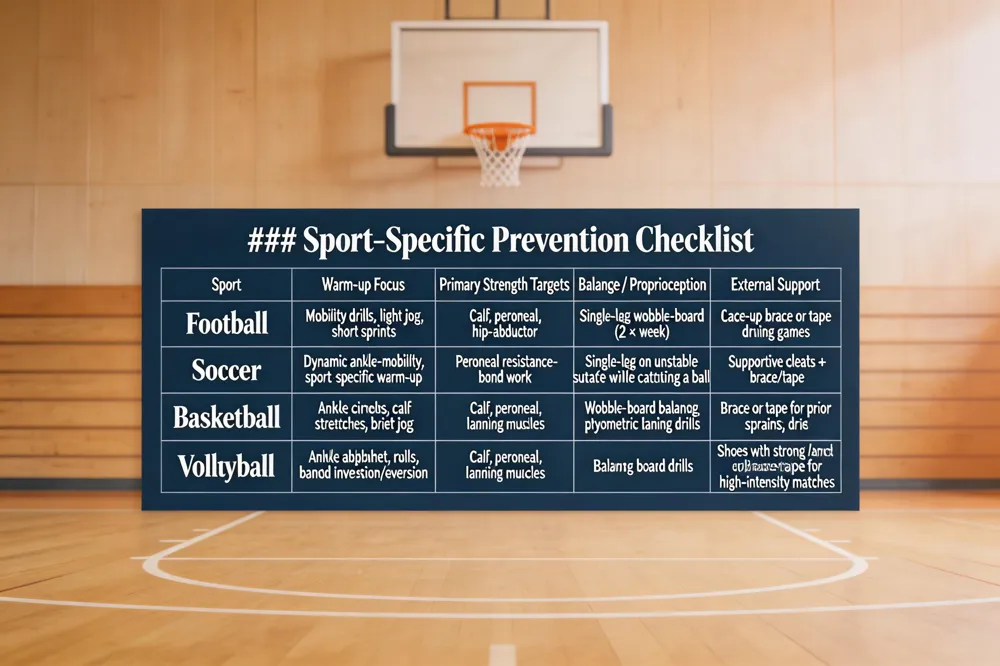 A well‑designed prevention program combines a sport‑specific warm‑up, targeted strengthening, neuromuscular training, and appropriate external support.
Football – Begin each practice with mobility drills, light jogging, and short sprints. Emphasize calf, peroneal, and hip‑abductor strength; add single‑leg balance on wobble‑board twice weekly. Use supportive cleats and a lightweight lace‑up brace or tape during games to limit inversion.
Soccer – Start with dynamic ankle‑mobility drills and a sport‑specific warm‑up. Choose soccer shoes with firm lateral support and fit a well‑adjusted brace or tape. Incorporate peroneal resistance‑band work and balance drills (single‑leg on an unstable surface while catching a ball).
Basketball – Wear basketball‑specific shoes with solid arch support and shock absorption. Perform ankle circles, calf stretches, and a brief jog before play. Include single‑leg calf raises, wobble‑board balance, and plyometric landing drills. Apply a brace or athletic tape for athletes with prior sprains and ensure the court surface is dry.
Volleyball – Use a warm‑up that includes ankle alphabet drills, rolls, and banded inversion/eversion. Add proprioceptive training on a balance board and strengthen landing muscles with calf raises and hop drills. Choose shoes with strong ankle and arch support; consider bracing or taping during high‑intensity matches.
Recovery, Return‑to‑Play, and Clinical Management
Rehabilitation Phases Timeline
| Phase | Days / Weeks | Goals | Typical Activities |
|---|---|---|---|
| Phase 1 | 1‑7 days | Pain‑free ROM, early weight‑bearing | Ankle circles, alphabet, stationary cycling, compress/compression |
| Phase 2 | 2‑4 weeks | Strength & balance development | Resisted dorsiflexion/eversion with bands, calf raises, single‑leg balance (stable → unstable) |
| Phase 3 | 4‑6 weeks | Sport‑specific conditioning, functional testing | Plyometrics, sport drills, single‑leg hop, Star Excursion Balance Test (≥80 % limb symmetry) |
| Return‑to‑Play | After Phase 3 clearance | Full functional performance | Full‑intensity practice with brace/tape as needed; monitor for pain/swelling |
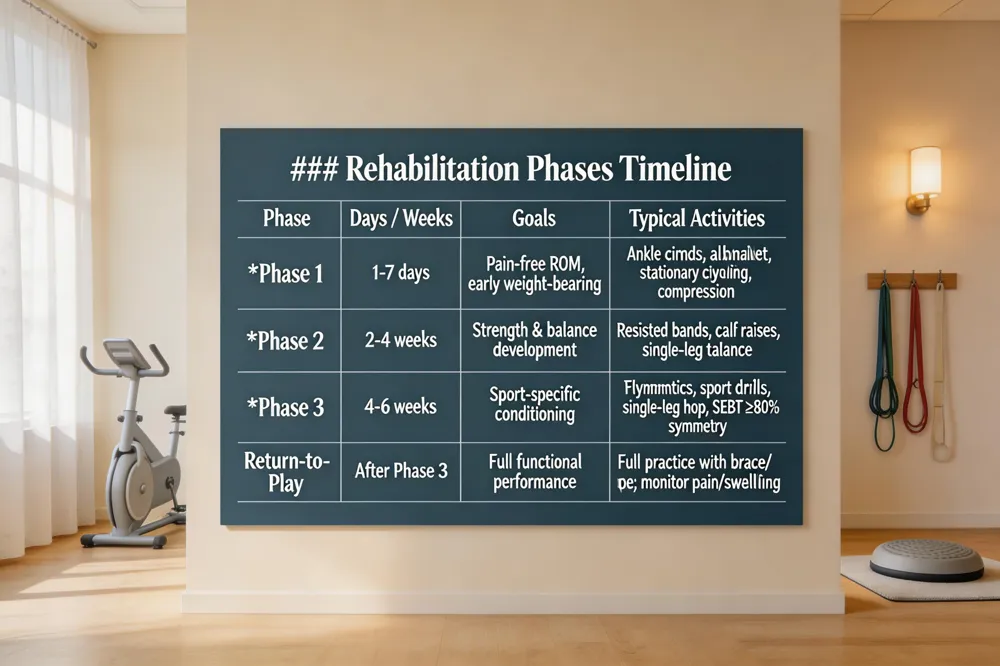 Ankle sprains should be managed initially with the RICE (or PRICE) protocol—rest, ice, compression, and elevation—for the first 48‑72 hours, combined with over‑the‑counter NSAIDs to control pain and inflammation. After swelling subsides, a graduated rehabilitation program begins: Phase 1 (days 1‑7) focuses on pain‑free range‑of‑motion (ankle circles, alphabet), weight‑bearing as tolerated, and low‑impact cardio such as stationary cycling. Phase 2 (weeks 2‑4) introduces resisted dorsiflexion, eversion, and calf strengthening with bands, plus single‑leg balance on stable then unstable surfaces. Phase 3 (weeks 4‑6) adds sport‑specific drills, plyometrics, and functional tests (single‑leg hop, Star Excursion Balance Test) aiming for ≥80 % limb symmetry before clearance. Athletes should seek professional care if weight‑bearing is impossible, swelling worsens after 48‑72 hours, a palpable “pop” is heard, or instability persists—situations that may require imaging or minimally invasive ligament repair. Early functional bracing or taping provides mechanical support and proprioceptive feedback, reducing reinjury risk while the neuromuscular program restores stability.
Broader Health Context and Special Cases
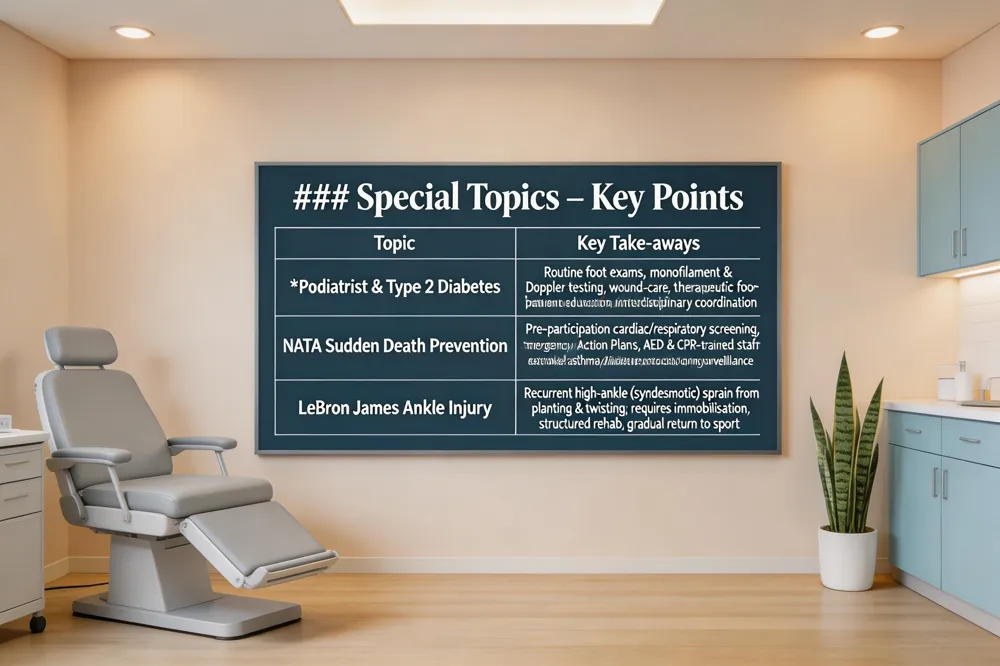
Special Topics – Key Points
| Topic | Key Take‑aways |
|---|---|
| Podiatrist & Type 2 Diabetes | Routine foot exams, monofilament & Doppler testing, wound‑care, therapeutic footwear, patient education, interdisciplinary coordination |
| NATA Sudden Death Prevention | Pre‑participation cardiac/respiratory screening, Emergency Action Plans, AED & CPR‑trained staff, heat‑stroke/asthma/diabetes protocols, ongoing surveillance |
| LeBron James Ankle Injury | Recurrent high‑ankle (syndesmotic) sprain from planting & twisting; requires immobilisation, structured rehab, gradual return to sport |
 How does a podiatrist help someone with type 2 diabetes?
A podiatrist performs routine comprehensive foot examinations to identify neuropathy, peripheral arterial disease, callus formation, ulcerations, or early infection. Using diagnostic tools such as monofilament testing and Doppler studies, the clinician grades risk, provides targeted wound‑care (debridement, dressings, off‑loading), prescribes topical or oral antibiotics when needed, and recommends therapeutic footwear or custom orthotics to redistribute pressure. Patient education on daily self‑inspection, proper nail care, and glycemic control is reinforced, and the podiatrist coordinates care with primary physicians and endocrinologists to reduce complications.
How does a podiatrist help someone with type 2 diabetes?
A podiatrist performs routine comprehensive foot examinations to identify neuropathy, peripheral arterial disease, callus formation, ulcerations, or early infection. Using diagnostic tools such as monofilament testing and Doppler studies, the clinician grades risk, provides targeted wound‑care (debridement, dressings, off‑loading), prescribes topical or oral antibiotics when needed, and recommends therapeutic footwear or custom orthotics to redistribute pressure. Patient education on daily self‑inspection, proper nail care, and glycemic control is reinforced, and the podiatrist coordinates care with primary physicians and endocrinologists to reduce complications.
NATA position statement preventing Sudden Death in Sports The National Athletic Trainers’ Association (NATA) mandates pre‑participation medical screening for cardiac, respiratory, metabolic, and neurologic disorders, plus education on warning signs. Schools and clubs must develop Emergency Action Plans, ensure AEDs and CPR‑trained athletic trainers are present, and implement heat‑stroke, asthma, and diabetes management protocols. Ongoing surveillance and rapid response are emphasized to mitigate fatal events.
How did LeBron James hurt his ankle? LeBron James suffered a recurrent high‑ankle (syndesmotic) sprain when he planted and twisted his foot while driving to the basket on February 26 2023. The injury involves tearing of the ligaments that bind the tibia and fibula, requiring immobilization and a structured rehabilitation program to restore stability and prevent chronic ankle instability.
Putting It All Together for Long‑Term Ankle Health
Start each session with a dynamic warm‑up, then progress to calf raises, peroneal eversion, and single‑leg balance drills while using a semi‑rigid brace or taping as needed. Track pain, range of motion, and symmetry; schedule periodic podiatric evaluations. Consistently applying these habits builds lifelong ankle resilience for you.