Why Foot Deformities Matter
Bunions and hammertoes affect roughly one‑third of U.S. adults, with prevalence rising after age 40 and in women who wear narrow, high‑heeled shoes. These deformities can cause chronic pain, callus formation, swelling, and difficulty finding comfortable footwear, leading to altered gait, reduced balance, and limited participation in work, exercise, or social activities. The goal of this article is to raise awareness of how common these conditions are, illustrate their impact on daily mobility, and introduce innovative podiatric treatments—both conservative measures and minimally invasive surgeries—that can restore function, relieve pain, and improve quality of life.
Bunion Basics – Causes, Types and Frequency
Key Points
| Aspect | Details |
|---|---|
| Causes | Repeated pressure on the first MTP joint, hereditary foot shape, abnormal bone structure, tight/narrow/high‑heeled shoes, repetitive stress, foot injuries, inflammatory arthritis |
| Hallux valgus | Lateral deviation of the great toe & medial drift of the first metatarsal; creates a medial eminence; affects up to 35 % of U.S. adults, especially women |
| Most common foot deformity | Bunions (hallux valgus) are the most frequently encountered; followed by hammertoes, flat feet (pes planus), high arches (pes cavus) |
| Ehlers‑Danlos link | Joint hypermobility leads to looser ligaments, greater MTP drift, higher likelihood of bunion formation |
 What causes bunions
Bunions develop when repeated pressure pushes the first metatarsophalangeal (MTP) joint out of alignment, creating a lateral deviation of the great toe and a medial bony prominence. The primary drivers are hereditary foot shape and abnormal bone structure, which make the joint prone to lateral drift. Tight, narrow, or high‑heeled shoes amplify this pressure, while repetitive stress, foot injuries, and inflammatory arthritis (e.g., rheumatoid arthritis) further weaken joint stability and accelerate the deformity.
Hallux valgus
Hallux valgus, the clinical term for a bunion, is a forefoot deformity in which the big toe deviates laterally and the first metatarsal drifts medially, forming a prominent medial eminence. It affects up to 35 % of U.S. adults—especially women—due to a combination of genetic predisposition, ligamentous laxity, metatarsal head shape, and ill‑fitting footwear. The misalignment stretches the medial MTP capsule, contracts the lateral capsule, and displaces the sesamoid complex, often leading to altered gait and secondary metatarsalgia.
What is the most common foot deformity?
Bunions (hallux valgus) are the most frequently encountered foot deformity in clinical practice. After bunions, the next most common conditions are hammertoes, flat feet (pes planus), and high arches (pes cavus), all of which are linked to footwear choices, genetics, or arthritis.
Are bunions common with Ehlers‑Danlos?
Yes. Individuals with joint hypermobility syndromes such as Ehlers‑Danlos have looser ligaments, which permits greater MTP joint drift and makes bunion formation more likely.
Bunion Care Without Surgery – Relief and Slow‑Progression Strategies
Conservative Management
| Strategy | Description |
|---|---|
| Footwear | Wide toe box, low heel, soft sole to avoid crowding of the big toe |
| Padding devices | Bunional pads, gel toe sleeves, custom orthotic inserts to redistribute pressure |
| Medication | OTC NSAIDs (ibuprofen, naproxen) or acetaminophen for inflammation and pain |
| Ice therapy | 15‑20 min ice packs (wrapped) after activity to reduce swelling |
| Night‑time splints / braces | Keep toe in neutral position, lessen throbbing and friction |
| Massage & stretching | Gentle massage of surrounding muscles; toe‑stretching exercises for flexibility |
| Professional care | Custom orthotics, corticosteroid injections, evaluation of minimally invasive surgery if pain persists |
 Effective bunion management begins with proper footwear: choose shoes with a wide toe box, low heel, and soft sole to avoid crowding the big toe. Padding devices—bunional pads, gel toe sleeves, or custom orthotic inserts—create a protective barrier and redistribute pressure across the forefoot. Over‑the‑counter NSAIDs (ibuprofen, naproxen) or acetaminophen control inflammation, while ice packs (15‑20 minutes, wrapped in a towel) reduce swelling after activity. Night‑time splints or rigid bunion braces keep the toe in a neutral position, easing throbbing pain and preventing friction from sheets. Gentle massage of the surrounding muscles and regular toe‑stretching exercises improve flexibility without stressing the bony bump. Although the bunion’s size cannot be permanently reduced without surgery, these measures can slow progression, diminish pain, and delay the need for operative correction. If discomfort persists, consult a podiatrist for custom orthotics, possible corticosteroid injections, or evaluation of minimally invasive surgical options.
Surgical Solutions for Bunions and Hammertoes
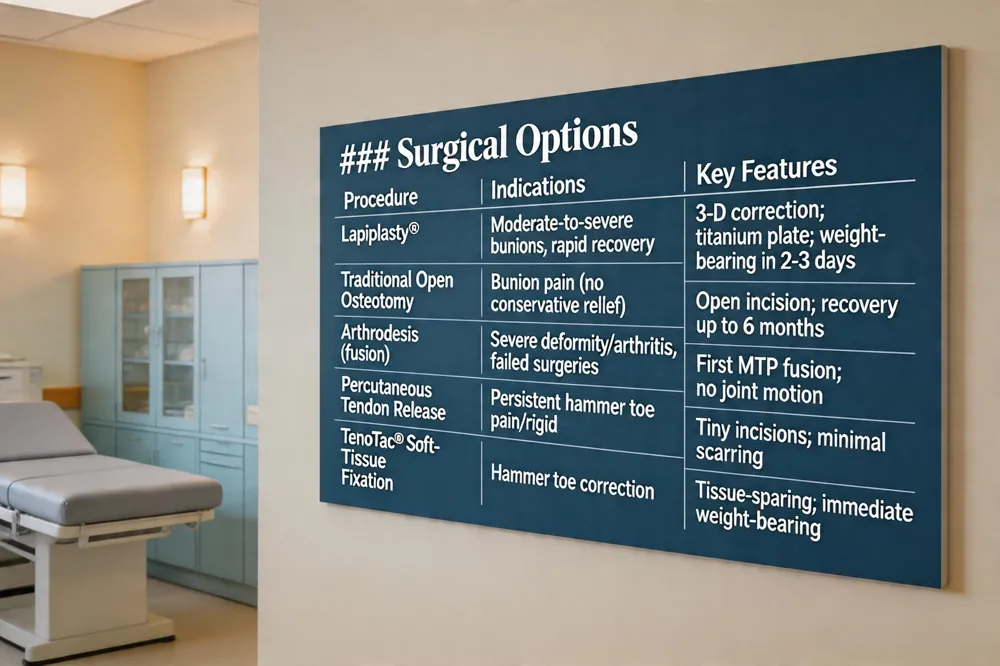
Surgical Options
| Procedure | Indications | Key Features |
|---|---|---|
| Lapiplasty® | Moderate‑to‑severe bunions, desire for rapid recovery | 3‑D correction of metatarsal in all planes; titanium plate fusion; weight‑bearing in 2‑3 days |
| Traditional open osteotomy | Bunions with pain/deformity not responding to conservative care | Open incision; bone cutting to realign; longer recovery (up to 6 months) |
| Arthrodesis (fusion) | Severe deformities, arthritis, failed previous surgeries | Fusion of first MTP joint; stable but eliminates joint motion |
| Percutaneous tendon release for hammer toe | Persistent pain or semi‑rigid/rigid hammer toe after conservative treatment | Tiny incisions; release of flexor tendon; minimal scarring |
| TenoTac® soft‑tissue fixation | Novel hammer toe correction | Tissue‑sparing; immediate weight‑bearing; faster return to activity |
 What is the newest bunion surgery called?
The newest bunion surgery is called Lapiplasty®. It is a patented three‑dimensional procedure that straightens the metatarsal bone in all planes (sideways, rotational, vertical) using a specialized instrument guide. The unstable joint is fused with titanium plates, allowing weight‑bearing within two to three days and a protective boot for six to eight weeks.
What is the newest bunion surgery called?
The newest bunion surgery is called Lapiplasty®. It is a patented three‑dimensional procedure that straightens the metatarsal bone in all planes (sideways, rotational, vertical) using a specialized instrument guide. The unstable joint is fused with titanium plates, allowing weight‑bearing within two to three days and a protective boot for six to eight weeks.
Bunion surgery Bunion surgery (bunionectomy) is indicated when pain, swelling, or deformity limits daily activities despite wide shoes, orthotics, NSAIDs, or icing. Goals are to remove the bony prominence, realign the first MTP joint, and restore function. Options include traditional open osteotomy, minimally invasive Lapiplasty®, or arthrodesis for severe cases. Outpatient surgery uses small incisions, local or regional anesthesia, and full recovery may take up to six months with progressive weight‑bearing and protective footwear.
Treatment for hammer toes Initial care focuses on wide toe‑box shoes, custom orthotics, padding, and toe‑stretching exercises. Persistent pain or semi‑rigid/rigid deformities require minimally invasive percutaneous tendon release or arthroplasty, which straighten the toe while preserving tissue. Surgery is reserved for cases that fail conservative measures and cause callus, pain, or functional limitation.
New surgery for hammer toes A novel percutaneous technique uses two tiny incisions to release the flexor tendon and place a soft‑tissue fixation implant (e.g., TenoTac®). This tissue‑sparing approach allows immediate weight‑bearing, minimal scarring, and faster return to activity compared with traditional open release.
Hammer Toe Management – From Daily Habits to Targeted Therapy
Management Overview
| Aspect | Recommendations |
|---|---|
| Symptoms & risk factors | Visible curl, pain/stiffness at toe top, corns/calluses; risk factors include ill‑fitting shoes, high heels, injury, genetics, arthritis, diabetes, flat feet, prolonged standing |
| Exercise & prevention | Toe curls (towel scrunches), toe taps, toe‑spread drills, seated calf raises; wear wide toe‑box shoes, low heels, supportive orthotics; maintain healthy weight |
| Pain control | NSAIDs, ice, padding; buddy‑taping for short‑term alignment; custom orthotics, splinting, or minimally invasive tendon release for lasting relief |
| Quick answers | Pain arises from toe rubbing against footwear; early conservative care often relieves pain; tape provides temporary alignment, not permanent fix |
 Symptoms and risk factors – Early signs include a visible curl, pain or stiffness at the top of the toe, and corns or calluses. Risk factors are ill‑fitting shoes, high heels, foot injury, genetics, arthritis, diabetes, flat feet, and prolonged standing.
Exercise and prevention – Daily toe curls (towel scrunches), toe taps, toe‑spread drills, and seated calf raises improve flexibility and balance muscle forces. Wearing shoes with a wide toe box, low heels, and supportive orthotics distributes pressure evenly. Maintaining a healthy weight and treating accompanying foot problems (bunions, corn formation) prevent compensatory toe positioning.
Pain control and temporary fixes – NSAIDs, ice, and padding reduce inflammation. Buddy‑taping can hold the toe in a neutral position for short periods, easing friction while shoes are worn. For lasting relief, a podiatrist may recommend custom orthotics, splinting, or minimally invasive tendon release when conservative measures fail.
Quick answers – Hammer toe is painful when the joint rubs against footwear; early conservative care (proper shoes, orthotics, exercises) often relieves pain. Tape provides temporary alignment but not a permanent fix. Visual references and before‑and‑after photos of minimally invasive correction are available through reputable podiatry clinics.
Flat Feet and Other Deformities – Diagnosis and Management
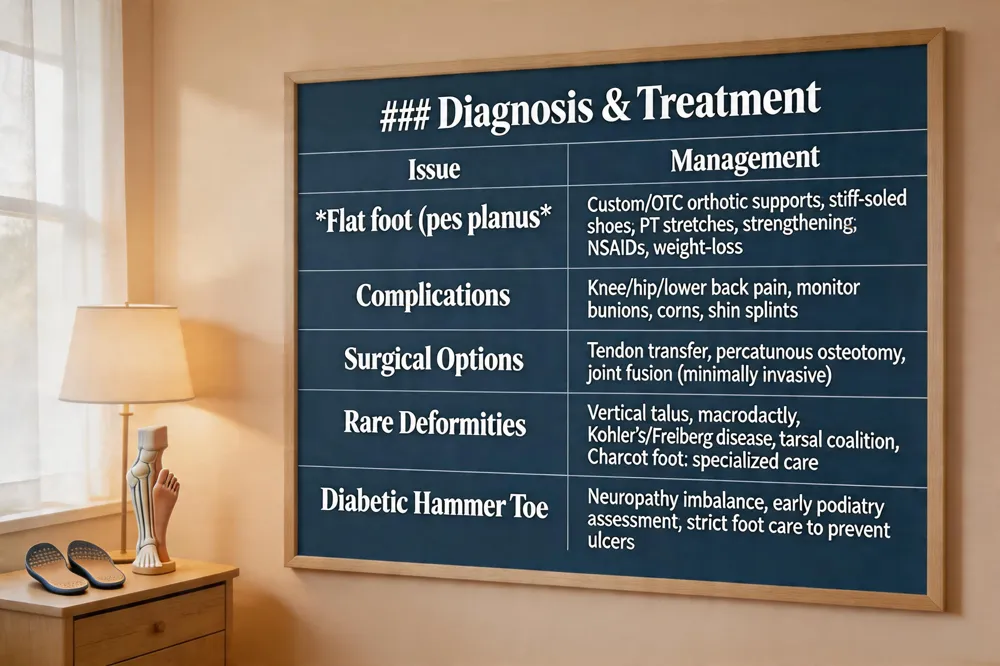
Diagnosis & Treatment
| Issue | Management |
|---|---|
| Flat foot (pes planus) | Custom or OTC orthotic arch supports; stiff‑soled shoes; PT stretches for calf/Achilles; strengthening intrinsic foot, ankle, core; NSAIDs, weight‑loss, low‑impact activity |
| Complications | Address secondary pain in knees, hips, lower back; monitor for bunions, corns, shin splints |
| Surgical options (when conservative fails) | Tendon transfer, percutaneous osteotomy, joint fusion (minimally invasive) |
| Rare deformities | Conditions like vertical talus, macrodactyly, Kohler’s disease, Freiberg disease, tarsal coalition, Charcot foot require specialized diagnosis & minimally invasive, personalized treatment |
| Diabetic hammer toe | Neuropathy‑induced muscle imbalance; early podiatric assessment; strict foot care to prevent ulceration |
 Flat‑foot biomechanics involve a collapsed medial arch that permits excessive pronation, shifting load med the midtarsals and destabilizing the ankle. Patients often report heel‑to‑forefoot pain, swelling, and difficulty finding shoes that fit. Over time, the altered gait can stress the knees, hips and lower back, and predispose to secondary problems such as bunions, corns, and shin splints.
Flat foot treatment – Initial management focuses on custom or over‑the‑counter orthotic arch supports and stiff‑soled shoes to stabilize the arch. Targeted physical‑therapy stretches for the calf and Achilles tendons, plus strengthening of intrinsic foot, ankle, and core muscles, improve flexibility and gait mechanics. Anti‑inflammatory medications, weight‑loss, and low‑impact activity modification further relieve symptoms. When conservative measures fail, minimally invasive surgery—tendon transfer, percutaneous osteotomy, or joint fusion—may be recommended to restore alignment.
Flat foot disadvantages – Chronic pain stems from overpronation and instability, which can transmit abnormal forces up the kinetic chain, leading to knee, hip, and back discomfort or worsening arthritis. The condition raises the risk of secondary foot issues (bunions, callus, bone spurs) and reduces athletic performance, increasing fatigue and injury risk. Early podiatric evaluation can prevent these complications.
Rare foot deformities – Uncommon structural or vascular conditions—such as vertical talus, macrodactyly, Kohler’s disease, Freiberg disease, tarsal coalition, or Charcot foot—require specialized diagnosis and often minimally invasive, personalized treatment at advanced podiatry clinics.
What is diabetic hammer toe? – Hyperglycemia can cause neuropathy and muscle imbalance, leading the lesser toe to flex at the proximal interphalangeal joint (hammertoe). Prompt foot care and podiatric assessment are essential to prevent progression and ulceration.
Take the First Step Toward Healthier Feet
Early evaluation catches bunions or hammertoes before they worsen. At Advanced Foot Care, expect a thorough exam, weight‑bearing X‑rays, custom orthotics discussion, and a personalized treatment plan for optimal outcomes.