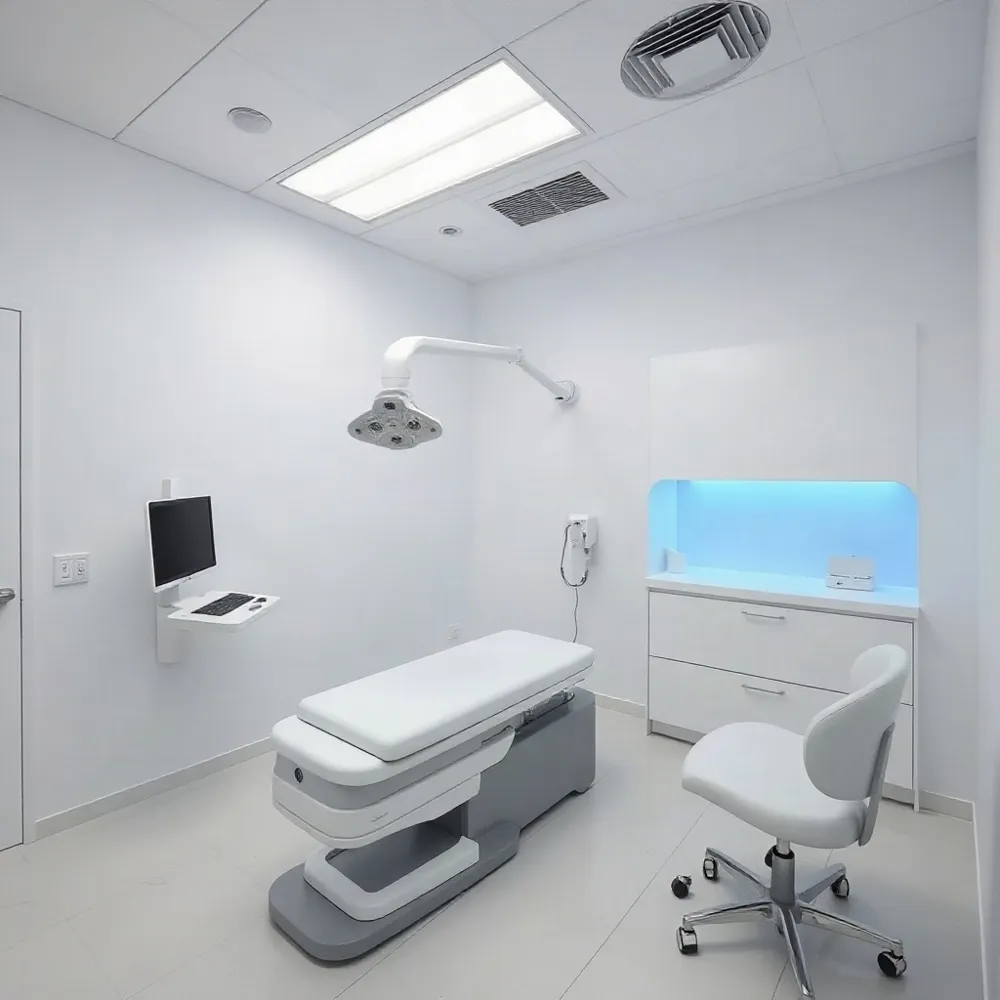
Understanding Surgical Options
Minimally invasive foot and ankle surgery (MIS) utilizes tiny portals—typically 5 mm to 15 mm (often ≤1 cm)—and high‑definition endoscopic cameras or percutaneous instruments to correct common conditions such as hallux valgus, hammertoes, plantar fasciitis, and osteochondral lesions. By preserving soft‑tissue integrity, MIS reduces postoperative pain, lowers opioid requirements, and shortens the time to weight‑bearing, with most patients returning to normal footwear within 2–4 weeks. Traditional open surgery, by contrast, employs larger incisions (5–10 cm or more) to provide direct visual and tactile access to bone and soft‑tissue structures. This approach is advantageous for severe deformities, extensive reconstructions, or complex fractures where broad exposure is essential. Open techniques generally involve longer swelling, higher infection and scar‑hypertrophy rates, and a recovery period of 6–12 weeks. Both methods aim for comparable long‑term radiographic and functional outcomes, but the choice hinges on deformity severity, patient comorbidities, and surgeon expertise.
Key Differences Between MIS and Open Foot & Ankle Surgery
Key Differences Between MIS and Open Foot & Ankle Surgery
| Aspect | Minimally Invasive Surgery (MIS) | Open Surgery |
|---|---|---|
| Incision size | ≤ 1 cm (often 2‑3 mm portals) | 5‑10 cm incision |
| Tissue trauma | Minimal soft‑tissue disruption; preserves blood supply | Greater muscle/skin disruption |
| Recovery timeline | Weight‑bearing 1‑2 weeks; normal footwear 2‑4 weeks | Protected weight‑bearing 6‑12 weeks; footwear 6‑8 weeks |
| Pain & opioid use | 30‑50 % lower pain scores; reduced opioid need in first 48 h | Higher pain scores; more opioid use |
| Infection & wound complications | 0.5‑1 % infection rate; fewer dehiscence/scar issues | 2‑5 % infection rate; higher wound‑related problems |
| Visualization | Camera‑based, fluoroscopic guidance; limited tactile feedback | Direct 3‑D view + tactile feedback |
| Learning curve | 30‑50 mentored cases; specialized equipment | Standard surgical training |
| Conversion risk | Low but possible for complex cases | Not applicable |
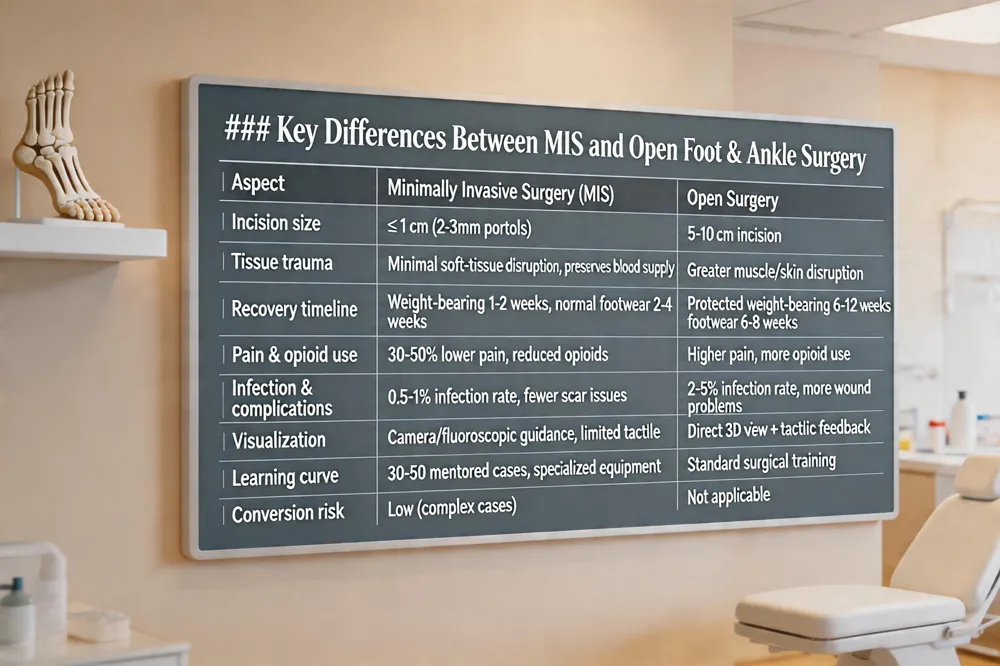 Minimally invasive surgery (MIS) for foot and ankle is performed through incisions often incisions ≤1 cm—sometimes as small as a few millimeters—using endoscopic cameras, fluoroscopic guidance, and micro‑instruments. In contrast, traditional open surgery typically requires 5–10 cm incisions to provide direct visual and tactile access to the anatomy.
Incision size and tissue trauma – The tiny portals of MIS preserve soft‑tissue blood supply, resulting in markedly less tissue disruption. Open procedures, with their larger cuts, produce greater muscle and skin trauma, which can prolong swelling and stiffness.
Recovery timelines and return to activity – Patients undergoing MIS usually bear weight or resume light activities within 2–4 weeks and return to normal footwear in the same window. Open surgery often mandates 6–12 weeks of protected weight‑bearing and a longer convalescence period.
Pain levels and opioid use – Because MIS spares tissue, postoperative pain scores are postoperative pain scores are 30‑50 % lower, and opioid requirements in the first 48 hours are reduced. Open cases commonly need higher analgesic doses and longer pain‑control regimens.
Infection and wound complication rates – Small incisions limit bacterial exposure, yielding infection rates of 0.5‑1 % for MIS versus 2‑5 % for open surgery. Wound dehiscence, scar hypertrophy, and delayed healing are likewise less frequent with MIS.
Visualization and tactile feedback – Open surgery offers direct, three‑dimensional visualization and tactile sensation, advantageous for complex deformities or extensive reconstructions. MIS relies on camera images and intra‑operative imaging; while precise, it provides limited tactile feedback and demands a steep learning curve (≈30‑50 mentored cases) and specialized equipment.
Minimally invasive meaning – A minimally invasive procedure uses very small incisions—often just a few millimeters—combined with cameras, endoscopes, and precision tools. This preserves surrounding tissue, reduces pain, infection risk, and scarring, and allows a quicker return to daily activities. In podiatric, minimally techniques, treationsions, hammertoes, and ligament injuries efficiently.
Minimally invasive surgery vs open – Open foot and ankle surgery requires larger incisions for direct visualization, leading to more postoperative pain, higher infection risk, and longer rehab. MIS uses keyhole‑size incisions and video guidance, resulting in less tissue trauma, lower pain, lower infection rates, and faster functional recovery. However, MIS demands specific training, board certification, and high case volume; surgeons must be prepared to convert to open if intra‑operative challenges arise. The choice should be individualized based on patient health, condition severity, and surgeon expertise.
Benefits and Drawbacks of Minimally Invasive Techniques
Benefits & Drawbacks of Minimally Invasive Techniques
| Category | Benefits | Drawbacks | Cost Implications |
|---|---|---|---|
| Clinical outcomes | ↓ Tissue trauma, ↓ pain, ↓ opioid use, faster return to activity | Limited tactile feedback may risk incomplete correction | Initial higher equipment cost, but overall episode cost ↓ 10‑20 % |
| Complications | Infection 0.5‑1 % vs. 2‑5 % open; less swelling & scarring | May need conversion to open if visualization poor | Lower postoperative care costs |
| Operative time | Slightly longer due to portal navigation | Longer OR time per case | Increases direct surgical cost |
| Equipment | Endoscopic cameras, fluoroscopy, micro‑instruments | Requires capital investment in imaging & instruments | Up‑front expense offset by reduced LOS & complications |
| Training | Requires 30‑50 mentored cases; steep learning curve | Surgeon availability may be limited | Potential higher provider fees initially |
| Patient setting | Often outpatient or overnight stay | May need hospital stay for complex cases | Outpatient cost $5‑12k vs. $7‑15k open (incl. LOS) |
 Minimally invasive foot and ankle surgery (MIS) uses incisions often ≤1 cm, which dramatically reduces tissue trauma. Clinical data consistently show lower postoperative pain scores and a 30‑50 % reduction in opioid requirements during the first 48 hours compared with open surgery. Smaller wounds also translate to fewer wound‑related complications—infection rates of 0.5‑1 % versus 2‑5 % for traditional approaches—and less postoperative swelling. Because the procedures are frequently performed in an outpatient or overnight setting, patients enjoy shorter hospital stays and a quicker return to weight‑bearing, often within 2‑4 weeks for bunion correction versus 6‑12 weeks after open repair.
However, MIS carries higher upfront costs due to specialized cameras, fluoroscopic or robotic equipment, and longer operative times as surgeons navigate through tiny portals. The learning curve is steep; proficiency typically requires 30‑50 mentored cases. Limited tactile feedback can increase the risk of incomplete correction or nerve irritation. These factors can raise the initial expense of the episode of care, though many studies report overall cost savings of 10‑20 % because of reduced hospital utilization and fewer complications.
Disadvantages: Longer operative times, need for advanced imaging and instrumentation, higher upfront costs, steep learning curve, limited tactile feedback, and occasional conversion to open surgery for complex cases.
Cost: Outpatient MIS ankle repairs range roughly $5,000‑$12,000 versus $7,000‑$15,000 for open repairs, with total health‑care expenditures often 10‑20 % lower due to shorter stays and fewer complications.
Examples: Percutaneous Achilles repair, endoscopic plantar fasciotomy, minimally invasive bunionectomy (Baker technique), arthroscopic ankle debridement, as well as general MIS procedures like laparoscopic cholecystectomy.
Clinical Success Rates and Patient Outcomes
Clinical Success Rates and Patient Outcomes
| Metric | MIS (≤ 1 cm incisions) | Open Surgery | Comments |
|---|---|---|---|
| Success rate | 90‑95 % | 90‑95 % | Comparable long‑term correction |
| Early pain scores | 30‑50 % lower (VAS) | Higher | Leads to reduced opioid use |
| Return to footwear | 2‑4 weeks | 6‑8 weeks | Faster functional recovery |
| Wound infection | 0.5‑1 % | 2‑5 % | Significantly lower with MIS |
| PROMs (AOFAS, FAOS, PROMIS) | Similar improvement at 12 months | Similar improvement at 12 months | MIS shows higher early satisfaction |
| Complication rate | Lower (scar hypertrophy, dehiscence) | Higher | Benefits for diabetic/vascular disease patients |
| Long‑term functional scores | Equivalent | Equivalent | Durability of both approaches confirmed |
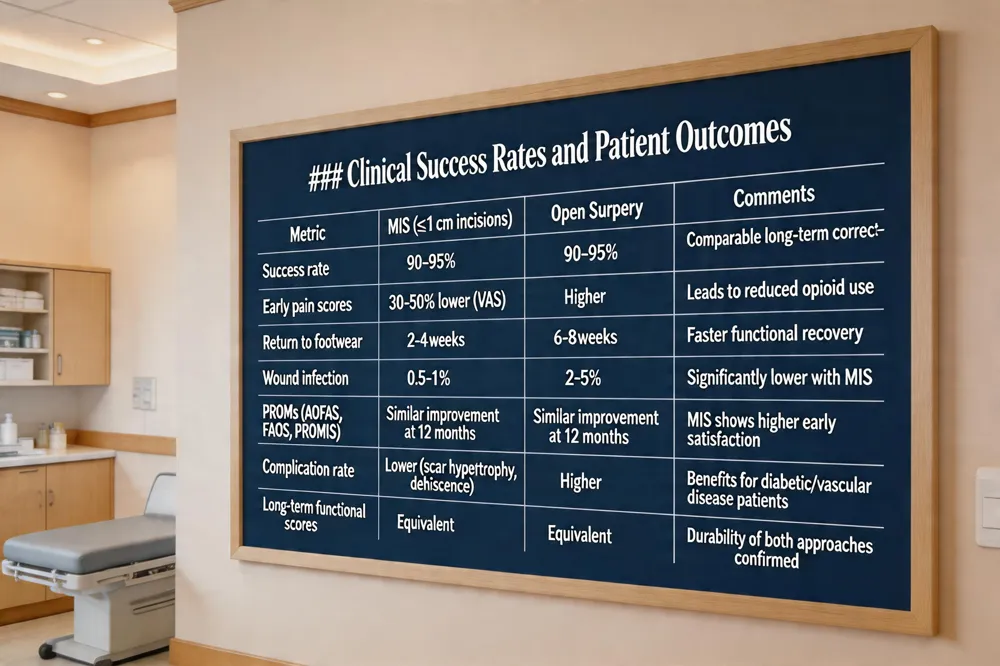 Minimally invasive foot and ankle surgery (MIS) employs tiny (≤1 cm) incisions, endoscopic cameras, and percutaneous instruments, allowing precise correction of bunions, hammertoes, plantar fasciitis and Achilles pathologies while preserving soft‑tissue blood supply. Across the most common conditions, MIS achieves 90‑95 % success rates—comparable to traditional open techniques—but with markedly lower postoperative pain scores, less opioid need, and faster return to normal footwear (2‑4 weeks versus 6‑8 weeks for open surgery). Patient‑reported outcome measures (PROMs) such as the AOFAS, FAOS and PROMIS physical‑function scores improve similarly at 12 months for both approaches, yet MIS patients report higher early satisfaction, and lower wound‑complication rates (0.5‑1 % vs. 2‑5 % in open surgery). Long‑term functional scores (AOFAS, FAOS) remain equivalent, supporting MIS as a durable option. In diabetic or peripheral‑vascular disease patients, the smaller incisions lessen wound‑healing risks, and when combined with vascular evaluation, MIS can reduce infection, delayed‑healing and amputation rates. Overall, the evidence positions MIS as a reliable, high‑success modality for modern podiatric care.
Choosing the Right Surgeon: Podiatrist vs. Orthopedic Surgeon
Choosing the Right Surgeon: Podiatrist vs. Orthopedic Surgeon
| Consideration | Podiatrist (DPM) | Orthopedic Surgeon (MD/DO) |
|---|---|---|
| Training focus | Foot‑ankle specific anatomy, soft‑tissue preservation | Broad musculoskeletal training, extensive instrumentation |
| Typical cases | Hallux valgus, hammertoe releases, percutaneous Achilles repair, diabetic foot care | Complex reconstructions, multi‑level ankle fusion, fracture fixation, limb‑salvage |
| Outcome data | Comparable AOFAS/FAOS scores for routine procedures | Comparable scores for complex cases |
| Hospital stay & cost | Slightly longer LOS (≈1.2×) and ~30 % higher episode cost in some analyses | Shorter LOS for complex inpatient cases |
| Board certification | American Board of Podiatric Surgery | American Board of Orthopaedic Surgery |
| When to choose | Routine foot pathology, minimally invasive procedures | Severe deformities, extensive reconstruction, large implant requirements |
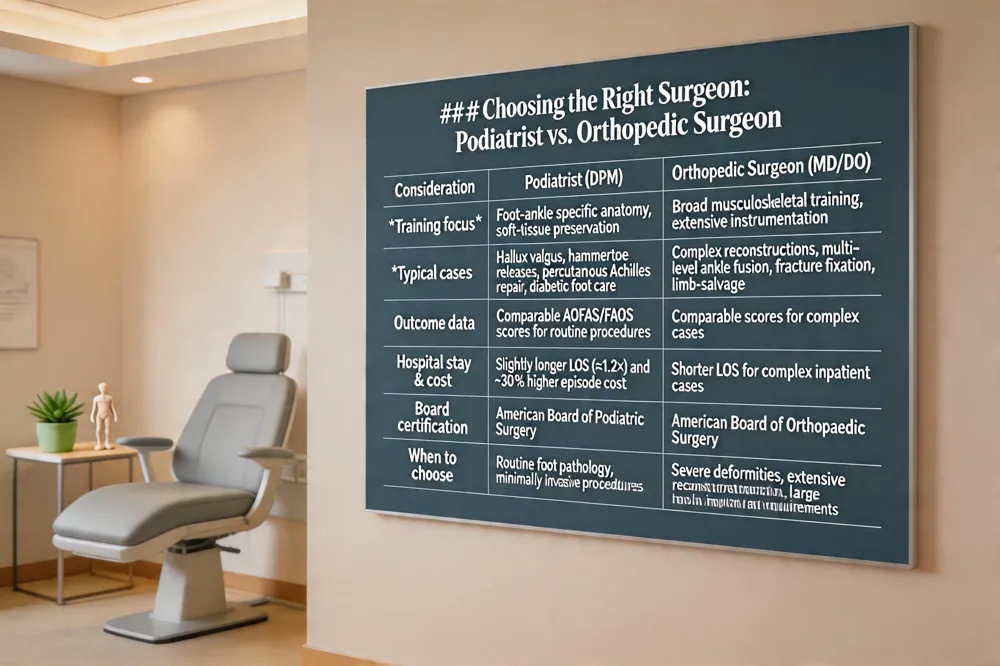 Both podiatrists and orthopedic foot and ankle surgeons complete 4 years of medical school, a 5‑year surgical residency, and often a fellowship that focuses on foot‑ankle pathology. The key distinction lies in the licensure pathway: podiatrists earn a DPM (Doctor of Podiatric Medicine) and are board‑certified by the American Board of Podiatric Surgery, while orthopedic surgeons hold an MD or DO and are certified by the American Board of Orthopaedic Surgery.
Outcome data from U.S. databases show that, when procedures are performed by experienced surgeons, long‑term functional scores (AOFAS, FAOS, PROMIS) are comparable between the two specialties. However, a national analysis reported that ankle arthroplasty and arthrodesis performed by podiatrists were associated with a 1.2‑fold longer hospital stay and a ~30 % higher episode‑of‑care cost, likely reflecting differences in hospital setting and case mix.
When to consider a podiatrist – Routine bunion (Hallux valgus) correction, hammertoe releases, percutaneous Achilles repair, and diabetic foot wound care are often managed efficiently by podiatrists who specialize in foot‑specific anatomy and soft‑tissue preservation.
When an orthopedic surgeon is preferred – Complex deformities (severe flatfoot reconstruction, multi‑level ankle fusion), extensive fracture fixation, limb‑salvage procedures, or cases requiring large implants benefit from the broader musculoskeletal exposure and instrumentation expertise of an orthopedic foot and ankle surgeon.
Answer to the common question – "Is it better to have foot surgery by a podiatrist or an orthopedic surgeon?" Both specialists can achieve excellent results; the choice should be guided by the complexity of the pathology, the surgeon’s specific training and experience, and the patient’s overall health status.
Practical Considerations for Patients
Practical Considerations for Patients
| Factor | MIS (Minimally Invasive) | Open Surgery |
|---|---|---|
| Recovery & weight‑bearing | Weight‑bearing 1‑2 weeks; normal shoes 2‑4 weeks | Protected weight‑bearing 6‑12 weeks; shoes 6‑8 weeks |
| Insurance & reimbursement | Same CPT reimbursement in many plans; higher upfront equipment cost | Standard reimbursement; potentially higher total cost due to longer LOS |
| Patient selection | Mild‑moderate deformities, good perfusion, no severe diabetes‑related disease | Severe deformities, peripheral vascular disease, extensive trauma |
| Conversion risk | Low but possible; surgeons discuss pre‑op | Not applicable |
| Hospital stay | Often outpatient or overnight | Typically inpatient (1‑3 days) for complex cases |
| Out‑of‑pocket cost | $5,000‑$12,000 (incl. equipment) | $7,000‑$15,000 (incl. longer stay) |
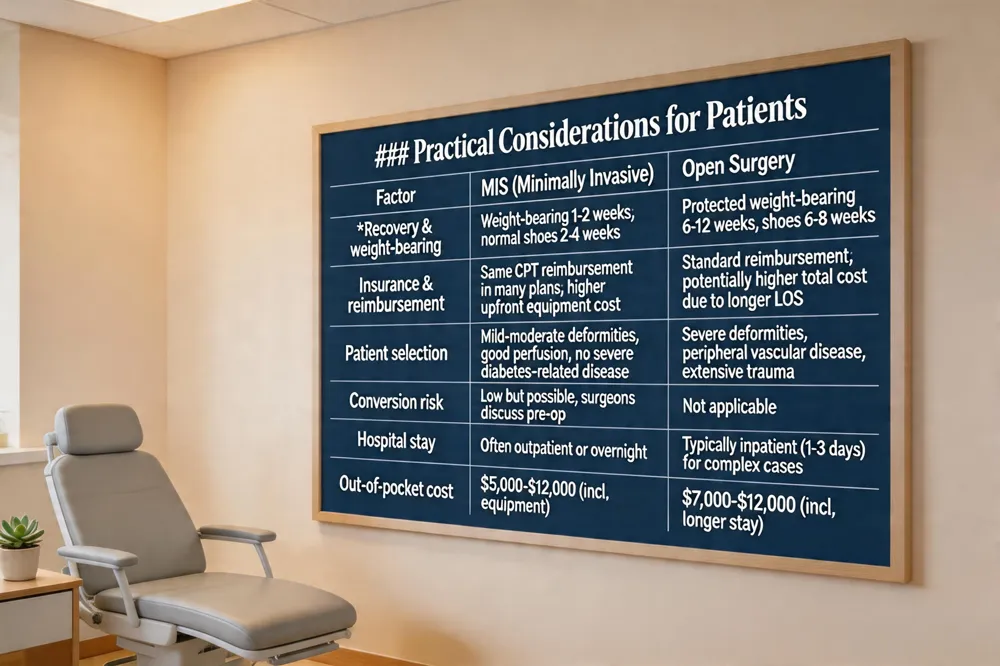 When deciding between minimally invasive (MIS) foot and ankle surgery and traditional open techniques, patients should weigh several practical factors.
Recovery timelines and weight‑bearing protocols – MIS procedures typically use incisions ≤1 cm, allowing patients to bear weight as early as 1‑2 weeks and return to normal footwear within 2‑4 weeks. Open surgery often requires 6‑12 weeks of protected weight‑bearing and a longer immobilization period. Early mobilization with MIS reduces swelling and stiffness, while the extended healing phase of open surgery may be necessary for complex reconstructions.
Insurance reimbursement and out‑of‑pocket costs – In the United States, most insurers reimburse MIS foot and ankle procedures at the same rate as open surgery, provided medical necessity is documented. However, MIS may involve higher upfront costs for specialized instruments and imaging, which can be offset by shorter hospital stays and fewer postoperative complications, ultimately lowering total episode‑of‑care expenses.
Patient selection criteria (comorbidities, anatomy) – Ideal MIS candidates have mild to moderate deformities, good peripheral perfusion, and no severe diabetes‑related foot disease. Those with peripheral vascular disease, uncontrolled diabetes, or extensive deformities may benefit from open surgery to allow thorough debridement and robust wound closure.
Conversion risk from MIS to open surgery – While conversion rates are low, complex cases or intra‑operative challenges (e.g., poor visualization, unexpected anatomy) may necessitate switching to an open approach. Surgeons should discuss this possibility pre‑operatively.
Answer to the question – Open surgery vs laparoscopic surgery: Laparoscopic surgery is a type of minimally invasive surgery performed with a camera and instruments inserted through small ports, whereas open surgery involves a single large incision. Laparoscopy generally offers reduced pain, shorter hospital stay, and faster recovery.
Final Takeaways
When deciding between minimally invasive surgery (MIS) and traditional open techniques for foot and ankle pathology, clinicians must balance the clear advantages of MIS—smaller incisions, reduced pain, lower infection rates, and quicker return to weight‑bearing—against its limitations, such as a steep learning curve, limited tactile feedback, and the occasional need for intra‑operative imaging. Surgeon expertise is paramount; proficiency typically requires 30‑50 ment cases under mentorship, and outcomes improve dramatically with high‑volume, board‑certified specialists. Equally important are patient‑specific factors—vascular status, diabetes, deformity severity, and personal goals—that dictate whether the minimal tissue disruption of MIS will translate into durable functional improvement. Ultimately, the goal is to achieve long‑term alignment, pain relief, and activity levels while minimizing surgical trauma, scar formation, and postoperative complications, regardless of the chosen approach.