Understanding Custom Orthotics
Custom orthotics are prescription shoe inserts individually molded to match a patient’s foot shape and biomechanical needs. After a podiatrist conducts a gait and foot‑structure analysis, a plaster cast, foam impression, or 3‑D digital scan captures the foot’s contours, which are used to fabricate the device in a lab.
Two primary types exist. Functional (corrective) orthotics are made from semi‑rigid or rigid materials such as polypropylene, carbon fiber, or thermoplastic and aim to realign the foot, control excessive pronation or supination, and redistribute load. Accommodative orthotics use softer, multi‑density foams or EVA to cushion sensitive areas and off‑load pressure points.
Material choice affects durability, shock absorption, and flexibility; rigid shells last 2‑5 years, while softer layers can be replaced as needs change. Benefits include relief from plantar fasciitis, flat‑foot pain, bunions, and metatarsalgia, improved gait symmetry, reduced stress on knees, hips and lower back, and overall stability for activity and sport.
Our Clinics and Digital Services
| Clinic | Address | Phone | Core Services | Notable Feature |
|---|---|---|---|---|
| Advanced Foot Care Ronkonkoma | 201 Portion Rd, Suite C, Ronkonkoma, NY 11779 | 631‑467‑2813 | Diabetic foot care, heel spurs, bunions, hammertoes, custom orthotics, shockwave therapy, reconstructive surgery | 24/7 patient portal |
| Advanced Foot Care Mineola | 155 Mineola Blvd, Suite B, Mineola, NY | 516‑741‑3338 | Custom orthotics, laser nail therapy, shockwave for heel pain, sports‑injury treatment, digital foot scanning | On‑site medical shoe store |
| Advanced Foot Care Huntington | 181 Main St., Suite 207, Huntington, NY 11743 | 631‑427‑3678 | Heel‑spur relief, diabetic care, orthotics, advanced imaging | Online & Zocdoc booking |
| Advanced Foot Care Woodbury | 20 Crossways Park Dr., West Suite 304, Woodbury, NY 11797 | 516‑681‑8866 | Minimally invasive surgery, pediatric podiatry, shockwave therapy, foot spa | Convenient online scheduling |
| Advanced Foot Care Center of Rochester (Fairport) | 2828 Baird Rd, Ste B, Fairport, NY | 585‑249‑0020 | Achilles tendon injuries, flat‑foot therapy, diabetic foot care, reconstructive procedures | Two locations |
| Advanced Foot Care Center of Rochester (Rochester) | 97 Canal Landing Blvd, Ste 3, Rochester, NY | 585‑249‑0020 | Same as Fairport | Two locations |
| Advanced Podiatry Maspeth | 70‑01 Grand Ave, Maspeth, NY 11378 | 718‑639‑0499 | Comprehensive foot care, laser surgery, custom orthotics with digital scanning | — |
| Advanced Foot Care of Coram | 100 Middle Country Rd., Coram, NY 11727 | 631‑696‑9636 | Full‑service foot & ankle care, same‑day urgent appointments, secure patient portal | — |
| Patient Portal (system‑wide) | — | — | View records, test results, treatment plans, schedule/reschedule, pay bills, update insurance | HIPAA‑compliant, multi‑factor authentication |
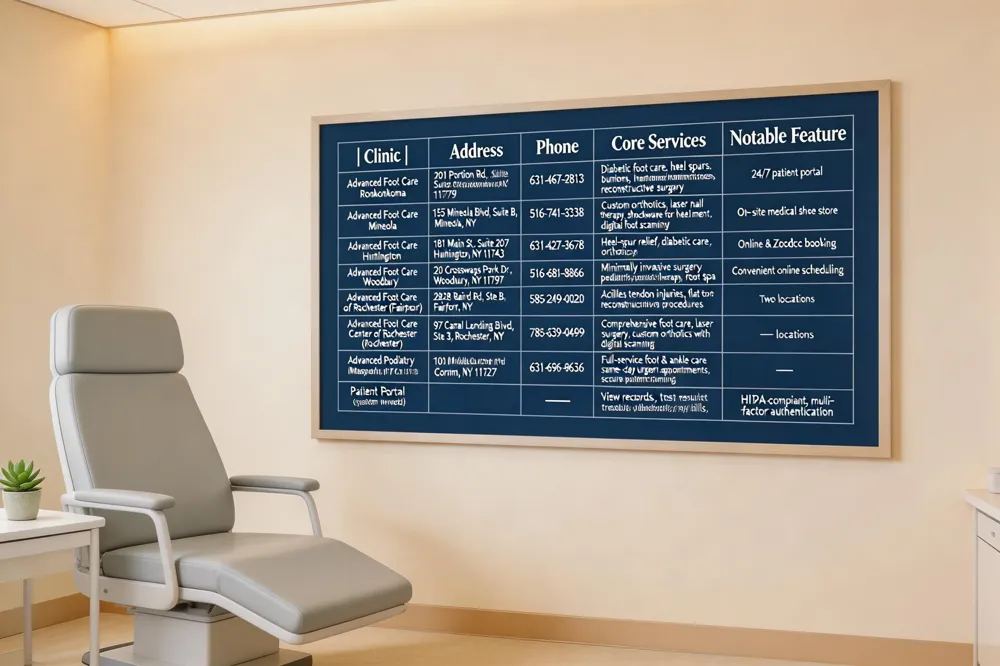 Advanced Foot Care operates a network of board‑certified podiatry clinics across Long Island and New York State, each equipped with on‑site X‑ray, digital foot scanning, laser and shockwave therapy, and minimally invasive surgical options.
Advanced Foot Care Ronkonkoma – Located at 201 Portion Rd, Suite C, Ronkonkoma, NY 11779 (631‑467‑2813). Services include diabetic foot care, heel spurs, bunions, hammertoes, custom orthotics, shockwave therapy, and reconstructive surgery. The clinic offers a 24/7 patient portal for record access and appointment scheduling.
Advanced Foot Care Mineola – 155 Mineola Blvd, Suite B, Mineola, NY (516‑741‑3338). Offers custom orthotics, laser nail therapy, shockwave for heel pain, and sports‑injury treatment, with digital foot scanning for orthotic fabrication and an on‑site medical shoe store.
Advanced Foot Care Huntington – 181 Main St., Suite 207, Huntington, NY 11743 (631‑427‑3678). Provides heel‑spur relief, diabetic care, orthotics, and advanced imaging. Appointments can be booked online or via Zocdoc.
Advanced Foot Care Woodbury – 20 Crossways Park Dr., West Suite 304, Woodbury, NY 11797 (516‑681‑8866). Features minimally invasive surgery, pediatric podiatry, shockwave therapy, and a foot spa. Convenient online scheduling is available.
Advanced Foot Care Center of Rochester – Two offices: 2828 Baird Rd, Ste B, Fairport, NY and 97 Canal Landing Blvd, Ste 3, Rochester, NY (585‑249‑0020). Services cover Achilles tendon injuries, flat‑foot therapy, diabetic foot care, and reconstructive procedures.
Advanced Podiatry Maspeth – 70‑01 Grand Ave, Maspeth, NY 11378 (718‑639‑0499). Provides comprehensive foot care, laser surgery, and custom orthotics with digital scanning.
Advanced Foot Care of Coram – 100 Middle Country Rd., Coram, NY 11727 (631‑696‑9636). Offers full‑service foot and ankle care, same‑day urgent appointments, and a secure patient portal for records, billing, and communication.
Patient Portal – A HIPAA‑compliant, multi‑factor‑authenticated online platform where patients can view medical records, test results, treatment plans, schedule or reschedule visits, pay bills, and update insurance information at any time.
Clinical Benefits and Foot Conditions
| Condition | Primary Benefit of Custom Orthotics | Typical Pain Reduction | Additional Notes |
|---|---|---|---|
| Plantar fasciitis, flat feet, high arches, bunions, hammertoes, metatarsalgia | Targeted alignment correction, pressure redistribution, improved biomechanics | 30‑60 % within weeks | Often combined with stretching & strengthening |
| Diabetes‑related foot disease | Off‑loading high‑pressure areas, ulcer risk reduction, better circulation | Variable; ulcer incidence ↓ | Requires regular foot checks & education |
| Ankle instability / sprains | Controls pronation/supination, stabilizes joint, reduces tendonitis risk | N/A (preventive) | May be paired with bracing or PT |
| Overpronation | Firm arch support, medial posting, limits inward roll, reduces stress up knee/hip/lower back | N/A (mechanical) | Strengthening exercises still needed |
| Supination (high arches) | Medial lift, deep heel cup, mitigates outward roll | N/A (mechanical) | Gait analysis essential for optimal fit |
| Hallux rigidus | Weight redistribution away from big‑toe joint, motion limiting, alignment improvement | Symptom relief, slower cartilage wear | Should be used with toe‑friendly shoes |
| General foot discomfort | Overall biomechanical correction, improved gait | Subjective improvement | May require periodic follow‑up for wear assessment |
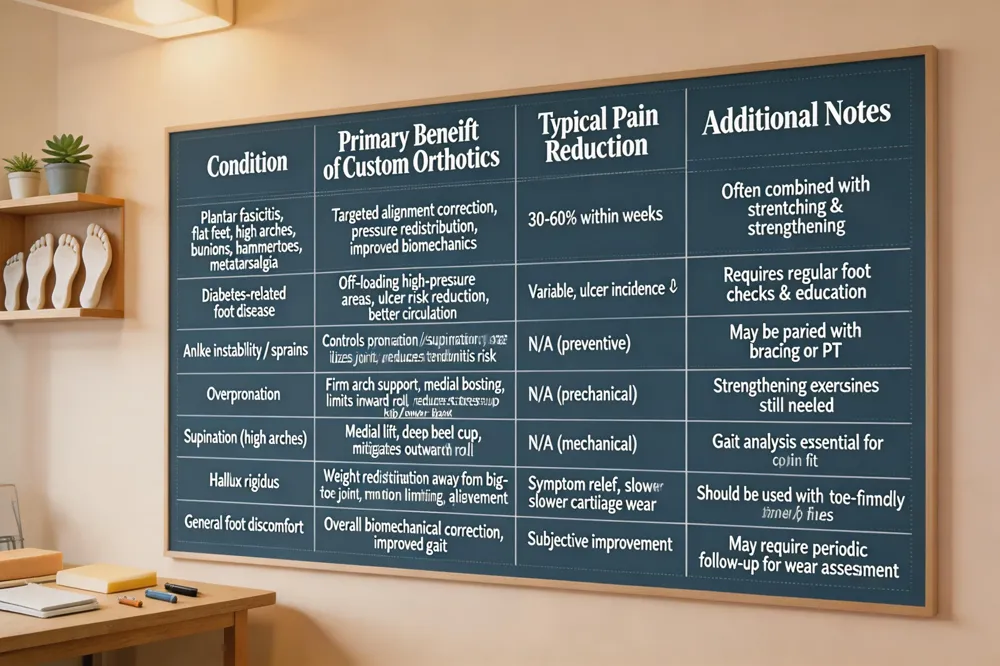 Custom orthotics provide targeted pain relief by correcting foot alignment, evenly distributing pressure, and improving overall biomechanics. Patients with plantar fasciitis, flat feet, high arches, bunions, hammertoes, and metatarsalgia often report a 30‑60% reduction in pain within weeks of use.
For people with diabetes, a podiatrist conducts comprehensive foot examinations—screening for neuropathy, vascular disease, ulcers and Charcot foot—then treats cuts, calluses, infections, or deformities. Custom orthotics off‑load high‑pressure areas, reducing ulcer risk and improving circulation. Patients receive education on daily foot checks, hygiene, nail care, and shoe selection to prevent complications.
Ankle health benefits from functional orthotics that control excessive pronation or supination, stabilizing the joint and decreasing the likelihood of sprains and tendonitis. A podiatrist can also prescribe bracing, physical therapy, or minimally invasive surgery when needed.
Key foot symptoms that should not be ignored include lingering ache after activity, numbness or tingling, changes in skin/nail/hair, uneven shoe wear, and recurrent ankle instability. Prompt evaluation can prevent progression to more severe conditions.
Orthotic disadvantages include the potential for discomfort if improperly fitted and, over time, weakening of intrinsic foot muscles when used without appropriate strengthening exercises.
Custom orthotics engineered for overpronation provide firm arch support and medial posting, limiting inward roll and reducing stress on the ankle, knee, hip, and lower back. They manage the motion but do not permanently change the biomechanical pattern; a is and stretching are essential.
Arch supports designed for high‑arched feet add medial lift and a deep heel cup, mitigating supination by preventing excessive outward roll. Proper fitting determined through gait analysis maximizes benefit.
Hallux rigidus patients gain symptom relief from orthotics that redistribute weight away from the big‑toe joint, limit excessive motion, and improve overall foot alignment, slowing cartilage wear while enhancing mobility.
Finding the Right Orthotic: Products and Reviews
| Product / Brand | Type | Key Features | Approx. Price Range | Pros | Cons |
|---|---|---|---|---|---|
| Advanced Foot Care Custom Orthotics (clinic‑based) | Fully custom | 3‑D foot scan, podiatrist‑prescribed, premium materials | $300‑$800 (plus $100‑$150 visit) | Precise fit, medically indicated, durable | Higher cost, requires appointment |
| Dr. Scholl’s Custom FiT® | FDA‑cleared custom insert | Online questionnaire, 3/4‑length or full‑length, HSA/FSA eligible | $100‑$150 | Convenient, affordable, fast delivery | Less precise than podiatrist‑crafted |
| Foot Levelers | Custom‑crafted (clinic‑partner) | Three‑arch design, podiatrist‑engineered, rigid shell | $250‑$500 | Strong support, good for severe cases | Requires fitting visit |
| Upstep | Mail‑in 3‑D impression | Semi‑custom, 120‑day guarantee, various arch types | $120‑$200 | Easy at‑home process, decent durability | May need adjustments |
| SprinSole | Semi‑custom high‑impact | Modular, shock‑absorbing, designed for runners | $140‑$220 | Good for athletes, lightweight | Limited medical coverage |
| Tread Labs | Modular semi‑custom | Adjustable components, interchangeable insoles | $130‑$210 | Versatile, can be tweaked | Not fully custom |
| HappyFeet Massaging Insoles | OTC (fibromyalgia) | Fluid‑filled glycerin core, continuous massage | $30‑$45 | Pain‑relief for fibromyalgia, soothing | Not a structural corrective device |
| Custom Feet (online) | Fully custom (mail‑in) | 3‑D scan, podiatrist review, premium material | $250‑$350 | Positive user reviews, good for flat feet | Shipping time, may need follow‑up |
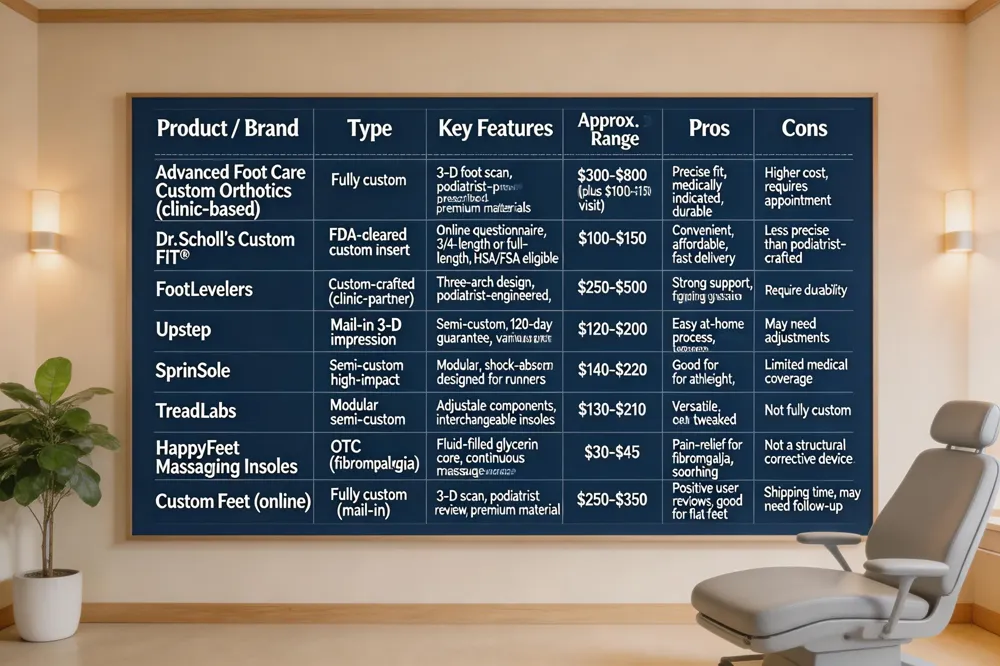 Custom made insoles near me
If you’re looking for custom‑made insoles close to you, Advanced Foot Care clinics in northwest Chicago and South Florida offer personalized orthotics. A board‑certified podiatrist conducts a detailed biomechanical assessment, uses 3‑D scanning, and fabricates insoles that fit your shoes perfectly. Schedule an appointment online or by phone and receive your orthotics within days for superior comfort and pain relief.
Custom made insoles near me
If you’re looking for custom‑made insoles close to you, Advanced Foot Care clinics in northwest Chicago and South Florida offer personalized orthotics. A board‑certified podiatrist conducts a detailed biomechanical assessment, uses 3‑D scanning, and fabricates insoles that fit your shoes perfectly. Schedule an appointment online or by phone and receive your orthotics within days for superior comfort and pain relief.
Dr. Scholl's custom insoles Dr. Scholl’s Custom FiT® orthotics are FDA‑cleared inserts created after an online foot‑shape questionnaire. They provide 3/4‑length or full‑length support for plantar fasciitis, heel pain, and flat feet, and are HSA/FSA eligible. While convenient and affordable, they lack the precise prescription‑based tailoring that a podiatrist‑crafted orthotic provides for complex biomechanical issues.
Best custom orthotics online Top online brands include Dr. Scholl’s Custom FiT® orthotics, Foot Levelers (three‑arch, podiatrist‑engineered), Upstep (mail‑in 3‑D impression with a 120‑day guarantee), SprinSole (high‑impact alignment), and Tread Labs (modular semi‑custom system). Choose a brand that offers a professional foot assessment and proven durability.
What are the best insoles for fibromyalgia? HappyFeet Massaging Insoles are widely praised for fibromyalgia foot pain. Their fluid‑filled glycerin core delivers a gentle, continuous massage that eases soreness and improves circulation, providing lasting arch support and cushioning.
Custom Feet insoles reviews Customers report dramatic relief: one reviewer with flat feet, ankle, knee, and sciatic pain described immediate numbness reduction and improved alignment after a week of wear, praising the expert staff and recommending Custom Feet for chronic foot issues.
Cost, Insurance, and Value
| Item | Typical Cost | Insurance Coverage | Key Points |
|---|---|---|---|
| Fully custom orthotic pair | $300‑$800 (plus $100‑$150 visit) | Medicare Part B: 1 pair/year, 20 % copay; most private plans cover with prescription & prior‑auth | Durable medical equipment (DME) classification |
| Semi‑custom orthotic | $60‑$300 | Often covered partially if medically necessary; varies by plan | Lower cost, less durable |
| OTC insert | $10‑$20 | Generally not covered | Good for temporary relief |
| Custom orthotic (clinic lab) | $300‑$800 | Highest value due to podiatrist expertise & premium materials | Long‑term durability (3‑5 years) reduces repeat purchases |
| FSA/HSA eligibility | All custom orthotics | Tax‑free payment option | Useful for out‑of‑pocket costs |
| Prior‑authorization requirement | Varies by insurer | Needed for Medicare & many private plans | Ensure prescription and diagnosis are documented |
| Co‑pay / deductible impact | 10‑30 % of cost depending on plan | Affects out‑of‑pocket expense | Check plan details before ordering |
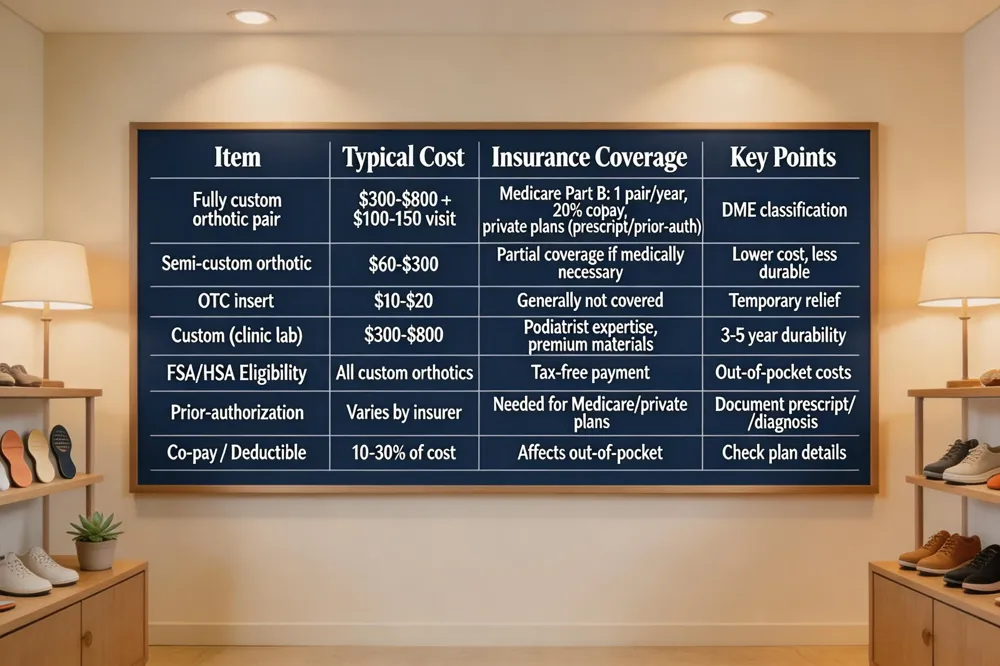 Custom orthotics are considered durable medical equipment, so most private insurers and Medicare Part B cover them when a podiatrist prescribes them for a medically necessary condition such as severe plantar fasciitis, diabetic foot disease, or a structural deformity. Coverage typically requires a formal diagnosis, prescription, and sometimes prior‑authorization; Medicare pays for one pair of custom‑molded shoes and one pair of inserts each year with a 20 % co‑pay, while private plans may have annual caps and network restrictions. Prices vary: a fully custom pair costs $300‑$800 (often $100‑$150 for clinic visit), semi‑custom options range $60‑$300, and OTC inserts are $10‑$20. Many plans reimburse a portion, and all custom orthotics are FSA/HSA‑eligible, allowing tax‑free payment. The best value comes from clinic‑based labs that combine podiatrist expertise with premium materials, ensuring precise fit and long‑term durability over mass‑market brands.
Usage Guidelines and Long‑Term Care
| Recommendation | Details |
|---|---|
| Break‑in schedule | Start 30‑60 min/day, increase by ~1 hr each day until full‑time wear (≈1‑2 weeks) |
| Daily wear after break‑in | Wear orthotics every day for optimal benefit; rotate between work and sport shoes |
| Replacement interval | Rigid/semirigid shells: 3‑5 years; cushioning inserts: 2‑3 years (earlier for high‑impact users) |
| Material considerations | Graphite, carbon fiber, polypropylene = longer life; softer foam = quicker wear |
| Care & maintenance | Clean with mild soap, keep dry, avoid extreme heat, monitor for wear signs |
| Follow‑up timing | Schedule a review ~1 year after fitting or sooner if pain returns or foot shape changes |
| Strengthening exercises | Perform foot intrinsic muscle strengthening to avoid deconditioning while using orthotics |
| When to seek professional help | New pain, loss of support, visible wear, changes in gait or foot shape |
| Value proposition | Addresses root cause, improves gait, may prevent expensive surgeries or repeated OTC replacements |
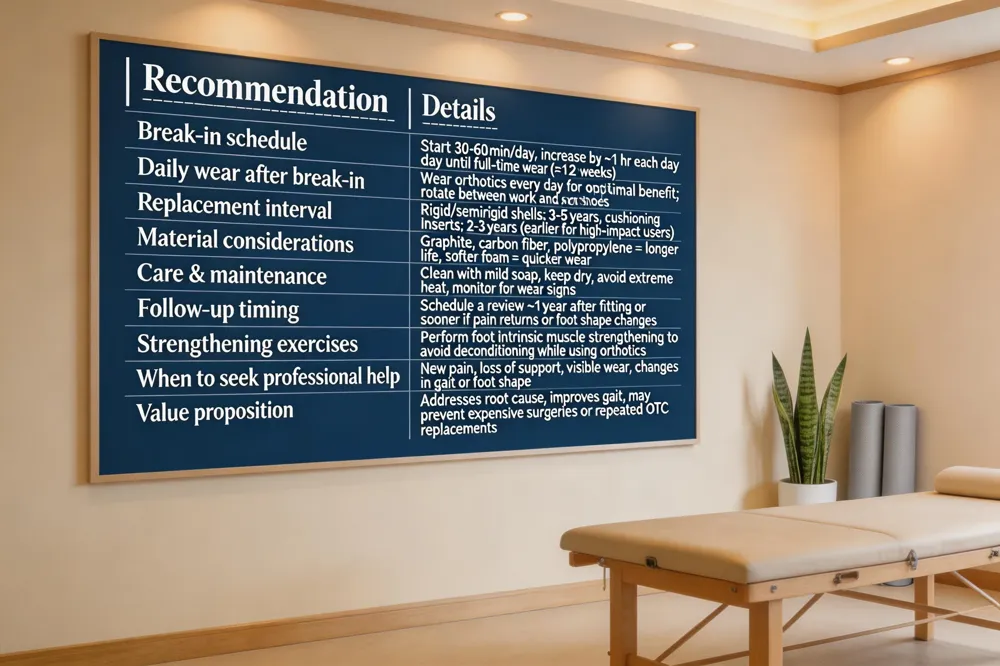 Custom orthotics should be introduced gradually—most clinicians recommend a break‑in schedule that starts with 30‑60 minutes of daily wear and increases by about an hour each day until full‑time use is comfortable (Cleveland Clinic). Once the break‑in period is complete, wear them daily for optimal benefit; rotating pairs for work and sport shoes can extend the device’s life.
Durability depends on material and activity level. Semi‑rigid or rigid shells (graphite, carbon fiber, polypropylene) typically last 3–5 years, while softer cushioning inserts may need replacement after 2–3 years, especially for high‑impact users (Foot Levelers, Advanced Foot Care).
The value proposition lies in the personalized biomechanical correction that over‑the‑counter inserts cannot provide—relieving chronic conditions such as plantar fasciitis, flat feet, and related knee or lower‑back pain while potentially preventing more invasive treatments (Diablo Foot & Ankle).
Patient education is essential: keep the orthotics clean, avoid extreme temperatures, monitor for wear, and schedule a follow‑up visit about a year after fitting or sooner if pain returns.
Is it worth getting custom made orthotics? Yes—when fitted by a qualified podiatrist, they address the root cause of pain, improve gait, and offer long‑term cost‑effectiveness compared with repeated OTC replacements.
How long should you wear custom orthotics? Aim for daily wear and plan to replace them every three to five years, or sooner if you notice loss of support, increased discomfort, or changes in foot shape.
Take the First Step Toward Pain‑Free Walking
Custom orthotics correct foot alignment, evenly distribute weight, and provide targeted cushioning, relieving plantar fasciitis, flat‑foot pain, bunions, and even knee or lower‑back discomfort. By improving gait mechanics they enhance posture, reduce fatigue, and help prevent future injuries. If persistent foot pain, gait changes, or difficulty standing affect your daily life, schedule a comprehensive foot and gait analysis with a podiatrist today. For appointments, call Diablo Foot & Ankle at +1 925‑464‑1982 or book online—Walnut Creek, Antioch, or San Ramon locations are ready to help you walk pain‑free.