Introduction
Foot and ankle injuries represent 20‑30% of all sport‑related trauma, with lateral ankle sprains alone accounting for roughly one‑fifth of athletic missed time. Each mile walked applies about 60 tons of force to the foot, illustrating the extreme loads placed on bones, ligaments, tendons, and fascia during rapid accelerations, jumps, and changes of direction. Prompt evaluation by a board‑certified podiatrist or foot‑and‑ankle orthopaedist ensures accurate imaging, appropriate RICE or advanced minimally invasive therapy, and a faster, safer return to play soon.
Common Acute Foot and Ankle Injuries in Sports
 Ankle sprain
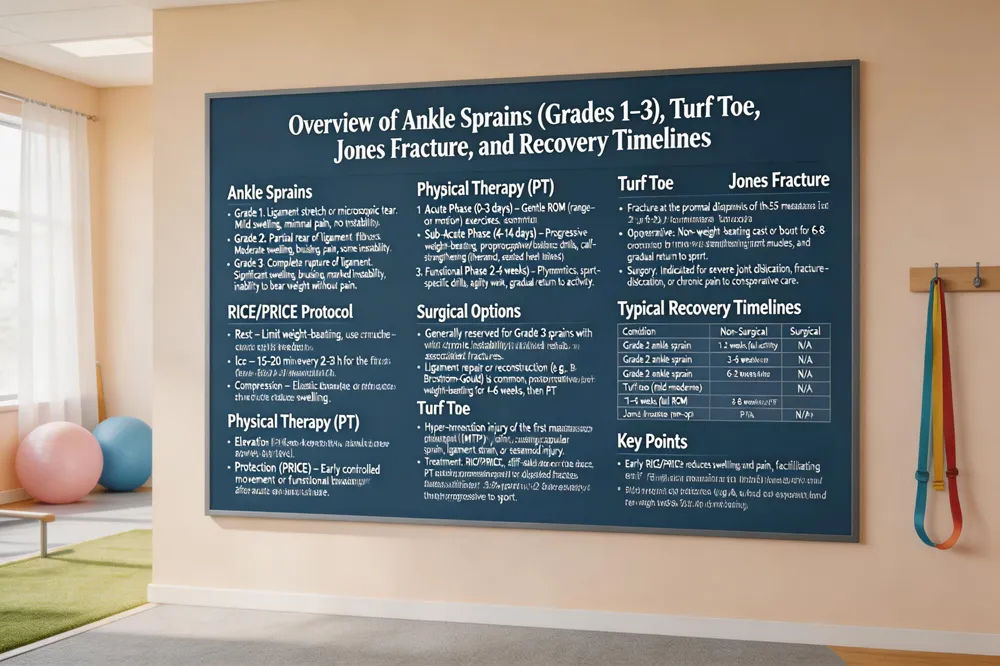
An ankle sprain is a soft‑tissue injury where lateral (or occasionally medial) ligaments are stretched or torn after an awkward twist, roll, or direct blow. Pain, swelling, bruising, reduced ROM, and a “pop” are typical. Immediate RICE care, NSAIDs, and early guided ROM prevent stiffness. Persistent symptoms warrant podiatrist evaluation; minimally invasive ligament repair restores stability when conservative care fails.
Grade 1 ankle sprain
Mild stretching/microscopic tear of ligaments; slight swelling, tenderness, and full weight‑bearing. RICE plus a supportive brace or taping leads to recovery in 5‑14 days. Early strengthening and balance work reduce chronic instability risk.
Grade 2 ankle sprain treatment
Partial ATFL tear and some CFL involvement; moderate pain, swelling, limited weight‑bearing. PRICE, semi‑rigid brace, and protected weight‑bearing are used. Structured PT begins within days, focusing on ROM, proprioception, and peroneal strengthening. Full sport return typically 2‑4 weeks; minimally invasive repair considered if instability persists.
Grade 3 ankle sprain treatment
Complete ligament tear; immobilization in a rigid boot or short‑term cast, crutches, NSAIDs, and possibly PRP or steroid injection. PT progresses over 8‑12 weeks to restore ROM, strength, and proprioception. Surgical reconstruction is reserved for persistent instability.
Turf toe
Hyper‑extension injury of the hallux MTP joint, common on artificial turf. Pain at the big toe base, swelling, and push‑off difficulty. Treatment starts with RICE, NSAIDs, and immobilization; severe cases may need PT or surgery.
Jones fracture
Break at the base of the fifth metatarsal with limited blood supply. Conservative care risks non‑union; percutaneous screw fixation offers >95 % union and return to sport in 10‑12 weeks.
Recovery timelines for athletes
Grade 1 sprains heal in 5‑14 days; Grade 2 in 2‑4 weeks; Grade 3 in 6‑12 weeks; high‑ankle (syndesmotic) sprains often require 6‑12 weeks. Early, supervised ROM and proprioceptive drills accelerate recovery, while a brace or taping for 12 months post‑return lowers re‑injury risk.
Chronic Overuse Injuries and Their Management
 Chronic overuse injuries such as Achilles tendinitis, plantar fasciitis, stress fractures, neuromas, and heel spurs are common among athletes and active adults. Effective management starts with proper diagnosis, activity modification, and targeted rehabilitation. Minimally invasive techniques—percutaneous Achilles repair, ultrasound‑guided injections, and percutaneous metatarsal fixation—allow faster return to sport while preserving tissue. Custom orthotics and strength‑training programs address biomechanical contributors and prevent recurrence.
Can a podiatrist repair an Achilles tendon?
Yes. Board‑certified podiatric surgeons perform both open and percutaneous Achilles repairs, using sutures, anchors or grafts, followed by structured rehab.
What are 5 symptoms foot doctors say you should never ignore?
Persistent pain, numbness/tingling, skin or nail changes, uneven shoe wear, and repeated ankle instability.
Lisfranc injury
Involves midfoot ligament or fracture disruption; early imaging and, when needed, minimally invasive fixation restore alignment and prevent arthritis.
Advanced Podiatric Specialists
A multidisciplinary clinic offering minimally invasive surgery, custom orthotics, and sports‑medicine care in Northwest Chicago and South Florida.
When to seek podiatric care: pain lasting > 3 days, swelling, bruising, inability to weight‑bear, or any sign of nerve or vascular compromise.
Diagnostic and Rehabilitation Protocols
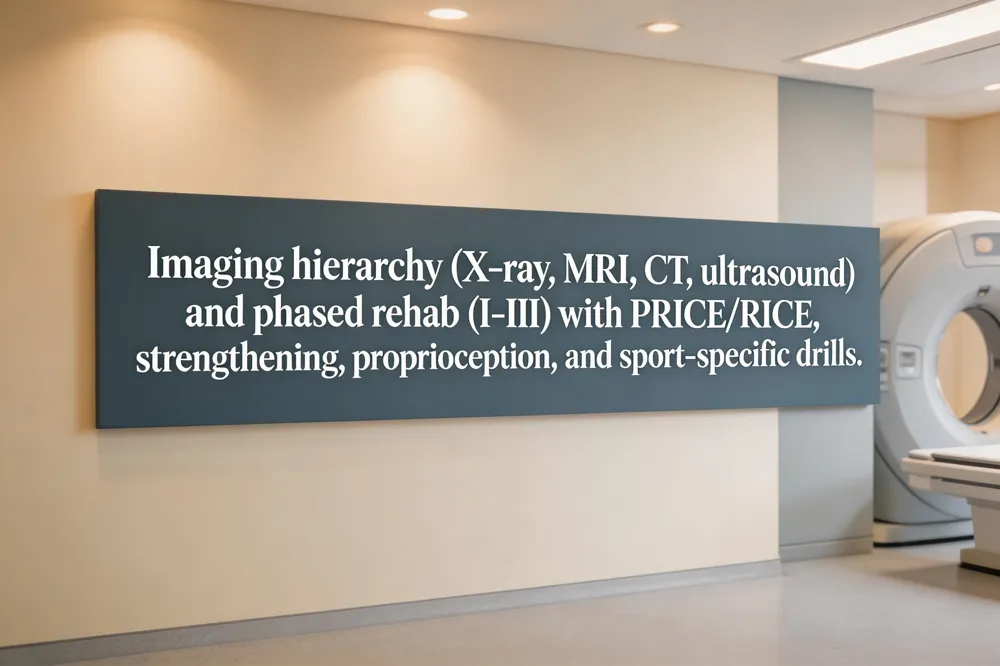 Imaging is the first step in evaluating foot‑and‑ankle injuries. Weight‑bearing X‑rays rule out fractures; MRI visualizes ligament and tendon tears; CT maps complex bony patterns; and high‑resolution ultrasound guides dynamic assessment of peroneal tendons and Achilles pathology. Acute management follows the PRICE protocol (Protection, Rest, Ice, Compression, Elevation), later expanded to RICE when anti‑inflammatory medication is added. Rehabilitation is divided into three evidence‑based phases. Phase I (0‑2 weeks) emphasizes protection, pain control, gentle ROM (ankle alphabet, ankle circles) and early weight‑bearing as tolerated. Phase II (3‑6 weeks) introduces progressive strengthening (towel scrunches, resisted eversion), proprioception on wobble boards, and gait training. Phase III (7‑10 weeks) focuses on advanced power, plyometrics, sport‑specific drills, and functional testing before return‑to‑play. Professional athletes adopt the same timeline but often use pneumatic braces, cryotherapy, low‑level laser, and PRP injections to accelerate healing while maintaining conditioning. Inversion (lateral) sprains are treated initially with PRICE protocol, followed by targeted peroneal strengthening, balance work, and, when needed, minimally invasive ligament augmentation. PDF protocols for Grade 1‑3 sprains are available from AOFAS and major academic centers, providing detailed exercise tables, progression criteria, and return‑to‑sport benchmarks.
Specialized Clinic Services, Locations, and Prevention
 Advanced Podiatry Locations in NY & NJ**
- Maspeth, NY: 70‑01 Grand Ave, Maspeth 11378 – board‑certified team, on‑site X‑ray, custom orthotics, shockwave & laser therapy. (Mon‑Fri 9:30‑5,00 pm, Sat 9‑1 pm; (718) 639‑0499)
- Huntington, NY: 181 Main St Suite 207, Huntington 11743 – diabetic foot care, minimally invasive surgery, digital imaging. (Mon‑Fri 9‑5 pm; (631) 427‑3678)
- Manhasset, NY: 2110 Northern Blvd Suite 208, Manhasset 11030 – digital X‑ray, laser, shockwave, orthotic scanning. (Mon‑Fri 9‑5 pm, Sat 9‑1 pm; (516) 869‑3300)
- Woodbury, NY: 20 Crossways Park Dr West Suite 304, Woodbury 11797 – comprehensive surgical & non‑surgical care, foot spa, medical shoe store. (Mon‑Fri 8:30‑5 pm; (516) 681‑8866)
- Union, NJ: 1308 Morris Ave Suite 104, Union 07083 – diabetic foot, sports‑medicine, minimally invasive procedures; video visits available. (Mon‑Thu 9‑7 pm; Fri 9‑5 pm; Sat 9‑2 pm; (908) 688‑5577)
Clinic Services All locations provide on‑site digital X‑ray, computerized impressions for custom orthotics, laser and shockwave therapy, and minimally invasive surgical options (percutaneous fixation, arthroscopy). Services cover ankle sprains, high‑ankle syndesmosis injuries, Achilles tendinitis/rupture, stress fractures, turf toe, plantar fasciitis, Jones fractures, and diabetic foot care.
Expertise of Foot & Ankle Surgeons Our board‑certified podiatric surgeons specialize in sports‑medicine, advanced imaging, and tailored rehabilitation. They combine minimally invasive techniques with comprehensive rehab to restore function quickly while minimizing postoperative pain.
Preventive Strategies for Athletes
- Proper conditioning, dynamic warm‑up, and regular stretching (including calf, Achilles, and intrinsic foot muscles).
- Use sport‑specific footwear with adequate support; replace when worn.
- Incorporate balance, proprioception, and strength drills (peroneals, ankle circles, resistance band work).
- Stay hydrated, avoid play when fatigued or in pain, and seek early podiatric evaluation for any discomfort.
Conclusion
Foot and ankle injuries most often seen in athletes—ankle sprains, high‑ankle syndesmosis sprains, Achilles tendinitis or rupture, stress fractures, turf toe, plantar fasciitis, and Jones fractures—can be managed conservatively with RICE, physical therapy, orthotics, or, when needed, minimally invasive surgery such as percutaneous fixation or arthroscopic repair. Early evaluation by a foot‑and‑ankle specialist ensures accurate diagnosis, prevents chronic instability, and speeds safe return to sport. Athletes should contact a qualified podiatrist or orthopedic surgeon promptly to begin a prevention and treatment plan.