Why Telehealth Matters for Modern Podiatry
Virtual care is the umbrella term that includes remote consultations, e‑prescriptions, patient education, and continuous monitoring, while telehealth refers specifically to real‑time video or phone visits for clinical diagnosis and treatment. The COVID‑19 pandemic accelerated telehealth adoption, with U.S. visits visits soaring from 5 million in 2019 to over 53 million in 2020, and many practices now offering hybrid models that blend in‑person care with virtual follow‑ups. Rural and underserved communities benefit most: travel distances shrink, wait times drop, and specialist podiatry expertise becomes reachable via HIPAA‑compliant platforms, wearable RPM devices, and store‑and‑forward imaging. Recent regulatory shifts—temporary pandemic waivers made permanent in many states and Medicare’s parity reimbursement for video visits—have cemented telehealth’s financial viability, encouraging broader insurer coverage and sustained growth.
Telemedicine Success Stories in Podiatry
Telemedicine Success Stories in Podiatry
| Metric | Impact | Source / Notes |
|---|---|---|
| Emergency visits for diabetic foot | ↓ 44%‑69% | Virtual follow‑ups with RPM |
| Hospital readmissions | ↓ 44%‑69% | RPM and remote wound monitoring |
| Travel burden for rural/older adults | Significantly reduced | Less transportation & missed‑work time |
| Patient satisfaction | Higher | Nurse‑led & large health system programs |
| Wait times | Reduced | Store‑and‑forward consultations |
 Across the United States, podiatric telemedicine has delivered measurable benefits for patients with chronic foot conditions. Remote patient monitoring (RPM) devices, such as wearable glucose and pressure sensors, enable clinicians to track ulcer healing and vital signs from a patient’s home, prompting timely adjustments to off‑loading devices and antibiotics. Store‑and‑forward consultations further expand access; patients upload photos of wounds or imaging, which specialists review within minutes, delivering diagnoses without a live video session. These models have markedly improved outcomes for diabetic foot care—studies report a 44%‑69% drop in emergency visits and hospital readmissions when virtual follow‑ups and RPM are employed. For rural and older adults, the travel burden shrinks dramatically, cutting transportation costs and missed‑work time while preserving clinical quality.
Is telemedicine successful? Yes. Evidence from podiatry clinics, nurse‑led programs, and large health systems shows higher patient satisfaction, reduced wait times, and lower readmission rates.
Should diabetics see a podiatrist? Absolutely. Regular podiatric evaluation detects early neuropathy, vascular compromise, and skin changes, enabling preventive care that prevents ulcers, infections, and eventual amputations.
Prescribing Medications Remotely: Allopurinol and Beyond
Prescribing Allopurinol Remotely
| Step | Action | Details |
|---|---|---|
| 1. Secure video visit | Review history, visual exam | HIPAA‑compliant platform |
| 2. Order labs | Serum uric acid, renal function | Via integrated EHR |
| 3. Confirm gout diagnosis | Clinical assessment, imaging, labs | Diagnosis before prescription |
| 4. Generate e‑prescription | Send to pharmacy electronically | Integrated EHR workflow |
| 5. Follow‑up virtual visits | Monitor renal function, adjust dose | Ongoing remote monitoring |
| 6. Collaborative care | Coordinate with PCP or rheumatologist | For comorbidities/complex regimens |
 Board‑certified podiatrists in the United States have a broad scope of practice that includes prescribing medications for foot‑related conditions such as gout. Yes—a podiatrist can prescribe allopurinol once a gout diagnosis is confirmed through clinical assessment, imaging, or laboratory tests. The telehealth workflow begins with a secure video visit, during which the podiatrist reviews the patient’s history, conducts a visual examination, and orders any needed labs (e.g., serum uric acid). After confirming the need for uric‑acid‑lowering therapy, the podiatrist generates an e‑prescription via an integrated EHR system, which is sent directly to the patient’s pharmacy. Follow‑up virtual appointments allow the clinician to monitor renal function, adjust dosing, and address side effects. When patients have comorbidities or complex medication regimens, the podiatrist collaborates with primary‑care physicians or rheumatologists to ensure coordinated care. This integrated, remote approach maintains clinical safety while offering patients the convenience of managing gout from home.
Managing Osteoarthritis and Ankle Problems via Virtual Visits
Managing Osteoarthritis & Ankle Problems via Virtual Visits
| Condition | Virtual Assessment | Treatment Options |
|---|---|---|
| Foot osteoarthritis | Video inspection of swelling, ROM, gait; review prior imaging | Custom orthotics, cushioned inserts, PT, videos, possible injections |
| Ankle pain | Visual inspection, functional tests, secure portal | t, PT protocols, referral for arthroscopy or surgery if needed |
| Chronic pain monitoring | Remote pain‑score tracking | E‑prescriptions, scheduled video check‑ins |
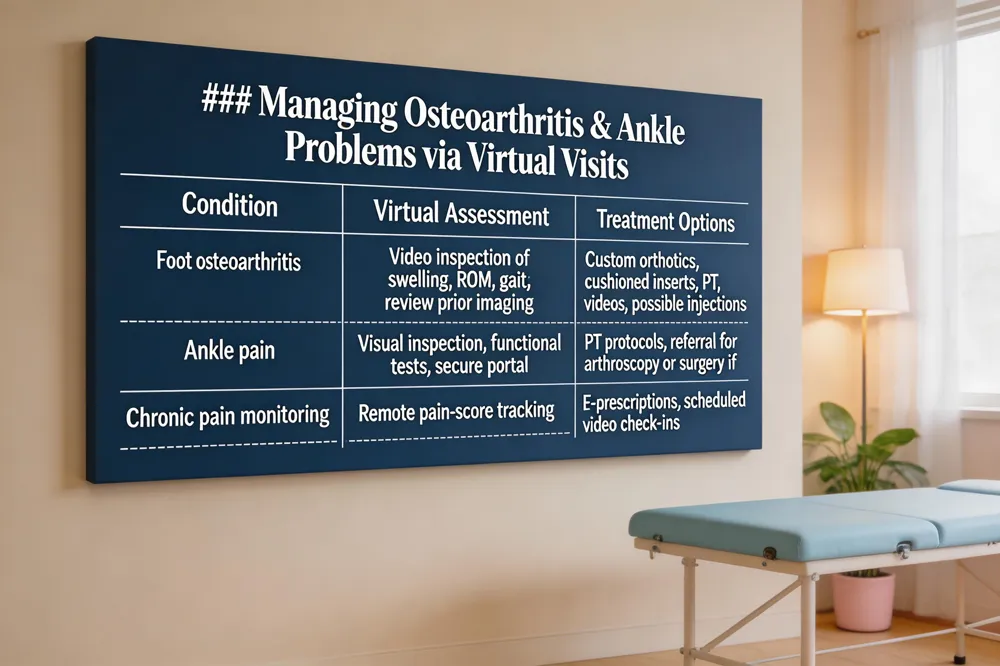 Virtual care platforms now let podiatrists assess and treat foot‑related osteoarthritis and ankle disorders without a clinic visit. Using HIPAA‑compliant video, patients can show swelling, range of motion, and gait while the clinician reviews prior imaging or orders new X‑rays or ultrasound through a secure portal. For osteoarthritis, the podiatrist prescribes custom orthotics, cushioned shoe inserts, and targeted strengthening or stretching programs; educational videos reinforce activity modification and weight‑management strategies. When pain persists, minimally invasive injections or referral for arthroscopic debridement can be arranged, with the virtual visit serving as a triage step. Ankle pain is evaluated similarly—visual inspection, functional tests, and review of any prior scans guide the decision to recommend braces, physical‑therapy protocols, or, in severe cases, surgical referral. Throughout, e‑prescriptions, remote monitoring of pain scores, and follow‑up video check‑ins keep treatment on track, reducing travel burden and improving outcomes for patients with chronic foot and ankle conditions.
Future of Telehealth: Policy Landscape Through 2028
Policy Landscape Through 2028
| Year | Policy Change | Impact on Podiatry |
|---|---|---|
| 2027 (Dec 31) | Medicare telehealth extensions allow anywhere‑based virtual care | Continue RPM and remote wound monitoring |
| 2028 (Jan 1) | Most telehealth visits require patient at rural medical facility | Need partnerships with rural centers; adjust workflows |
| Ongoing | State parity laws mandate equal reimbursement for telehealth | Financial viability varies by state & payer |
| Behavioral health | Remains flexible location requirements | No direct impact on podiatry but indicates broader flexibility |
 Current Medicare telehealth extensions allow beneficiaries to receive virtual care anywhere in the U.S. through December 31, 2027, covering podiatry services such as remote wound monitoring and prescription refills. Beginning January 1, 2028, most telehealth visits will require the patient to be located in a rural medical facility, although behavioral‑health services remain more flexible. This shift will affect podiatry practices that rely on home‑based remote patient monitoring (RPM) for diabetic foot care, urging clinics to partner with rural health centers or adjust workflows. State parity laws continue to mandate that commercial insurers reimburse telehealth at the same rate as in‑person visits in many jurisdictions, but coverage varies by state and payer.
Is telehealth ending in 2026? No—telehealth is not ending in 2026. Under current Medicare rules, beneficiaries can receive telehealth services anywhere in the United States and its territories through December 31, 2027. Starting 2028, most services will require a rural‑facility location, but the temporary expansions and broader practitioner eligibility keep telehealth alive well beyond 2026.
Practical Guide: Scheduling Telemedicine at Advanced Foot Care Clinics
Practical Guide: Scheduling Telemedicine
| Requirement | Details | Example |
|---|---|---|
| Device | Video‑capable (smartphone, tablet, computer) | iPhone 12, iPad, Windows laptop |
| Internet | ≥ 3 Mbps download & upload | 5 Mbps typical broadband |
| Platform | HIPAA‑compliant (Zoom, Doxy.me) | Zoom for Texas Foot & Ankle Center |
| Scheduling | Online request form or phone call | Call (214) 660‑0777 for Texas Foot & Ankle Center |
| Pre‑visit paperwork | Insurance verification, meds list, health history | Upload via portal or email PDF |
| Photo upload | Foot images if requested | JPEG/PNG up to 5 MB |
| Post‑visit | E‑prescription sent to pharmacy | Automatic electronic fill |
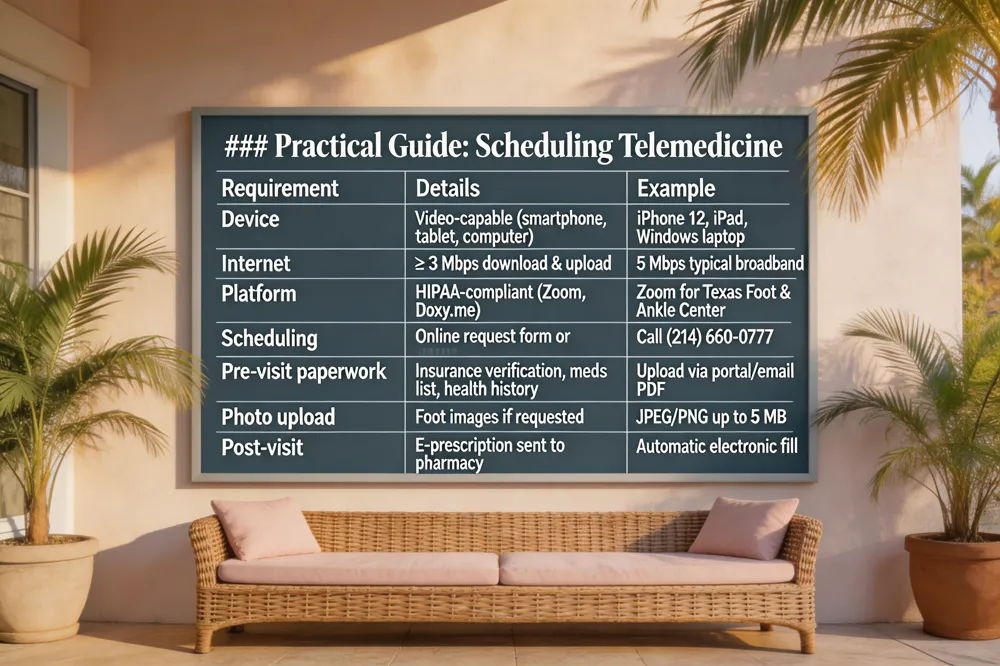 To book a virtual podiatry visit you’ll need a video‑capable device (smartphone, tablet, or computer) and a reliable broadband connection—ideally at least 3 Mbps download and upload—to support smooth, HIPAA‑compliant video. Most clinics use secure platforms such as Zoom (as with Texas Foot & Ankle Center) or Doxy.me (used by Ryan Foot & Ankle Clinic), which provide end‑to‑end encryption and password‑protected links. Scheduling can be done in two ways: fill out the clinic’s online request form, which automatically generates a secure link and appointment reminder, or call the practice directly (e.g., (214) 660‑0777 for Texas Foot & Ankle Center or (704) 544‑6517 for Ryan Foot & Ankle Clinic). Before the visit, patients should complete any pre‑visit paperwork—insurance verification, medication list, and health history—through the portal or emailed PDFs, and upload photos of the affected foot if requested. After the consult, e‑prescriptions are sent electronically to the patient’s pharmacy, eliminating the need for a separate in‑person pick‑up.
Telehealth is Here to Stay—A Vital Tool for Foot and Ankle Health
Virtual care and telehealth have proven to improve accessibility, reduce travel costs, and lower emergency‑department visits for patients with chronic foot and ankle conditions such as diabetic foot ulcers, gout, and plantar fasciitis. Recent Medicare and state policy updates now reimburse telemedicine appointments at parity with in‑person visits, sustaining financial viability for podiatrists nationwide. By delivering video consultations, e‑prescriptions, and secure image sharing, patients can actively manage self‑care, receive timely wound‑monitoring guidance, and stay engaged in treatment plans from home. Looking ahead, integration of wearable remote‑monitoring sensors, AI‑driven symptom triage, and interoperable EHR platforms will further personalize care, detect early complications, and expand the reach of specialty podiatry to rural and underserved communities.