Introduction
Shockwave therapy, also called extracorporeal shockwave treatment (ESWT), delivers focused acoustic pressure waves through the skin to stimulate natural healing. Because the energy is generated outside the body, the procedure is non‑invasive, requires no incisions, anesthesia, or hospital stay, and patients can usually resume normal activities immediately after each outpatient session. In podiatry it is most commonly used for chronic heel and ankle problems such as plantar fasciitis, Achilles tendinitis, heel spurs, ligament sprains, stress fractures, shin splints, and Morton’s neuroma. By increasing local blood flow, promoting neovascularization, breaking down scar tissue, and releasing growth factors, shockwave therapy addresses the underlying tissue degeneration rather than merely masking pain. A typical course consists of three to six sessions spaced three to seven days apart, with minimal side effects like bruising or mild swelling. This non‑surgical option is attractive for patients who have exhausted conservative care but wish to avoid surgery.
How Shockwave Therapy Works and What It Treats
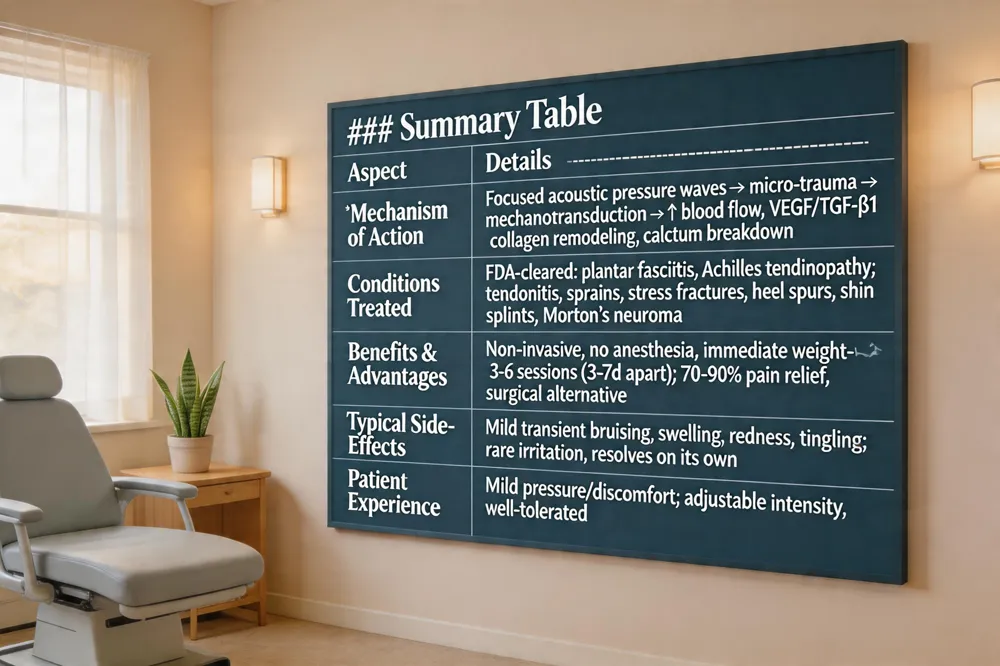
Summary Table
| Aspect | Details |
|---|---|
| Mechanism of Action | Focused acoustic pressure waves create micro‑trauma → mechanotransduction → ↑ blood flow, neovascularization, growth‑factor release (VEGF, TGF‑β1) → collagen remodeling, calcium deposit breakdown, temporary overstimulation of pain‑transmission nerves |
| Conditions Treated | FDA‑cleared for chronic plantar fasciitis & Achilles tendinopathy; also used for tendonitis, ligament sprains, stress fractures, heel spurs, shin splints, Morton’s neuroma, and other overuse injuries failing 3‑6 months of conservative care |
| Benefits & Advantages | Non‑invasive, no anesthesia, immediate weight‑bearing, minimal downtime; 3‑6 sessions spaced 3‑7 days; full benefit often 10‑15 weeks post‑treatment; 70‑90 % pain‑relief rates, surgical alternative |
| Typical Side‑Effects | Mild, transient bruising, swelling, redness, brief tingling; rare skin/nerve irritation, usually resolves without intervention |
| Patient Experience | Mild pressure or discomfort; intensity adjustable; usually well‑tolerated |
 Mechanism of action – Extracorporeal shockwave therapy (ESWT) delivers focused acoustic pressure waves through a gel‑coupled probe into foot or ankle tissue. The pulses create controlled micro‑trauma that triggers mechanotransduction, raising local blood flow, promoting neovascularization, and releasing growth factors (e.g., VEGF, TGF‑β1). These signals stimulate collagen remodeling, break down calcium deposits, and temporarily overstimulate pain‑transmission nerves, providing both regenerative and analgesic effects.
Conditions treated – The therapy is FDA‑cleared for chronic plantar fasciitis and Achilles tendinopathy and is widely used for tendonitis, ligament sprains, stress fractures, heel spurs, shin splints, Morton’s neuroma, and other overuse injuries that have failed at least three to six months of conservative care.
Benefits and advantages – Shockwave therapy is non‑invasive, requires no anesthesia or incisions, and allows immediate weight‑bearing with minimal downtime. Typical protocols involve 3–6 outpatient sessions spaced 3–7 days apart; full therapeutic benefit often emerges 10–15 weeks after the final treatment. Studies report 70‑90 % pain‑relief rates, making it a viable alternative to surgery for many patients.
Typical side‑effects – Most patients experience only mild, transient reactions such as slight bruising, swelling, redness, or a brief tingling sensation. Rare complications (e.g., skin irritation or nerve irritation) are uncommon and usually resolve without intervention.
What is shockwave therapy for plantar fasciitis? – Shockwave therapy is a targeted, non‑surgical delivery of high‑energy sound waves to the inflamed plantar fascia, stimulating blood flow and tissue repair while reducing pain perception.
Shockwave therapy for foot pain – Shockwave therapy uses the same acoustic principle for a range of chronic foot and ankle disorders, delivering rapid pain relief and accelerating healing without surgery.
Does shockwave therapy work for foot pain? – Shockwave therapy is supported by clinical trials and systematic reviews that confirm significant pain reduction and functional improvement for conditions such as plantar fasciitis, Achilles tendinopathy, and heel spurs.
Does shockwave therapy for plantar fasciitis hurt? – Most patients report only mild pressure or discomfort; intensity can be adjusted for comfort.
Side effects for plantar fasciitis – Typically mild and temporary: bruising, swelling, redness, or brief soreness; serious adverse events are rare.
Treatment Protocols, Timeline, and Expected Outcomes
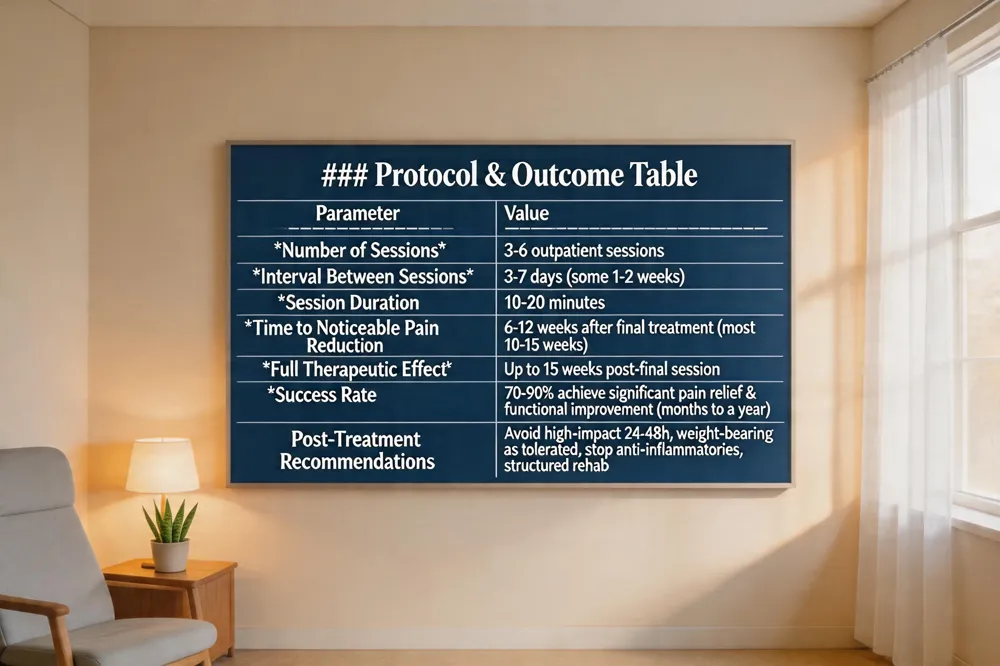
Protocol & Outcome Table
| Parameter | Value |
|---|---|
| Number of Sessions | 3‑6 outpatient sessions |
| Interval Between Sessions | 3‑7 days (some protocols 1‑2 weeks) |
| Session Duration | 10‑20 minutes |
| Time to Noticeable Pain Reduction | 6‑12 weeks after final treatment (most patients 10‑15 weeks) |
| Full Therapeutic Effect | Up to 15 weeks post‑final session |
| Success Rate | 70‑90 % achieve significant pain relief & functional improvement lasting months‑to‑a‑year |
| Post‑Treatment Recommendations | Avoid high‑impact activity 24‑48 h, weight‑bearing as tolerated, stop anti‑inflammatory meds during course, structured rehab (stretching, orthotics, gradual return) |
 Shockwave therapy for foot and ankle problems is typically delivered in a series of 3–6 outpatient sessions spaced 3–7 days apart (some protocols use 1‑2‑week intervals). Each session lasts 10‑20 minutes, during which a gel‑coupled probe delivers low‑ or high‑energy acoustic pulses to the target tissue. Most patients begin to notice pain reduction 6‑12 weeks after the final treatment, with some experiencing relief earlier and others requiring up to 15 weeks for full effect.
Post‑treatment recommendations include avoiding high‑impact activity for 24‑48 hours, bearing weight as tolerated, discontinuing anti‑inflammatory medications during the course, and following a structured rehabilitation program (stretching, orthotics, and gradual return to sport). Long‑term effectiveness is high; studies report 70‑90 % of patients achieving significant pain relief and functional improvement lasting months to a year, often avoiding surgery.
Common questions:
- How long does shockwave therapy take to work on feet? – Noticeable improvement usually appears within three months of completing the series, with the greatest benefit emerging 10‑15 weeks after the last session.
- Is shockwave therapy good for your feet? – Yes. It is a non‑invasive, evidence‑based option that promotes neovascularization, collagen remodeling, and pain‑modulation for chronic conditions such as plantar fasciitis, Achilles tendinopathy, and stress fractures.
- Side effects for plantar fasciitis? – Mild, transient bruising, swelling, redness, or discomfort that resolve within days; serious complications are rare.
- Does it hurt? – Most patients feel only a mild tapping sensation; the intensity can be adjusted for comfort, and significant pain should be reported for device modification.
Finding Shockwave Therapy Near You and Choosing a Provider
Provider & Cost Overview
| Provider | Locations | Typical Cost per Session | Typical Course Cost | Insurance Coverage | Contact |
|---|---|---|---|---|---|
| Advanced Foot Care | North‑west Chicago & South Florida | $100‑$300 | $300‑$1,500 (3‑5 sessions) | Limited; usually only for chronic plantar fasciitis/Achilles tendinopathy after 6 months of conservative care | www.advancedfootcare.com |
| Orthopedic / Sports‑Medicine Practices (U.S.) | Nationwide | $150‑$350 | $450‑$2,100 (3‑6 sessions) | Varies; many require pre‑approval | Varies by practice |
| Rothman Orthopaedics – Foot & Ankle (Willow Grove, PA) | Willow Grove, PA | $120‑$280 | $360‑$1,400 | Usually not covered for elective ESWT | (215) 657‑1115 / WGPT@rothmanortho.com |
| Center for Foot & Ankle Disorders (Philadelphia) | Philadelphia, PA | $130‑$310 | $390‑$1,550 | Limited; consult insurer | Dr. Michael Troiano, DPM, FACFAS |
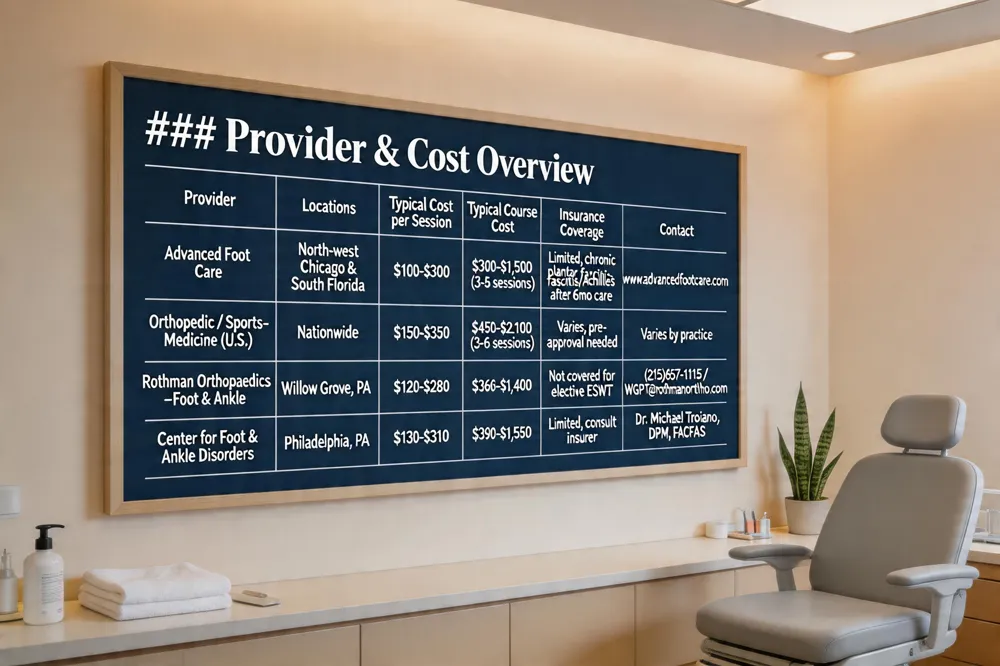 Clinic locations: Advanced Foot Care operates outpatient Advanced in north‑west Chicago and South Florida, offering ESWT/EPAT in a board‑certified podiatry setting. Many orthopedic and sports‑medicine practices across the U.S. also provide shockwave therapy, but Advanced Foot Care combines treatment with custom orthotics and rehabilitation.
What to expect during a visit: After a brief evaluation of your history and imaging, a gel is applied to the foot and a handheld probe delivers focused acoustic pulses for 5‑15 minutes. The procedure is non‑invasive, requires no anesthesia, and patients can bear weight and resume normal activities immediately.
Insurance considerations: Coverage is limited; most insurers reimburse only for medically necessary chronic plantar fasciitis or Achilles tendinopathy after six months of conservative care. Verify benefits before treatment and be prepared for out‑of‑pocket costs.
Cost of treatment: Sessions range from $100 to $300 each, with a typical course of 3‑5 sessions, totaling $300‑$1,500. Prices vary by provider, geographic market, and any additional diagnostics.
Shockwave Therapy for foot pain near me: Advanced Foot Care’s Chicago and Florida clinics provide quick, non‑surgical relief for plantar fasciitis, neuromas, and other soft‑tissue injuries.
Where can I get shockwave therapy for plantar fasciitis: At Advanced Foot & Ankle Care, where 2‑3 weekly ESWT sessions are standard, plus personalized rehab.
How much does shockwave therapy cost?: $100‑$300 per session, overall $300‑$1,500 for a full course, with limited insurance reimbursement.
Specialized Foot and Ankle Care Beyond Shockwave
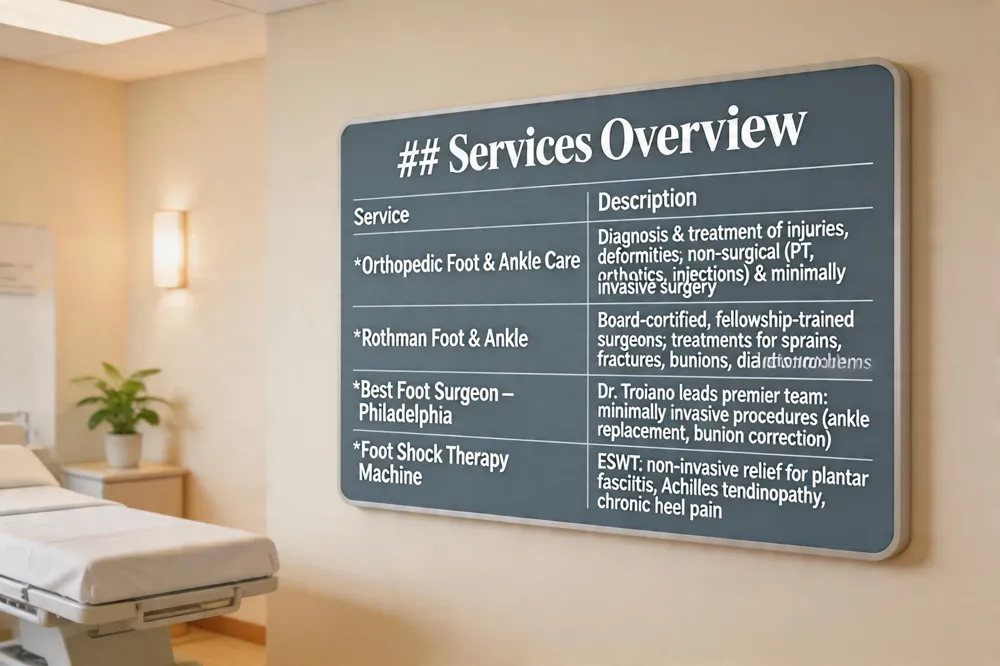
Services Overview
| Service | Description |
|---|---|
| Orthopedic Foot & Ankle Care | Diagnosis & treatment of injuries, deformities, degenerative conditions; non‑surgical options (PT, orthotics, injections) and minimally invasive surgery (arthroscopy, ankle replacement, deformity correction) |
| Rothman Foot & Ankle | Board‑certified, fellowship‑trained surgeons; surgical & non‑surgical treatments for sprains, fractures, tendon injuries, bunions, hammertoes, diabetic foot problems; advanced arthroscopic techniques |
| Best Foot Surgeon – Philadelphia | Dr. Troiano leads a premier team offering minimally invasive procedures (total ankle replacement, bunion correction, complex tendon repairs) |
| Foot Shock Therapy Machine | ESWT device delivering focused acoustic pulses to increase blood flow, reduce inflammation, stimulate regeneration; non‑invasive, drug‑free relief for plantar fasciitis, Achilles tendinopathy, chronic heel pain |
 Orthopedic foot and ankle
 care diagnoses and treats injuries, deformities, and degenerative conditions of the foot‑ankle complex. Options range from non‑surgical therapies—physical therapy, custom orthotics, injections, activity modification—to minimally invasive surgery such as arthroscopic repairs, ankle replacement, and precise deformity corrections. The goal is to restore function, reduce pain, and enable a rapid return to activity.
Orthopedic foot and ankle
Orthopedic foot and ankle care diagnoses and treats injuries, deformities, and degenerative conditions of the foot‑ankle complex. Options range from non‑surgical therapies—physical therapy, custom orthotics, injections, activity modification—to minimally invasive surgery such as arthroscopic repairs, ankle replacement, and precise deformity corrections. The goal is to restore function, reduce pain, and enable a rapid return to activity.
Rothman foot and Ankle Rothman Orthopaedics’ Foot & Ankle department is staffed by board‑certified, fellowship‑trained surgeons who provide both surgical and non‑surgical treatments for sprains, fractures, tendon injuries, bunions, hammertoes, and diabetic foot problems. Their minimally invasive arthroscopic techniques and advanced ankle replacements accelerate recovery while preserving joint health.
Rothman foot and Ankle Willow Grove PA Located at 2400 Maryland Rd, Suite 20, the Willow Grove center offers comprehensive foot‑ankle care, including on‑site MRI, extended‑hour physical therapy, and personalized treatment plans. Appointments can be made by calling (215) 657‑1115 or emailing WGPT@rothmanortho.com.
Best foot surgeon Philadelphia Dr. Troiano, DPM, FACFAS, leads Philadelphia’s premier foot‑ankle team at the Center for Foot & Ankle Disorders. Board‑certified and fellowship‑trained, he performs advanced minimally invasive procedures such as total ankle replacement, bunion correction, and complex tendon repairs.
Foot Shock Therapy Machine An extracorporeal shockwave therapy (ESWT) device delivers focused acoustic pulses that increase blood flow, reduce inflammation, and stimulate cellular regeneration. Non‑invasive and drug‑free, it is especially effective for plantar fasciitis, Achilles tendinopathy, and chronic heel pain, offering rapid pain relief with minimal side effects.
Emerging Applications and Future Directions
Emerging Uses & Research
| Application | Target Condition | Typical Protocol | Reported Success |
|---|---|---|---|
| Neuropathic Foot Pain | Diabetic or traumatic foot neuropathy (numbness, tingling, burning) | 3‑5 sessions spaced 3‑10 days; 10‑15 minutes per session | Early case series show pain reduction after first treatment; 70‑90 % improvement reported in chronic plantar fasciitis/Achilles tendinopathy; larger RCTs pending |
| Chronic Heel Pain (Heel Spurs) | Recalcitrant heel spurs | 4‑6 sessions, 5‑7 days apart | 70‑85 % pain‑relief in clinical studies |
| Stress Fractures | Non‑union or delayed‑union stress fractures | 5‑7 sessions, weekly | Accelerated healing reported; up to 80 % return to activity within 12 weeks |
| Morton’s Neuroma | Persistent forefoot neuropathic pain | 3‑4 sessions, 5‑7 days apart | Moderate pain reduction; 60‑70 % patient satisfaction |
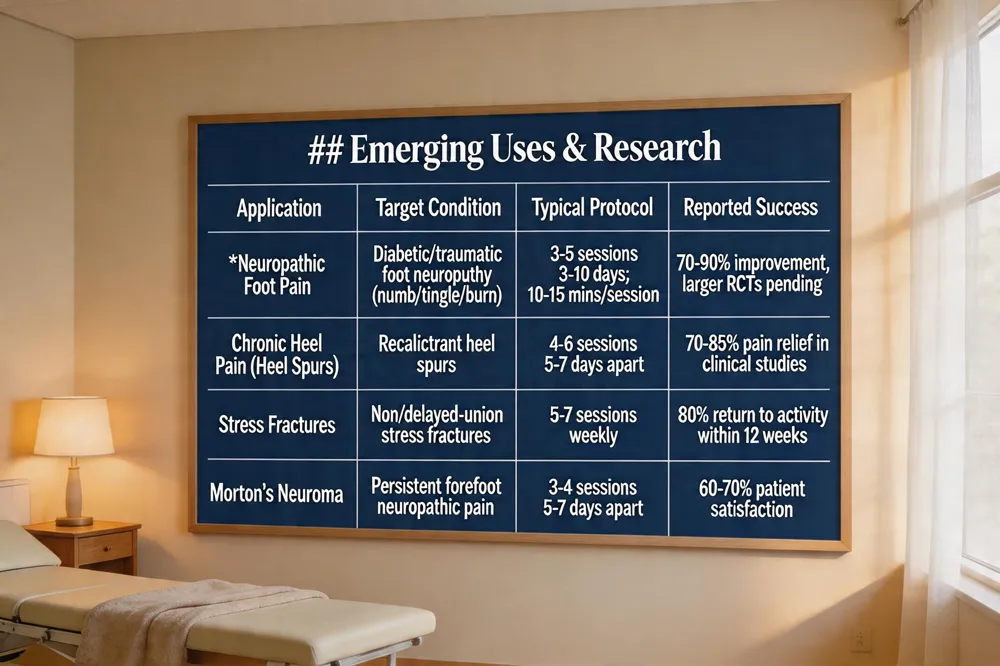 Shockwave therapy, originally developed for kidney stones and now a mainstay for plantar fasciitis, Achilles tendinopathy, and stress fractures, is expanding into neuropathic foot pain. Focused acoustic pulses increase micro‑vascular flow, stimulate collagen and growth‑factor release, and can modulate nerve signaling, offering relief from numbness, tingling, and burning sensations often seen in diabetic or traumatic foot neuropathy. Typical protocols involve 3‑5 outpatient sessions spaced 3‑10 days apart; most patients report reduced pain after the first treatment and continued improvement over the course of therapy, with only mild transient soreness and no downtime.
Advanced research reports success rates of 70‑90 % for chronic plantar fasciitis and Achilles tendinopathy, and emerging case series suggest comparable relief for neuropathic symptoms, though larger randomized trials are pending. Ideal candidates are adults with chronic (>6 months) pain unresponsive to rest, orthotics, NSAIDs, and without active infection, coagulopathy, pregnancy, or implanted electronic devices.
For personalized care, patients should seek board‑certified foot and ankle specialists who offer both non‑surgical and minimally invasive options. Notable providers include Dr. Michael Troiano, DPM, FACFAS, at the Center for Foot & Ankle Disorders in Philadelphia, and leading orthopedic teams at Mountainstate Orthopedic Associates in West Virginia. These clinicians combine shockwave therapy with comprehensive rehabilitation to maximize functional recovery.
Conclusion
Shockwave therapy offers a non‑invasive, anesthesia‑free option for chronic foot and ankle pain, delivering acoustic pressure waves that increase blood flow, break down scar tissue, stimulate collagen production and promote neovascularization. Outcomes include significant pain reduction for plantar fasciitis, Achilles tendinopathy, heel spurs and stress fractures, with most patients resuming normal activities immediately and experiencing lasting relief 10–15 weeks after the final session. To begin, schedule a comprehensive evaluation with a board‑certified podiatrist who will review your medical history, imaging and prior treatments, then design a personalized protocol—typically 3–6 outpatient sessions spaced 3–7 days apart, with possible maintenance visits. Because candidacy depends on factors such as chronicity, tissue depth and any contraindications (e.g., pregnancy, anticoagulation, pacemakers), consulting a specialist ensures the therapy is safe and optimally tailored to your needs.