Introduction
Minimally invasive podiatry (MIS) employs tiny incisions—often less than 1 cm—and specialized instruments such as burrs, endoscopes, and real‑time fluoroscopy to correct common foot and ankle problems. Compared with traditional open surgery, MIS reduces tissue trauma, lowers infection rates, cuts postoperative pain, and shortens recovery so patients can return to normal footwear in 2–4 weeks versus 6–8 weeks. Clinics in North‑west Chicago and South Florida—such as Advanced Foot & Ankle Specialists of Arizona, Advanced Foot Care, and Hall Podiatry—provide these cutting‑edge, outpatient procedures, leveraging AI‑driven imaging, robotic assistance, and evidence‑based protocols to deliver faster, safer patient care.
Technology Driving Modern Podiatry
 Robotic assistance, exemplified by the FDA‑cleared da Vinci Surgical System, is transforming foot and ankle surgery by delivering up to a 30 % reduction in operative time and heightened placement accuracy for procedures such as bunion correction and tendon repairs. Complementing robotics, AI‑driven imaging and surgical planning tools—now deployed at clinics like North Texas Podiatry Associates—enhance pre‑operative visualization, allowing surgeons to map deformities with millimeter precision and to simulate instrument trajectories before incision. These technologies work hand‑in‑hand with FDA‑approved minimally invasive devices, including the Mini‑MTP Fusion System for metatarsophalangeal joint stabilization and percutaneous Achilles tendon repair kits, which enable percutaneous bone cuts and ligament fixation through incisions smaller than 1 cm. Together, robotic platforms, AI‑guided imaging, and cleared minimally invasive instruments reduce tissue trauma, lower infection rates, and accelerate return to normal footwear—often within 2–4 weeks—while maintaining the cosmetic and functional outcomes expected of modern podiatric care.
Common Foot Conditions & Minimally Invasive Solutions
 The foot and ankle complex most frequently presents two problems: plantar fasciitis and ankle sprains. Plantar fasciitis is an inflammation of the thick plantar fascia that causes sharp heel pain after periods of rest, while ankle sprains involve stretched or torn stabilizing ligaments after a twist or inversion injury. Both are now routinely managed with minimally invasive options such as ultrasound‑guided injections, custom orthotics, and targeted physical‑therapy protocols, allowing early return to activity and reducing chronic pain risk.
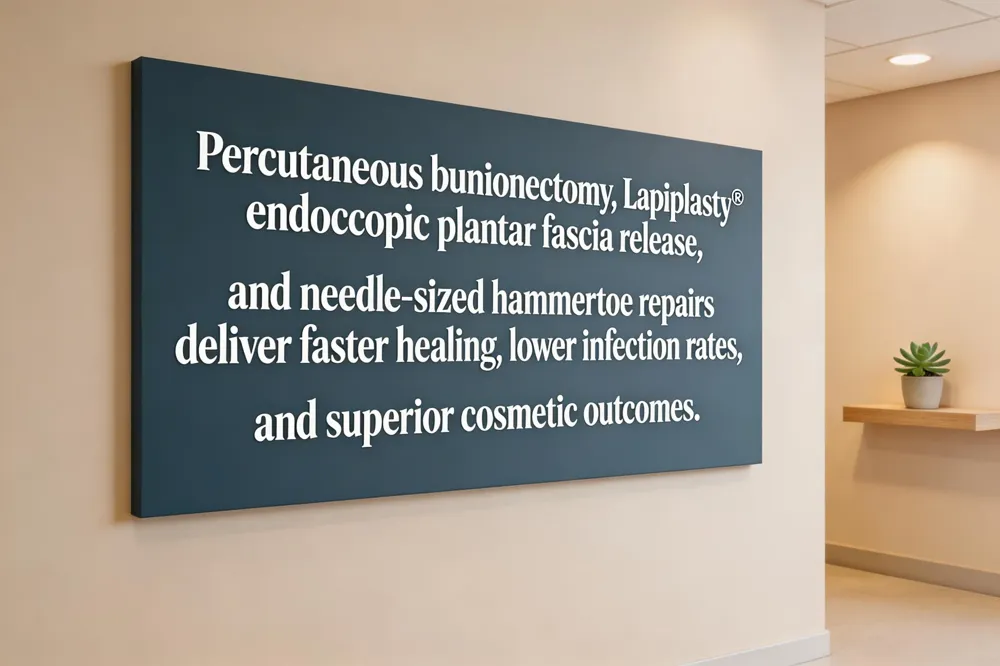
Bunion correction – percutaneous bunionectomy & Lapiplasty® Percutaneous bunionectomy uses 2‑3 mm incisions to realign the first metatarsal while preserving soft tissue, cutting operative time by up to 30 % and lowering infection rates (American College of Foot and Ankle Surgeons, 2023). Lapiplasty®, a 3‑D bunion‑, also employs tiny incisions and computer‑guided guides, achieving comparable correction angles to open surgery with less swelling and scarring.
Hammertoe & metatarsalgia relief Minimally invasive hammertoe correction releases or repositions tendons through needle‑sized portals, preserving the joint capsule and shortening rehab to 2‑4 weeks. For metatarsalgia, percutaneous metatarsal osteotomies and endoscopic decompression reduce bone‑spurs and pressure points while minimizing tissue trauma.
Plantar fasciitis – endoscopic plantar fascia release Endoscopic plantar fascia release (EPF) uses a 1‑cm heel incision and a tiny camera to cut the tight fascia band, allowing immediate weight‑bearing and return to normal shoes within 1‑2 weeks—far faster than the 4‑6‑week recovery after open release. This technique also reduces postoperative pain scores by 2‑3 points on a 10‑point visual analog scale.
Collectively, these minimally invasive procedures—supported by FDA‑cleared devices, robotic assistance, and AI‑driven imaging—provide faster healing, lower infection risk, and superior cosmetic outcomes across the most common foot and ankle conditions.
Managing Pain and Neuropathy
 Minimally invasive podiatry leverages both pharmacologic and non‑pharmacologic therapies to control foot‑related pain and neuropathy.
Gabapentin prescribing for foot‑related neuropathic pain
Yes, a podiatrist (Doctor of Podiatric Medicine) can prescribe gabapentin when indicated for neuropathic symptoms such as burning, tingling, or numbness in the feet and ankles. The medication is commonly used for diabetic peripheral neuropathy and other nerve‑pain conditions. Podiatrists have prescribing authority in all 50 states, though the exact scope may vary by state and often requires DEA registration. They evaluate the patient’s condition, review other medications, and monitor for side effects as part of a comprehensive treatment plan.
Topical NSAIDs (Voltaren) for ankle sprains
Voltaren (diclofenac) gel is an effective over‑the‑counter topical NSAID that can reduce pain and inflammation in mild to moderate ankle sprains when applied to the affected area. It works best alongside the classic RICE protocol (rest, ice, compression, elevation) and early physical‑therapy exercises. While it does not replace a proper clinical evaluation—especially for severe swelling, inability to bear weight, or high‑energy trauma—it can speed symptom relief in uncomplicated sprains. Persistent pain or chronic instability warrants evaluation by a specialized podiatrist.
Cryotherapy for inflammation and pain control
Cryotherapy is offered by podiatrists to decrease inflammation, numb pain, and promote cellular repair in foot and ankle conditions. The treatment involves applying controlled cold temperature to the affected tissue, which can be performed in‑office or with at‑home devices under professional guidance.
These evidence‑based options—gabapentin, topical NSAIDs, and cryotherapy—allow podiatrists to tailor pain‑management strategies while minimizing reliance on systemic opioids and supporting faster functional recovery.
Diabetic Foot Care and Tendon Repair
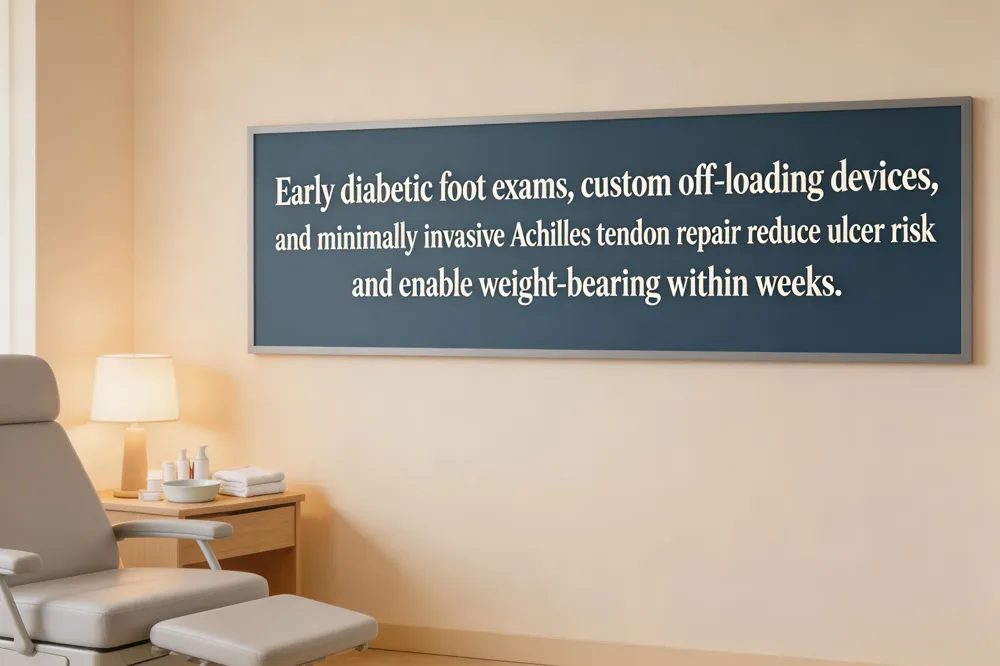 A podiatrist is the first line of defense for patients with diabetes. Comprehensive diabetic foot examinations include detailed assessment of sensation, circulation, foot architecture, and nail health, allowing early detection of neuropathy, peripheral arterial disease, and structural deformities. When ulcers develop, the podiatrist employs off‑loading devices—custom orthotics, total contact casts, or removable walkers—to redistribute pressure and promote healing, and performs meticulous wound debridement to remove devitalized tissue and reduce infection risk.
Modern podiatric surgery also offers minimally invasive Achilles tendon repair. Using percutaneous or endoscopic techniques, the surgeon makes incisions smaller than 1 cm, inserts specialized burrs or cameras, and repairs the tendon under fluoroscopic guidance. This approach lowers infection rates, shortens operative time by up to 30 %, and enables patients to bear weight early, often return to normal footwear within 2–4 weeks.
Can a podiatrist help with diabetic foot care? Yes. A podiatrist provides routine exams, education on daily foot hygiene, off‑loading devices, debridement, and coordinates care to prevent ulcers, infection, and amputation.
Can a podiatrist repair an Achilles tendon? Yes. Board‑certified podiatrists trained in surgical residency can perform minimally invasive Achilles tendon repair, offering faster recovery and reduced tissue trauma compared with open surgery.
Choosing the Right Podiatrist and Outpatient Care
 When selecting a podiatrist, patients in Chicago and the broader Midwest often ask, "Best podiatrist in Chicago?" The top‑rated specialists are board‑certified foot and ankle surgeons who lead Advanced Foot Care Clinics in north‑west Chicago and South Florida. These clinicians combine extensive fellowship training with cutting‑edge, minimally invasive techniques—such as percutaneous bunionectomy, endoscopic plantar fascia release, and robotic‑assisted ankle arthroscopy—to achieve faster healing, smaller scars, and reduced infection rates (American College of Foot and Ankle Surgeons, 2023).
For those searching "Podiatrist Chicago near me," the Advanced Foot Care locations in NW Chicago and South Florida offer convenient access to state‑of‑the‑art imaging, AI‑driven pre‑operative planning, and same‑day outpatient surgery suites. Patients benefit from a coordinated care model that includes custom orthotics, telehealth follow‑ups, and comprehensive diabetic foot programs, all under one roof.
Finally, "Is foot surgery outpatient?" Yes—most minimally invasive foot and ankle procedures are performed on an outpatient basis, allowing patients to return home the same day. Small incisions (often <1 cm) and regional anesthesia minimize operative time and hospital stay, cutting costs by $1,200–$1,800 and reducing postoperative complications (Healthcare Cost and Utilization Project, 2022. Complex cases requiring extensive reconstruction may need brief observation, but the majority of interventions—bunions, hammertoes, plantar fasciitis, and ankle arthroscopy—are safely completed in a ambulatory setting, delivering quicker recovery and lower overall expense.
Conclusion
The future of minimally invasive podiatry is being shaped by AI‑driven imaging, robotic assistance, and 3‑D‑printed guides that promise even smaller incisions, higher precision, and reduced operative times. As these technologies become routine, clinics across NW Chicago and South Florida are integrating telehealth platforms and wearable smart‑insoles to monitor healing in real time. Empowering patients through clear education—pre‑operative gait analysis, digital portals, and transparent consent for AI‑assisted procedures—ensures they actively participate in decision‑making and postoperative care. This synergy of cutting‑edge science and informed, patient‑centered communication will continue to accelerate recovery, lower complications, and broaden access to advanced foot and ankle treatment.