into mornings of giving your feet the attention they deserve. A short, consistent routine that blends mobility, calf, and balance work can reduce stiffness, improve circulation, and lay the foundation for stronger arches and healthier ankles. Advanced foot‑care clinics in northwest Chicago and South Florida see patients benefit from daily foot‑strengthening drills that complement minimally invasive treatments. Below is a comprehensive narrative that answers the most common questions about foot health, provides a seven‑move morning stretch sequence, and outlines tools, PDFs, and videos to keep you on track.
Why foot strength matters: Strong intrinsic muscles support the arch, improve balance, and reduce the risk of plantar fasciitis, ankle sprains, and knee‑hip‑back pain. 7‑move morning routine: 1) Child’s Pose (hip & spine opening), 2) Cat‑Cow (spine mobility), 3) Downward‑Facing Dog (hamstring & calf stretch), 4) Warrior I (shoulder‑leg power), 5) Mountain Pose (alignment), 6) Standing Forward Bend (hamstring & lower‑back), 7) Toe‑Alphabet (ankle dorsiflexion). Home‑based drills: toe raises, curls, splay with a band, marble pick‑ups, Achilles wall stretch, and sand walking for intrinsic strength. Condition‑specific programs: plantar fasciitis – calf‑Achilles stretch + tennis‑ball roll; hammertoes – toe splay and towel scrunch; balance deficits – single‑leg stance and ankle circles. Equipment & resources: resistance bands, rubber‑band toe splay, tennis/golf ball rollers, PDF guides, and instructional videos offered by north‑west Chicago and South Florida podiatry clinics.
Why Foot Strength Matters & Recognizing Weakness
 Weak feet often reveal themselves through difficulty standing on tip‑toes or heels, a tendency for the foot to flop outward, frequent tripping, a slapping sound when the sole contacts the floor, and early fatigue or aching after short walks. Numbness, tingling, or reduced ankle reflexes can also signal underlying weakness. The most common culprits are lack of regular challenge, age‑related muscle degeneration, nerve damage such as peripheral neuropathy, ankle or lumbar injuries, restrictive footwear, excess body weight, and systemic conditions like diabetes. Fortunately, a weak foot can be strengthened. Begin with low‑impact activities—walking on the ball of the weaker foot—then progress to single‑leg heel raises, toe curls, resisted dorsiflexion, and short‑foot (doming) drills. Consistency and gradual overload are essential, and a podiatrist can tailor a program to your anatomy. For seniors, the heel‑to‑toe walk is the number‑one exercise; it challenges balance, promotes ankle stability, and can be paired with a sit‑to‑stand movement for lower‑body strength. Fundamental movement patterns that support foot health include ankle circles, toe splay with a rubber band, and the alphabet exercise, all of which improve proprioception and intrinsic muscle activation while complementing innovative minimally invasive podiatry treatments.
Morning Stretch Sequence: 7 Simple Moves for Unbreakable Feet
 A short, 5‑10‑minute morning routine can boost circulation, lubricate joints, and prime the feet for the day ahead. 1️⃣ Neck rolls & shoulder shrugs – release upper‑body tension while still in bed. 2️⃣ Cat‑Cow – mobilizes the spine and gently massages abdominal organs, waking the core. 3️⃣ Standing calf‑Achilles stretch – place hands on a wall, step one foot back, keep the heel flat and lean forward; hold 30 seconds, repeat each side. 4️⃣ Top‑of‑foot stretch – sit, slide one foot back so the knee points down, press the toe nails into the floor, hold 30 seconds; add a toe‑spread hold to activate dorsiflexors. 5️⃣ Ankle circles – 10 rotations clockwise and counter‑clockwise to improve ankle mobility. 6️⃣ Toe‑pull (plantar‑fascia stretch) – loop a towel around the ball of the foot, pull toward the shin, hold 30 seconds; works the intrinsic foot muscles and Achilles tendon. 7️⃣ Balance pose – stand tall (Mountain Pose), spread toes, shift weight onto one foot for 30 seconds, then switch; engages foot stabilizers and improves proprioception. This full‑body sequence, complemented by a printable PDF and a short YouTube video, delivers a comprehensive foot‑focused warm‑up that builds “unbreakable” foot strength and supports overall posture.
Foot‑Strengthening Drills You Can Do at Home
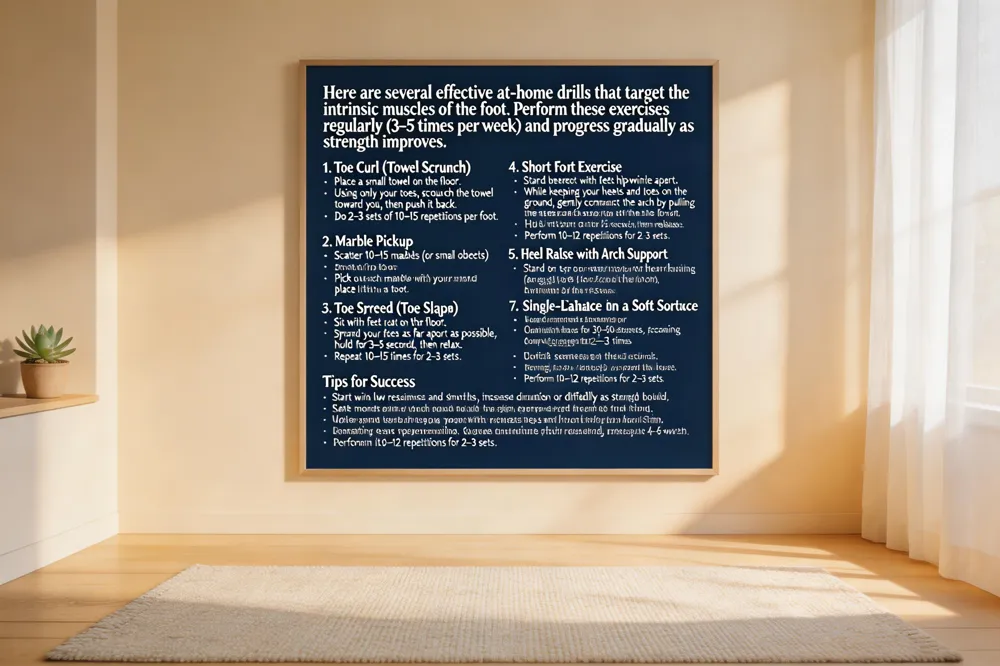 At‑home exercise list – Begin with towel scrunches, marble pick‑ups, and toe‑spreads (3 sets × 12‑15). Progress to short‑foot draws (arch‑draw) while standing, calf raises, heel‑to‑toe walks, and banded dorsiflexion. Finish with single‑leg balance on a foam pad, advancing to eyes‑closed or wobble‑board variations.
Techniques for tight muscles – Roll the sole on a lacrosse or foam roller 1‑2 min, then perform a standing calf stretch (wall push‑up) and ankle circles (10 sec each direction). Follow with toe‑yoga (spread, flex, curl each toe) and a seated plantar‑fascia pull‑back (20‑30 sec).
Bed‑time foot mobilization – While lying on your back, gently pull each toe toward the shin, point away, and draw circles with the big toe in the air. Use a towel looped under the ball of the foot for a 20‑30 sec plantar‑fascia stretch.
Beginner and senior adaptations – For beginners, keep movements slow, use a chair for support, and limit holds to 15‑20 sec. Seniors can start with side‑to‑side rolls, supported heel raises, and chair‑assisted single‑leg balance (10 sec each side).
Balance and proprioception drills – Ankle pumps, ankle circles, and the alphabet exercise (writing letters with the big toe) improve joint mobility and proprioception. Incorporate 2‑3 sets daily, increasing reps or resistance as stability improves.
Targeted Programs for Specific Foot Concerns
 A focused foot‑strengthening regimen can address a variety of common problems while supporting overall mobility.
Flat‑foot strengthening – Emphasize intrinsic arch muscles with towel scrunches, marble pick‑ups, and short‑foot (arch‑draw) drills performed seated. Progress to heel‑raise variations on a step and calf stretches for gastrocnemius/soleus flexibility; big‑toe and four‑toe lifts improve coordination and reduce overpronation.
Plantar fasciitis relief – Combine slow heel‑raises on a step, toe‑towel scrunches, short‑foot draws, resistance‑band dorsiflexion, and ankle inversion work. Aim for 2‑3 daily sets with a controlled tempo to strengthen the foot’s intrinsic apparatus and unload the plantar fascia.
Post‑injury / post‑fracture protocols – Begin with non‑weight‑bearing toe curls, ankle pumps, and seated heel raises. Advance to marble pick‑ups, towel scrunches, standing heel raises, and resisted dorsiflexion 8 ‑ ‑ 12‑2‑5/week, day when pain‑free and under clinician guidance.
Running‑specific foot work – A daily foot‑core circuit of short‑foot raises, toe‑spreading (splay) drills, towel‑curl or marble‑pick‑up curls, calf raises, single‑leg hops, and plantar‑fascia rolls on a massage ball improves stability, running economy, and reduces overuse injuries.
Balance‑focused drills – Single‑leg stands on a foam pad or wobble board, toe‑yoga (spreading, gripping, alphabet writing), towel scrunches, and heel‑to‑toe walks develop proprioception and ankle stability, lowering fall risk.
These evidence‑based moves, drawn from Healthline, Harvard Health, and other reputable sources, can be tailored to each patient’s needs in our Northwestern Chicago and South Florida podiatry clinics.
Equipment, Tools, and Technology to Accelerate Gains
 Foot strengthening equipment
Resistance bands, the Foot‑Gym’s toe‑curl and toe‑flex modules, and slant‑board calf‑stretch devices target intrinsic foot muscles while providing progressive overload. Balance boards and wobble pads improve ankle stability and proprioception, reducing injury risk (Healthline, Mayo Clinic).
Foot strengthening tools
Simple accessories—mini‑weight plates, rubber bands, massage balls (cork or tennis), toe‑spacers, and textured rollers—offer low‑impact strength training and fascial release. Rolling a tennis ball for two minutes per foot mobilizes the plantar fascia and eases arch pain (Healthline, PowerStep).
Foot pain exercises video
Our clinical video, led by a board‑certified foot surgeon, demonstrates towel curls, toe extensions, alphabet writing, calf raises, ankle circles, arch‑lift, and ice‑massage roll. Each movement includes clear repetitions, hold times, and frequency for safe home use.
Morning Stretch routine PDF
A downloadable 5‑minute PDF outlines a routine beginning with Cat‑Cow, bridge, calf raises, plantar‑fascia stretch, toe‑spread, and ending with Child’s Pose. Stretches are held 15‑30 seconds, repeated 2‑3 times, promoting circulation and joint lubrication (Harvard Health, Healthline).
Foot pain exercises PDF
The PDF provides a step‑by‑step conditioning program for chronic foot pain, starting with a low‑impact warm‑up, followed by heel‑cord stretches, ankle rotations, toe‑pulls, heel‑raise variations, single‑leg balances, and arch‑activation drills (UCLA Health, AARP). Stretches are held 30 seconds; strengthening sets 8‑15 reps, 3‑5 days per week.
Foot strengthening exercises PDF
A printable guide walks users through toe curls, marble‑pick‑up drills, heel raises, short‑foot exercises, plantar‑fascia stretches, ankle‑alphabet motions, and recommended repetitions, complete with illustrated diagrams and safety tips (Healthline, Correct Toes).
Putting It All Together: Sample Weekly Plan & Pro Tips
 A balanced weekly plan starts with a 5‑10‑minute morning stretch (Child’s Pose, Cat‑Cow, Downward‑Dog, Mountain Pose) to boost circulation and lubricate joints. Follow with a 10‑minute foot‑strengthening circuit on non‑consecutive days (Monday, Wednesday, Friday). Begin each session with a brief warm‑up—light walking or ankle circles—to increase blood flow, then perform mobility drills (ankle rotations, calf stretches), strengthening moves (toe‑scrunches, short‑foot draws, heel raises, toe splay with a band), and balance work (single‑leg stance on a foam pad, wobble‑board drills). Apply progressive overload by adding resistance bands, increasing hold times (30‑45 seconds for stretches) or reps (10‑15 per set) every 1‑2 weeks. Cool down with gentle calf and plantar‑fascia rolls (tennis ball or frozen bottle) for 2‑3 minutes. Seek professional advice if pain exceeds a 0‑5 rating, if you have diabetes, recent injury, or notice persistent swelling. For runners, integrate short‑foot raises, toe‑spreading, marble pick‑ups, and single‑leg hops 3‑4 times weekly to improve foot‑core activation and reduce injury risk.
Your Path to Unbreakable Feet Starts Today
Consistency is the cornerstone of foot health. A 5‑10‑minute routine performed every morning keeps blood flow high, lubricates joints, and prevents the stiffness that leads to plantar fasciitis and calf tightness. Combine stretches (Child’s Pose, Cat‑Cow, calf raises) with strengthening moves such as toe raises, towel scrunches, short‑foot or “arch‑control” exercises, and balance drills like single‑leg stands. Tools—like rubber band for toe splay, a tennis or golf ball for plantar‑fascia rolling, and sand surface for walking—enhance the workout. Finally, consult a podiatrist or physical therapist for guidance and to ensure progression, especially if you have diabetes, arthritis, or recent injuries.