Why Minimally Invasive Foot Surgery Matters
Minimally invasive foot surgery (MIS) employs millimeter‑scale incisions, fluoroscopic or arthroscopic guidance, and specialized burrs or tubular retractors to correct deformities such as bunions, hammertoes, and plantar fasciitis while preserving surrounding soft tissue. Patients benefit from markedly less postoperative pain, reduced swelling, and a lower reliance on opioid analgesics; many can bear weight within 1–2 days and return to normal footwear in 2–4 weeks. Clinical studies consistently show 30‑50 % lower pain scores, 20‑30 % faster return to activity, and infection rates equal to or below those of open surgery, with scar lengths 60‑80 % shorter. Clinics such as Wilmette Foot & Ankle (Dr. Gary Rogers), Advanced Footcare Inc. (Dr. Deeva Frankel), and Hall Podiatry (Dr. Patrick Hall) combine FDA‑cleared MIS devices with real‑time imaging, board‑certified surgeons, and multidisciplinary postoperative protocols—including early motion, silicone scar therapy, and custom orthotics—to achieve outcomes comparable to traditional surgery while enhancing cosmetic and functional recovery.
The Core of Minimally Invasive Foot Surgery
| Feature | Minimally Invasive Surgery (MIS) | Traditional Open Surgery |
|---|---|---|
| Incision length | 3‑5 mm (keyhole) | 3‑5 cm |
| Instruments | Arthroscope, endoscopic camera, percutaneous burrs, low‑profile distractors | Standard scalpels, larger retractors |
| Imaging guidance | Real‑time fluoroscopy or ultrasound | Usually limited intra‑op imaging |
| Soft‑tissue preservation | Ligaments, tendons, fascia largely intact | More extensive dissection |
| Post‑op pain | Significantly lower | Higher |
| Swelling & edema | Reduced | More pronounced |
| Infection risk | Lower | Higher |
| Scar appearance | Fine, faint line hidden under footwear | Larger, more visible scar |
| Weight‑bearing start | 1‑2 days (protected) | Often 1‑2 weeks (non‑weight‑bearing) |
| Full downtime | 2‑4 weeks | 6‑8 weeks |
| Typical indications | Bunions, hammertoes, plantar fasciitis, metatarsalgia, select fractures | Same, but with larger incisions |
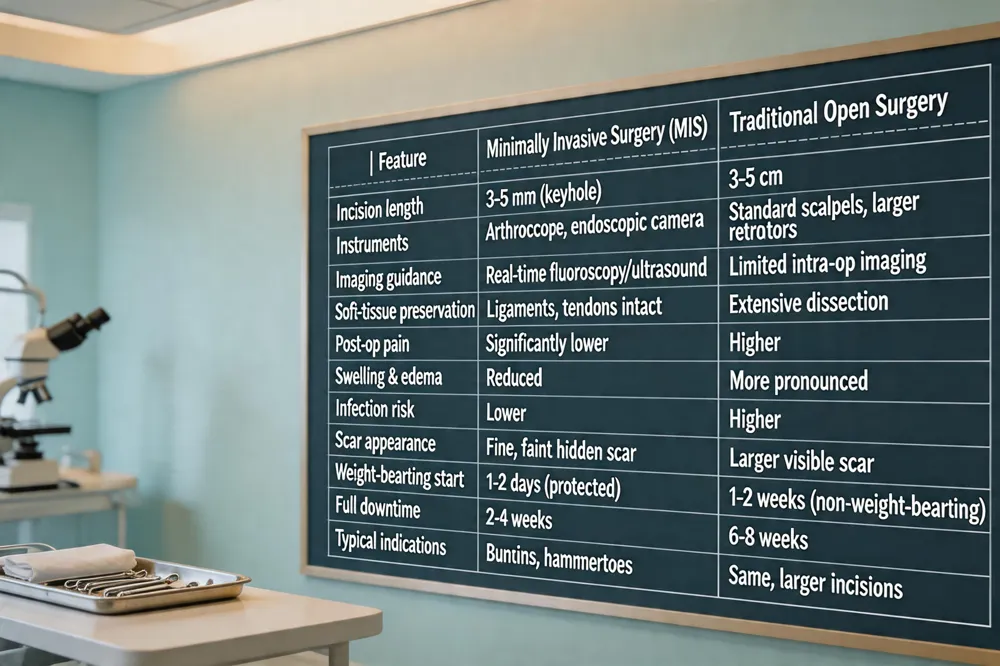 Minimally invasive foot surgery (MIS) treats foot and ankle problems through tiny 3‑5 mm incisions—often called “keyholes”—instead of the 3–5 cm cuts used in traditional open procedures.
Specialized instruments such as arthroscopes, endoscopic cameras, percutaneous burrs, and low‑profile distractors are introduced through these portals, while real‑time fluoroscopic or ultrasound imaging guides bone reshaping and hardware placement with high precision.
By preserving ligaments, tendons, and surrounding soft tissue, MIS markedly reduces postoperative pain, swelling, and infection risk, and it yields scars that are fine, faint lines hidden under footwear.
Compared with open surgery, patients typically bear weight within 1–2 days, resume normal footwear in 2–4 weeks, and enjoy a shorter overall downtime of 2–4 weeks versus 6–8 weeks.
The approach is effective for bunions, hammertoes, plantar fasciitis, metatarsalgia, and even select fractures, delivering outcomes comparable to open surgery while minimizing tissue trauma and cosmetic concerns.
Recovery Timelines and Weight‑Bearing
Recovery Milestones
| Phase | Typical Duration | Weight‑Bearing Status | Key Activities |
|---|---|---|---|
| Immediate post‑op (Days 0‑2) | 0‑2 days | Heel‑only loading in removable boot | Elevation (continuous), edema control |
| Early protected (Weeks 1‑2) | 1‑2 weeks | Partial weight‑bearing (boot) | Gentle ROM, continue elevation (continuous then intermittent) |
| Transition (Weeks 2‑4) | 2‑4 weeks | Gradual increase to full weight‑bearing as tolerated | Switch to stiff‑soled shoe, begin light ambulation |
| Soft‑tissue repairs | 4‑6 weeks | Full weight‑bearing by week 4‑6 | Normal footwear, low‑impact activities |
| Bunions, fractures, fusions | 2‑6 weeks non‑weight‑bearing → 2‑4 weeks partial → full thereafter | Progressive boot to shoe, functional rehab | |
| Return to normal activities | 3‑4 months | Unrestricted | Sport‑specific training, full gait recovery |
| Pain‑free gait | 6‑12 weeks | — | Completion of structured rehab |
 Minimally invasive foot surgery (MIS) uses incisions of 3‑5 mm, which limits soft‑tissue disruption and allows patients to begin protected weight‑bearing much earlier than after traditional open procedures. Most surgeons advise a removable boot or stiff‑soled shoe for the first 7‑14 days, often with heel‑only loading, and then gradual increase to full weight‑bearing as pain and swelling subside. Early elevation—continuous for the first 1‑2 weeks and then intermittent—helps control edema and promotes healing; many patients continue brief elevation for several weeks until swelling resolves. The boot protects the operative site, limits unwanted motion, and should be fitted snugly but comfortably; duration varies by procedure (typically 1‑6 weeks) and is guided by the surgeon’s assessment of bone or soft‑tissue healing. Walking milestones differ: simple soft‑tissue repairs may allow limited ambulation within days and full walking by 4‑6 weeks, whereas bunion corrections, fracture fixation, or joint fusions often require 2‑6 weeks of non‑weight‑bearing followed by partial weight‑bearing for another 2‑4 weeks before unrestricted walking. Full return to normal activities, including sports, generally occurs around 3‑4 months, with most patients achieving pain‑free gait by 6‑12 weeks when rehabilitation follows the prescribed protocol.
Scar Management: From Prevention to Treatment
Scar‑Care Timeline & Methods
| Time Post‑Op | Recommended Intervention | Details |
|---|---|---|
| 0‑2 weeks | Dry, covered dressing | Protect incision, keep clean and dry |
| 2‑3 weeks | Begin silicone therapy | Apply silicone sheet/gel 12 h/day once incision fully closed |
| 2‑3 weeks onward | Gentle scar massage | 5‑10 min circular motions, twice daily |
| Ongoing (up to 12 months) | Sun protection | SPF 30+ sunscreen or clothing, especially first 6 months |
| 2‑3 weeks onward | Moisturization | Aloe‑vera gel or vitamin E‑oil blend twice daily |
| Persistent thick/raised scar (months later) | Adjunctive treatments | Intralesional steroid injection, laser resurfacing, microneedling, limited surgical release |
| Long‑term (years) | Manual therapy & compression | Myofascial release, targeted compression to remodel adhesions |
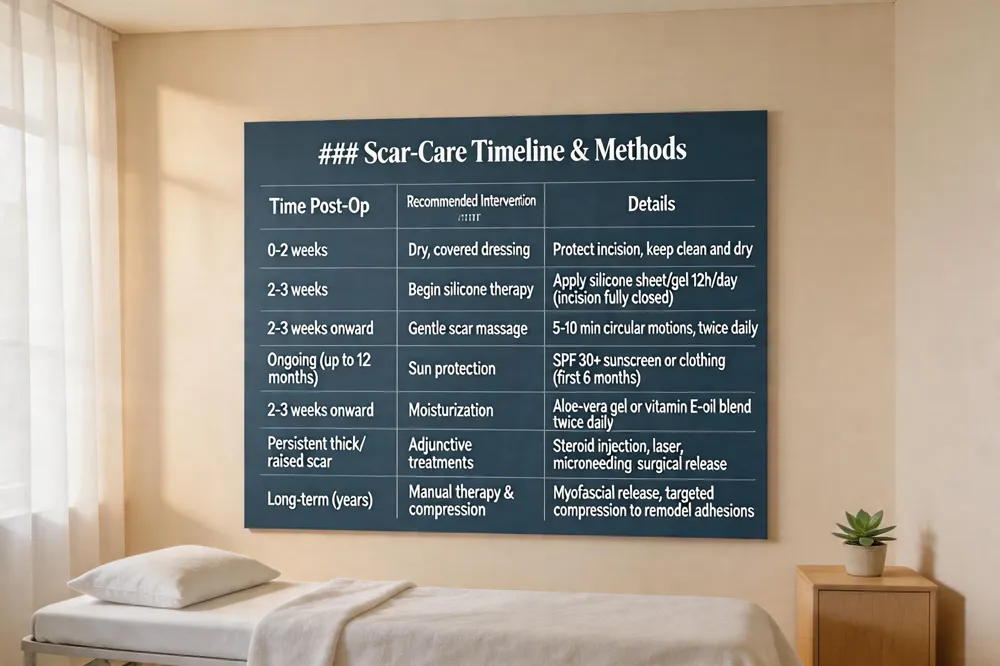 Minimally invasive foot surgery (MIS) creates incisions that are usually under 1 cm, which already limits scar formation. Healing proceeds through three stages—he, inflammation, and remodeling—each requiring specific care to achieve the best cosmetic and functional outcome.
Natural scar‑reduction methods: Keep the wound clean and moisturized; apply pure aloe‑vera gel or a vitamin E‑oil blend twice daily. Gentle scar massage (5‑10 minutes, circular motions) after suture removal helps align collagen fibers. Protect the scar from UV light with SPF 30+ sunscreen or clothing for at least six months.
Silicone therapy and massage: Silicone sheets or gels provide a moist environment that flattens and softens the scar. Begin silicone use once the incision is fully closed (≈2–3 weeks post‑op) and combine it with light massage to enhance tissue remodeling.
Timing of scar care: Early protection (dry, covered dressing) lasts the first two weeks. After closure, start silicone application and massage; continue daily for 12 hours or more until the scar matures (up to 12 months).
Options for persistent scar tissue: For raised, thick, or painful scars, discuss adjunctive treatments such as intralesional steroid injections, laser resurfacing, microneedling, or limited surgical release. Even years later, targeted manual therapy, myofascial release, and compression can remodel internal adhesions and improve flexibility.
Key take‑aways: Consistency, sun protection, and a multimodal approach—silicone, massage, and, when needed, professional interventions—yield the most favorable scar outcomes after minimally invasive foot surgery.
Specific Minimally Invasive Procedures
Procedure Summary
| Procedure | Incision Size | Primary Instruments | Immediate Weight‑Bearing | Transition to Shoes | Return to Normal Activities |
|---|---|---|---|---|---|
| Bunionette (Tailor’s bunion) | < 1 cm | Burr, fluoroscopic guidance | Immediate (protective boot) | After 2 weeks | ~6 weeks |
| Hallux valgus (bunion) correction | ≤ 5 mm | Arthroscope, burr, percutaneous screw | Immediate (boot) | After 2 weeks | 3‑4 months |
| Hammertoe correction | ≤ 5 mm | Tubular retractors, fluoroscopy | Partial, boot | 2‑3 weeks | 6‑8 weeks |
| Metatarsalgia | ≤ 5 mm | Endoscopic camera, burr | Partial, boot | 2‑3 weeks | 6‑8 weeks |
| Select foot fractures | ≤ 5 mm | Percutaneous pins/screws, fluoroscopy | Immediate (boot) | 2‑4 weeks | 8‑12 weeks |
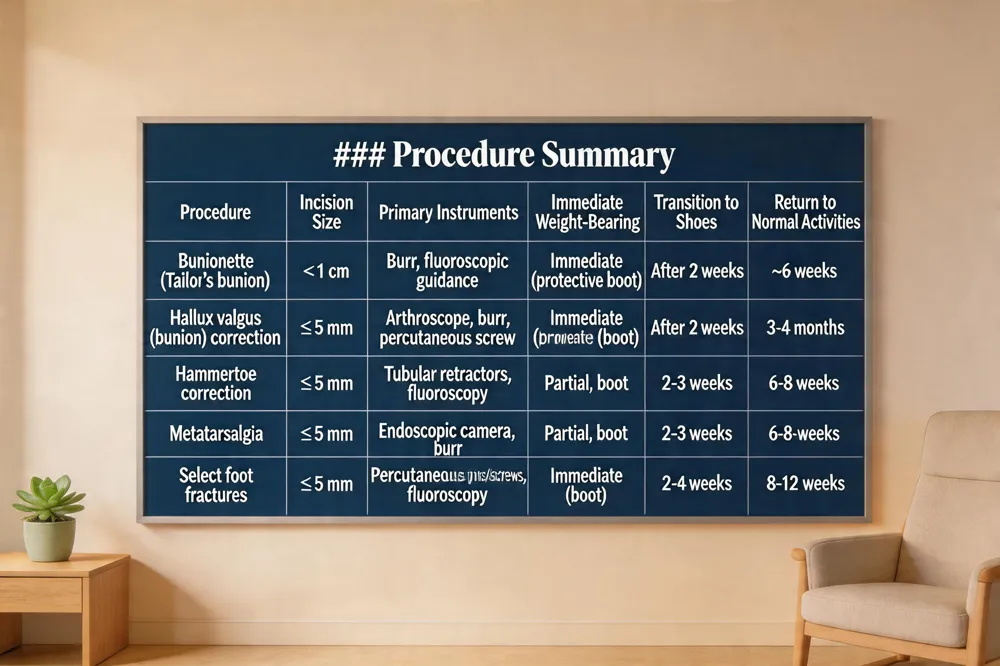 Minimally invasive bunionette (tailor’s bunion) surgery uses a sub‑1 cm incision and a burr reshaping the head of the metatarsal. At the metatarsal, alignment reduces swelling and pain while allowing immediate weight‑bearing in a protective boot. Patients transition to supportive shoes after two weeks and usually resume normal activities by six weeks, enjoying faster recovery and fewer complications than open surgery.
In minimally invasive bunion correction, a small incision (≤5 mm) realigns the first metatarsal and removes excess cartilage, preserving soft tissue. Post‑operative pain is markedly lower, scars are faint, and most patients bear full weight immediately, wearing their own shoes within six weeks and returning to regular activities in three to four months. Long‑term outcomes show a straight toe, reduced pain, and low recurrence rates.
Minimally invasive techniques also address hammertoes and metatarsalgia with tubular retractors and fluoroscopic guidance, providing precise bone and soft‑tissue work while minimizing swelling and scarring.
Candidates are patients with mild‑to‑moderate deformities, good circulation, and a desire for rapid return to function. Our MIS‑trained surgeons practice in Northwestern Chicago and South Florida, offering outpatient procedures with same‑day discharge. Contact us to determine eligibility and schedule a consultation.
Safety, Complications and Patient Guidance
Warning Signs & Recommended Actions
| Symptom / Sign | Possible Issue | Immediate Action |
|---|---|---|
| Persistent sharp/burning pain | Hardware irritation, nerve injury, infection | Call surgeon; possible imaging or medication adjustment |
| Fever ≥ 100.4 °F, redness, warmth, foul drainage | Surgical site infection | Seek urgent medical care; may need antibiotics or debridement |
| New numbness, tingling, loss of toe movement | Nerve compromise | Notify surgeon promptly; neuro‑evaluation may be needed |
| Swelling not decreasing, calf pain, shortness of breath | Deep‑vein thrombosis / pulmonary embolism | Go to emergency department immediately |
| Persistent swelling > 2 weeks despite elevation | Delayed healing or hematoma | Contact surgeon for possible aspiration or imaging |
| Uncontrolled bleeding from wound | Vascular injury or coagulopathy | Apply pressure, seek urgent care |
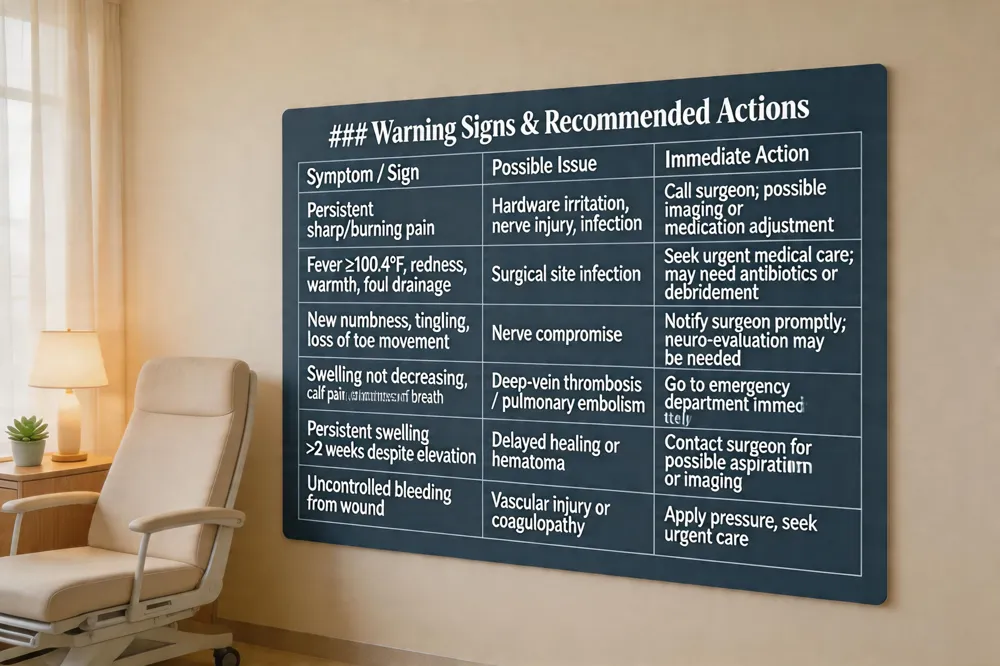 Minimally invasive foot and ankle surgery (MIS) offers smaller incisions, reduced pain, and quicker return to activities, but patients still need to recognize warning signs and understand realistic expectations.
Warning signs after foot surgery – Persistent or worsening pain, especially sharp or burning sensations that do not improve with medication, may indicate a problem. Fever ≥ 100.4 °F, increasing redness, warmth, foul‑smelling drainage, or new numbness, tingling, or loss of toe movement are red flags for infection, nerve injury, or vascular compromise. Swelling that fails to decrease, calf pain, or sudden shortness of breath could signal a blood clot and requires urgent evaluation.
Warning signs after ankle surgery – Similar red flags apply: unrelieved pain, significant swelling, redness, pus‑like drainage, fever, or systemic symptoms. Calf swelling and pain suggest deep‑vein thrombosis, while new numbness or weakness in the foot may indicate nerve damage.
Candidate selection – Ideal candidates for minimally invasive bunion surgery are patients with painful hallux valgus unresponsive to orthotics, shoe changes, or physical therapy, and with X‑rays showing a correctable deformity. They must be medically fit for a regional block and willing to follow postoperative protocols.
Surgeon choice – For routine foot conditions, a DPM‑qualified podiatrist with MIS expertise (e.g., Dr. Gary Rogers in Wilmette or Dr. Deeva Frankel in Miami) provides focused care. Complex fractures or severe ankle arthritis may be better managed by an orthopedic foot‑and‑ankle surgeon.
Scar expectations – MIS does leave scars, but they are typically a few millimeters long, fine, and often hidden under footwear. The reduced tissue trauma also lowers internal scarring and adhesions, leading to superior cosmetic outcomes.
Pain and nerve healing – Post‑operative pain scores are 1‑2 points lower on a 10‑point scale than open surgery, and many patients can bear weight within days. Nerve regeneration proceeds at ~1 mm per day; sensory recovery generally occurs over 3‑6 months, with full healing possibly extending to 9‑12 months.
Most painful procedures – Ankle arthrodesis and extensive flat‑foot reconstruction are usually the most painful foot surgeries, though modern analgesic techniques have reduced discomfort.
Patients should promptly contact their surgeon or seek emergency care if any warning signs arise, and adhere to prescribed weight‑bearing, scar‑care, and rehabilitation protocols for optimal outcomes.
Putting It All Together – Your Path to a Faster, Smoother Recovery
Minimally invasive foot surgery (MIS) delivers the most compelling advantages: tiny (often ≤ 5 mm) incisions, less soft‑tissue disruption, markedly lower postoperative pain, minimal scarring, and a quicker return to weight‑bearing—often within days rather than weeks. By preserving ligaments, tendons, and blood supply, MIS also reduces infection risk and swelling, allowing many patients to resume daily activities in 2‑4 weeks.
Patient empowerment begins with education. Understanding your condition, the specific MIS technique, and realistic recovery milestones lets you set achievable goals and actively participate in rehab. Ask your surgeon about early range‑of‑motion exercises, scar‑massage protocols, and silicone gel or sheet use to optimize cosmetic results.
Our clinics (Wilmette Foot & Ankle, Advanced Footcare, Hall Podiatry, etc.) provide on‑site X‑ray, sound‑wave therapy, and a secure patient portal where you can view post‑op instructions, schedule follow‑ups, and track therapy progress.
Ready to experience faster, smoother healing? Call today or use the online portal to book a consultation and start your personalized MIS journey.