Why Laser Therapy Is Gaining Ground
Onychomycosis affects millions of Americans and is notoriously hard to eradicate because the fungus hides beneath a thick, keratinized nail plate that blocks topical agents and often requires long‑term oral drugs with liver‑toxicity concerns. Recent advances in podiatric technology have introduced FDA‑cleared lasers—most commonly 1064 nm Nd:YAG, 810 nm diode, and 405 nm blue wavelengths—that penetrate the nail, generate controlled heat, and selectively destroy fungal cells while sparing healthy tissue. Modern protocols combine multiple wavelengths, real‑time temperature monitoring, and adjunctive debridement or photodynamic agents to improve eradication rates. This article reviews the scientific basis, clinical outcomes, and practical considerations of laser therapy as a minimally invasive, patient‑friendly option for stubborn nail fungus.
Understanding the Laser Technology Behind Nail Fungus Treatment
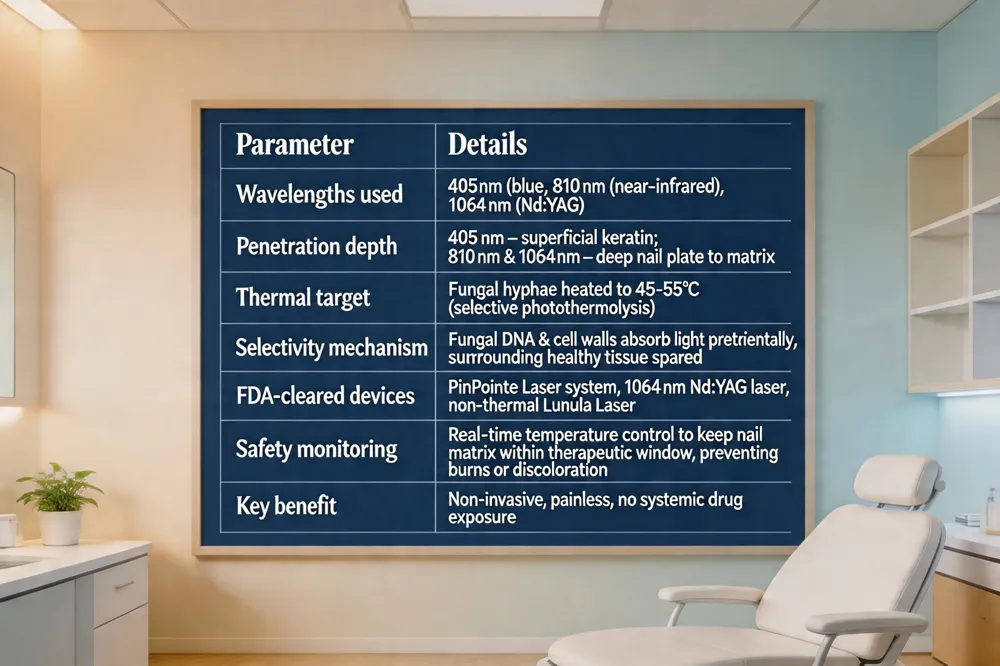
| Parameter | Details |
|---|---|
| Wavelengths used | 405 nm (blue), 810 nm (near‑infrared), 1064 nm (Nd:YAG) |
| Penetration depth | 405 nm – superficial keratin; 810 nm & 1064 nm – deep nail plate to matrix |
| Thermal target | Fungal hyphae heated to 45‑55 °C (selective photothermolysis) |
| Selectivity mechanism | Fungal DNA & cell walls absorb light preferentially; surrounding healthy tissue spared |
| FDA‑cleared devices | PinPointe Laser system, 1064 nm Nd:YAG laser, non‑thermal Lunula Laser |
| Safety monitoring | Real‑time temperature control to keep nail matrix within therapeutic window, preventing burns or discoloration |
| Key benefit | Non‑invasive, painless, no systemic drug exposure |
 Laser therapy for onychomycosis relies on specific wavelengths—most commonly 405 nm (blue), 810 nm (near‑infrared) and 1064 nm (Nd:YAG)—that can penetrate the dense keratin of the nail plate and reach the underlying nail bed. By delivering pulsed energy at these wavelengths, the laser creates selective photothermolysis: fungal hyphae absorb the light, heat rapidly to 45‑55 °C, and undergo cellular damage while surrounding healthy tissue remains unharmed. The physics of selective photothermolysis ensures that the energy is absorbed preferentially by the fungal DNA and cell walls, sparing the nail matrix and reducing the risk of pain or tissue loss.
The U.S. Food and Drug Administration has cleared several laser devices for onychomycosis, including the PinPointe Laser system, the 1064 nm Nd:YAG laser, and the non‑thermal Lunula Laser. FDA clearance signifies that these devices meet rigorous safety and efficacy standards for non‑invasive podiatric care. In practice, clinicians monitor real‑time temperature to keep the nail matrix within the therapeutic window, minimizing adverse effects such as burns or discoloration.
What is the FDA‑approved laser for nail fungus? The FDA‑approved laser for treating nail fungus is the PinPointe Laser system. It delivers a concentrated beam of light that penetrates the nail plate and destroys the fungal cells without the need for oral or topical medications. The treatment is non‑invasive, painless, and typically completed in a single 30‑minute session with no downtime. By targeting the infection at its source, PinPointe Laser promotes healthy nail regrowth over several months. It is widely used in advanced podiatry clinics for safe and effective onychomycosis management.
Clinical Effectiveness: How Well Does Laser Therapy Work?
| Study / Protocol | Cure / Clearance Rate | Comparison to Oral Antifungals | Influencing Factors |
|---|---|---|---|
| Multi‑session (2‑4 treatments, 4‑6 wk apart) | 60‑80 % mycological & clinical cure; up to 90 % when combined with topical agents | Comparable (60‑80 % vs 70‑90 % for terbinafine/itraconazole) | Wavelength, session number, nail thickness, debridement, adjunctive topicals |
| Low‑level lasers (405 nm/635 nm) | ≥3 mm clear nail growth in 67 % of nails after 6 mo | Slightly lower than oral | Superficial colonies targeted; limited depth penetration |
| Nd:YAG 1064 nm devices (systematic review) | 63‑71 % cure | Similar to oral for moderate disease | Deep matrix penetration, proper temperature control |
| Oral terbinafine/itraconazole | 70‑90 % cure | Gold‑standard first‑line | Requires hepatic monitoring, systemic side effects |
| Overall takeaway | Laser therapy offers 60‑80 % clearance with minimal systemic risk; best for patients contraindicated for oral meds |
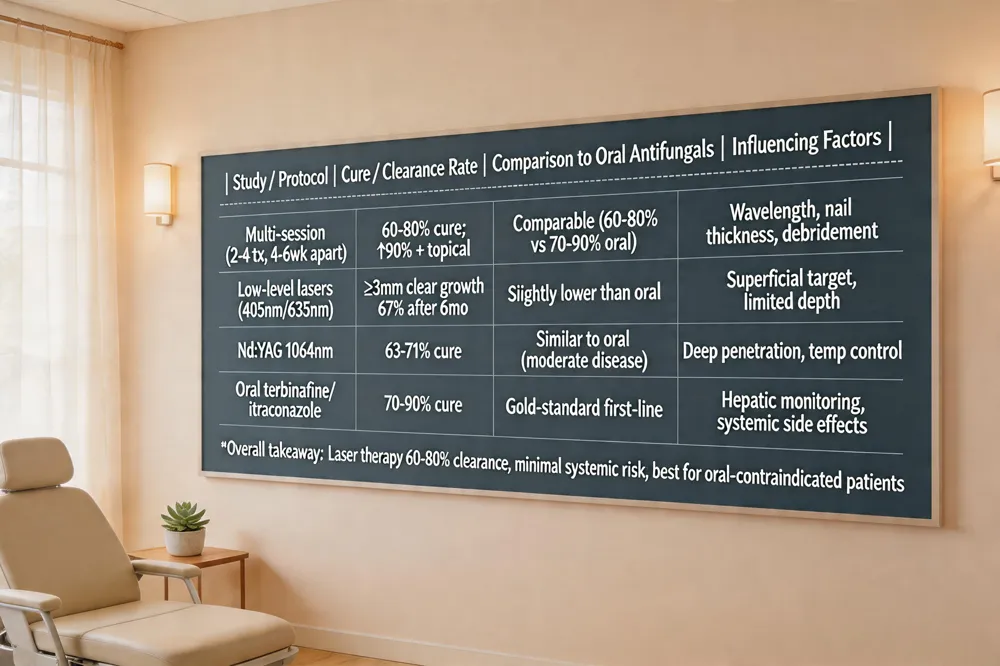 Cure and clearance rates from recent studies
Multi‑session laser protocols (2–4 treatments spaced 4–6 weeks apart) report mycological and clinical cure rates of 60‑80 % for stubborn onychomycosis, with several trials noting up to 90 % improvement when combined with topical agents. Non‑thermal low‑level lasers (e.g., 405 nm/635 nm) have shown ≥3 mm clear nail growth in 67 % of nails after six months , while Nd:YAG 1064 nm devices achieve 63‑71 % cure in systematic reviews.
Comparison with oral antifungal medications
Oral terbinafine or itraconazole achieve 70‑90 % cure rates but carry hepatic risks and require laboratory monitoring. Laser therapy delivers comparable clearance (60‑80 %) without systemic side effects, making it attractive for patients with liver disease, drug interactions, or pregnancy. However, oral agents remain the most reliable first‑line option for extensive disease.
Factors that influence success
Wavelength matters: 405 nm targets superficial colonies, while 1064 nm Nd:YAG penetrates deeper nail matrix. Session number and spacing (2‑6 sessions, 4‑6 weeks apart) improve eradication. Nail thickness and degree of hyperkeratosis affect light transmission; pre‑treatment debridement or filing enhances efficacy. Combination with topical antifungals or photodynamic agents further raises clearance rates.
Does laser therapy really work on toenail fungus?
Yes—laser reduces fungal load by heating fungal cells within the nail plate, sparing healthy tissue. Clinical experience shows noticeable improvement after a series of treatments, especially for mild‑to‑moderate infections. Cure rates of 60‑80 % have been reported, though recurrence can occur without diligent foot hygiene and follow‑up.
What is the #1 absolute best toenail fungus cure?
Prescription oral antifungals (terbinafine or itraconazole) remain the most reliable, achieving 70‑90 % success when taken for 3‑6 months, provided liver function is monitored. Laser therapy serves as an adjunct or alternative when oral therapy is contraindicated.
Modern Protocols and Adjunctive Strategies
| Component | Description |
|---|---|
| Combined wavelengths | 405 nm (DNA disruption) + 810 nm & 1064 nm (deep heat) |
| Adjunctive debridement | Mechanical trimming, filing, or laser‑assisted micro‑perforation to thin nail plate |
| Photodynamic therapy (PDT) | Apply methylene blue (or similar) → laser activation → ROS generation for extra fungal kill |
| Typical regimen | 3‑4 sessions, 4‑6 weeks apart; real‑time temperature monitoring (45‑55 °C) |
| Expected timeline | Visible improvement 3‑4 months; full nail regrowth 9‑12 months |
| Patient FAQ | Do toenails fall off? – No, nail remains attached and grows out healthy |
| Cost note | Sessions $300‑$1,200 each; bundled packages often discounted |
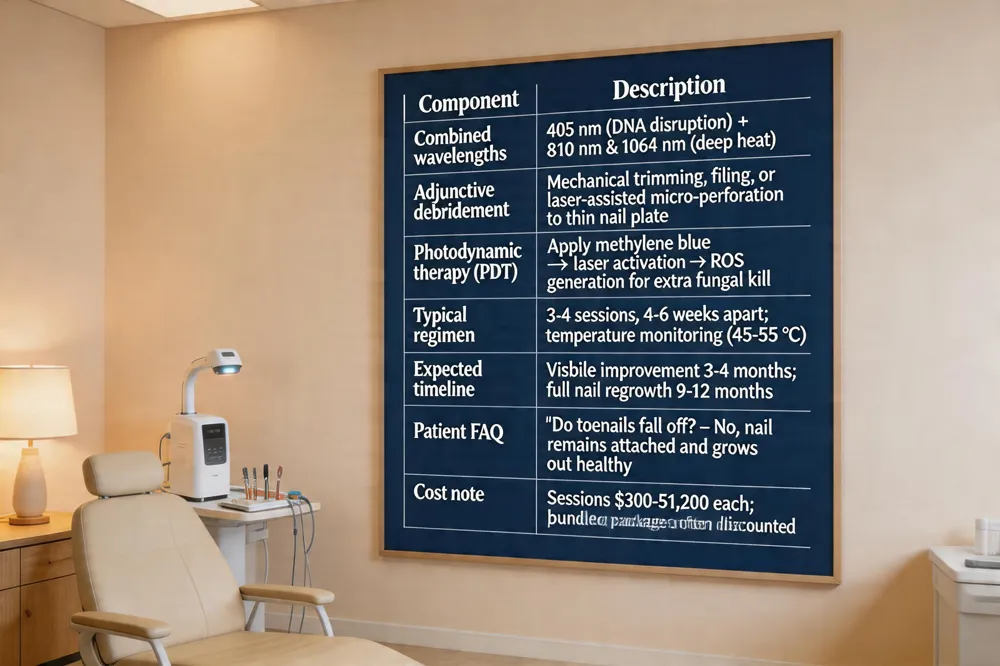 Current laser protocols for stubborn onychomycosis now combine multiple wavelengths—typically 405 nm (blue), 810 nm (near‑infrared) and 1064 nm (Nd:YAG)—to reach both superficial hyphae and deep fungal colonies. The shorter 405 nm light disrupts fungal DNA, while the longer 810 nm and 1064 nm beams penetrate the nail plate and heat the nail bed to 45‑55 °C, destroying fungal cells without damaging healthy tissue.
Adjunctive techniques enhance these effects. Mechanical debridement (trimming, filing, or laser‑assisted micro‑perforation) thins the nail plate, improving light transmission. Photodynamic therapy (PDT) adds a photosensitizing agent such as methylene blue; after a brief soak, the laser activates the agent, generating reactive oxygen species that further kill fungi.
Typical regimens involve 3‑4 sessions spaced 4‑6 weeks apart, with real‑time temperature monitoring to keep the nail matrix within the therapeutic window. This schedule allows the nail to grow out while the fungus is eradicated, leading to visible improvement within 3‑4 months and full regrowth by 9‑12 months.
Do toenails fall off after laser treatment for fungus? No. The laser targets the fungus beneath the nail plate and preserves the nail itself. The nail remains attached; as the infected portion is cleared, a healthier nail grows from the matrix, usually taking 6‑12 months for complete turnover.
How expensive is laser therapy for toenail fungus? Costs range from $300 to $1,200 per session, depending on the number of nails treated, infection severity, and technology used. Some clinics price per nail, while others offer bundled packages for multiple sessions. A personalized consultation provides an accurate estimate.
Financial Overview: What Patients Can Expect to Pay
| Region / Model | Pricing Details |
|---|---|
| U.S. bundled package | $1,000‑$1,200 for complete course (Lunula system) covering 3‑4 sessions, debridement, follow‑up |
| U.S. per‑session | $200‑$400 per visit (varies by laser type & nail thickness) |
| U.K. single foot session | £270 (≈ $340 USD) |
| U.K. both feet | £540 (≈ $680 USD) |
| U.K. two biggest toes | £450 (≈ $570 USD) |
| Consultation fees | U.S.: $80‑$150; U.K.: £80 (≈ $100 USD) |
| Insurance | Generally classified as cosmetic/investigational → rare reimbursement |
| Financing options | HSA/FSA eligibility, credit‑card installments, “pay‑as‑you‑go” plans, bundled discounts |
| Average total cost | $1,000‑$1,200 for full treatment (U.S.) |
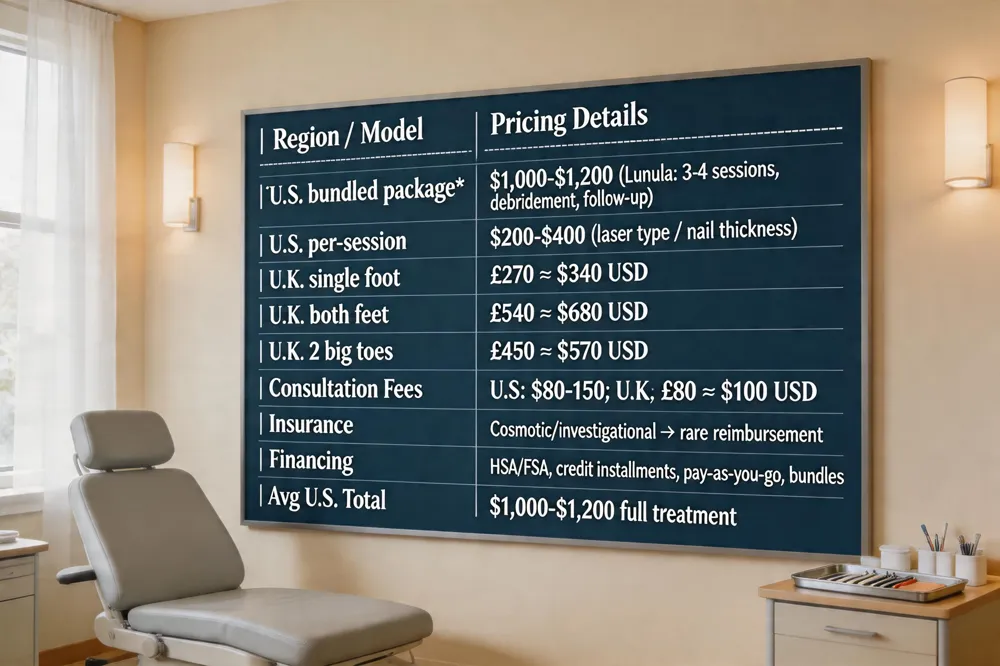 Package pricing versus per‑session billing
Laser therapy for toenail fungus is frequently quoted as a bundled package that covers all required sessions, debridement, and post‑treatment follow‑up. A typical complete course using the Lunula system at a U.S. podiatry clinic costs $1,000–$1,200. If a patient prefers to pay per visit, individual laser sessions are billed as specialized procedures ranging from $200 to $400 each, depending on the laser type and nail thickness. Clinics often offer a discount when the full package is paid up front, because the total number of sessions (usually 3–4) is known in advance.
Insurance coverage and financing options
Most private insurers classify laser nail fungus treatment as a cosmetic or investigational service, so reimbursement is rare. However, many clinics provide financing plans, health‑savings‑account (HSA) or flexible‑spending‑account (FSA) eligibility, and bundled‑pricing discounts to make the out‑of‑pocket expense more manageable. Some providers also accept credit‑card installments or offer “pay‑as‑you‑go” options for patients who cannot afford the full package upfront.
International price examples
In the United Kingdom, a single Lunula laser session for one foot or hand is priced at £270 (≈ $340 USD). Treating both feet costs £540 (≈ $680 USD), while a session focused on the two biggest toes is £450 (≈ $570 USD). An initial consultation is billed at £80 (≈ $100 USD) and follow‑up visits at £35 (≈ $45 USD). These figures illustrate how costs can vary by region, currency exchange rates, and local clinic policies.
What is the average cost of laser treatment for toenail fungus?
Laser therapy for toenail fungus typically runs between $1,000 and $1,200 for a complete course using the Lunula system at Foot & Ankle Centers. Individual sessions range from $200 to $400, but most patients purchase the full package.
How much does fungal nail laser treatment cost?
A Lunula laser session is £270 for one foot or hand over a three‑month plan (≈ $340 USD). Treating both feet costs £540 (≈ $680 USD), and the two biggest toes cost £450 (≈ $570 USD). Initial consultation £80 (≈ $100 USD) and follow‑up £35 (≈ $45 USD) are billed separately.
After‑Care, Monitoring, and Long‑Term Success
| Post‑treatment step | Recommendation |
|---|---|
| Nail hygiene | Keep nails dry, avoid soaking; use mild antiseptic or short‑term antifungal topical (e.g., efinaconazole) for 2‑4 weeks |
| Debridement before each session | Gentle filing to improve light transmission |
| Growth rate | Approx. 1 mm/month for toenails → visible change by 3‑4 months |
| Monitoring schedule | Baseline photos, then after each session, and at 3‑, 6‑, 12‑month intervals |
| Recurrence rate | 15‑20 % (similar to oral therapy) |
| Preventive measures | Daily foot drying, rotate shoes, antifungal powders in socks/shoes, treat athlete’s foot promptly |
| Follow‑up visits | Early detection of re‑infection; retreatment if needed |
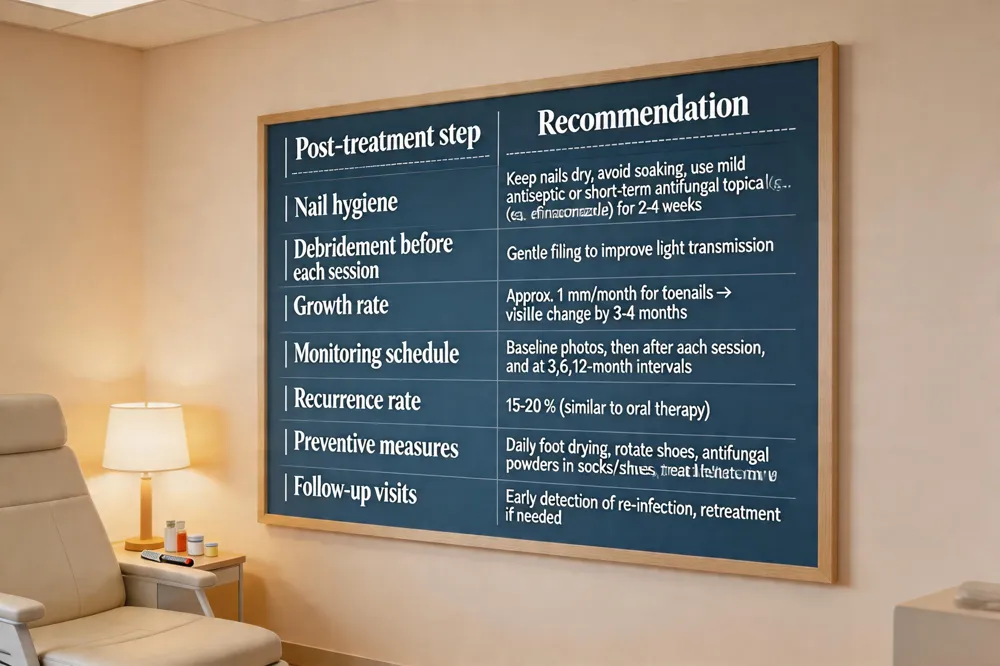 After laser sessions the most important step is meticulous nail hygiene. Patients should keep the treated nail dry, avoid soaking, and use a mild antiseptic or antifungal topical (e.g., efinaconazole or ciclopirox) for 2–4 weeks to suppress any residual organisms. Gentle filing or debridement before each session improves light penetration, and continued topical therapy after the laser helps maintain a clear nail bed. Nail regrowth follows the natural growth rate—approximately 1 mm per month for toenails—so visible improvement appears within 3–4 months and full replacement can take 9–12 months. Clinicians recommend photographic documentation at baseline, after each session, and at 3‑, 6‑, and 12‑month intervals to objectively track clearance and patient satisfaction. Recurrence is reported in 15‑20 % of cases, comparable to oral therapy, and is usually linked to persistent moisture, untreated athlete’s foot, or contaminated footwear. Preventive measures include daily foot drying, rotating shoes, using antifungal powders in socks and shoes, and treating any concurrent skin fungal infection promptly. Regular follow‑up visits allow early detection of re‑infection and timely retreatment, ensuring long‑term success while minimizing the need for systemic medications.
Putting It All Together: A Balanced View of Laser Treatment
Laser therapy for onychomycosis delivers targeted wavelengths (405‑nm, 810‑nm, 1064‑nm) that heat fungal cells while sparring surrounding tissue. Clinical trials report mycological cure rates of 60‑80 % after 3‑4 sessions, comparable to oral antifungals but with minimal systemic side effects such as liver toxicity. The procedure is painless, non‑invasive, and requires no anesthesia, making it attractive for patients who cannot take oral medication because of liver disease, drug interactions, or pregnancy. Costs range from $300‑$500 per session, and many insurers classify it as cosmetic, so out‑of‑pocket expense must be weighed against the avoidance of drug monitoring. Successful outcomes depend on proper nail debridement, dry foot environments, and regular photographic follow‑up to track regrowth and catch early recurrence. Adding a topical antifungal regimen can boost clearance by roughly 15 % and reinforces outcomes.