Welcome to Future‑Fit Foot Care
Future‑Fit Foot Care, serving Northwest Chicago and South Florida, blends a patient‑centered philosophy with cutting‑edge technology to treat common foot and ankle disorders such as plantar fasciitis, bunions, diabetic neuropathy, and Achilles tendinopathy. The clinic’s state‑of‑the‑art digital foot scanner creates a micrometer‑accurate 3‑D model of each patient’s foot, allowing same‑day production of custom orthotics and patient‑specific surgical guides via additive manufacturing. AI‑driven gait‑analysis platforms analyze pressure, motion, and temperature data from smart‑insoles to identify early biomechanical abnormalities and predict diabetic ulcer risk. Robotic‑assisted minimally invasive surgery, augmented‑reality navigation, and MLS laser therapy provide precise, tissue‑sparing treatment while accelerating recovery. Tele‑podiatry and cloud‑based monitoring keep patients connected to their care team, ensuring timely adjustments and optimal outcomes. By integrating 3‑D printing, artificial intelligence, wearable sensors, and regenerative medicine, Future‑Fit delivers personalized, efficient, and evidence‑based podiatric care.
Artificial Intelligence & Data‑Driven Diagnostics
 AI is reshaping podiatry by turning raw imaging and sensor data into actionable insights. Machine‑learning algorithms now analyze radiographs, MRI scans and gait‑capture data with accuracy comparable to board‑certified clinicians, flagging flat feet, bunions, diabetic neuropathy and early stress fractures. Predictive models that combine electronic health‑record variables, foot‑temperature and moisture sensor readings can forecast ulcer risk in diabetic patients, enabling pre‑emptive interventions. Telemedicine platforms integrate these AI tools, allowing podiatrists to review high‑resolution foot images, receive automated wound‑measurement reports and adjust treatment plans without an in‑person visit.
Will AI replace podiatrists? AI will not replace podiatrists; it acts as an adjunct that enhances decision‑making. FDA‑cleared AI applications standardize wound assessment and detect subtle changes clinicians might miss, helping to predict complications earlier. The clinician’s expertise remains essential for interpreting AI outputs, performing procedures and delivering compassionate care.
What are the latest advancements in podiatry? Recent breakthroughs include AI‑driven gait analysis, 3‑D‑printed patient‑specific orthotics, robotic‑assisted surgical navigation (e.g., Mazor X™ and ROSA®), high‑resolution weight‑bearing CT imaging, and smart‑shoe sensors that feed real‑time pressure data into AI platforms for early diagnosis of plantar fasciitis and stress fractures.
3‑D Printing, Custom Orthotics & Minimally Invasive Bunion Care
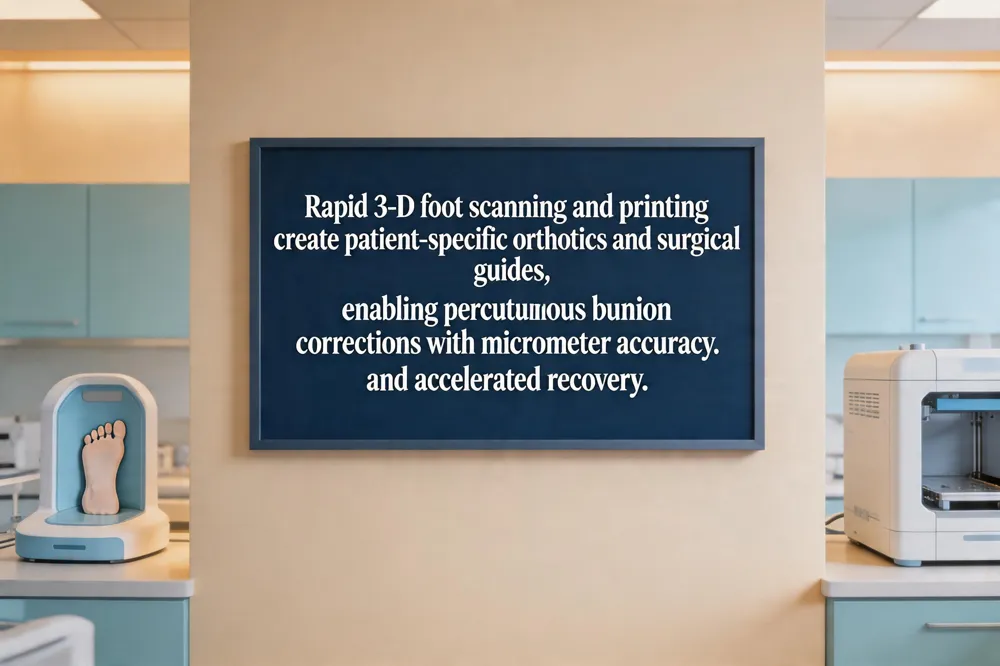 Three‑dimensional foot scanning creates a digital replica of the foot in seconds, eliminating the need for plaster casts and allowing instant transmission of the model to a lab. When the scan is fed to a desktop 3‑D printer, custom orthotics are fabricated in 24‑48 hours from medical‑grade TPU or nylon, delivering a micrometer‑accurate fit that redistributes plantar pressure and reduces strain on the hallux. The same digital data can be used to design patient‑specific surgical guides that match the exact bony anatomy; these guides are printed in durable thermoplastic and placed intra‑operatively to ensure precise osteotomy cuts for bunion correction.
Candidate for minimally invasive bunion surgery – Adults with symptomatic hallux valgus who have persistent pain or functional limitation despite conservative measures (wide‑toe shoes, orthotics, padding, physical therapy) are prime candidates. The deformity should be mild‑to‑moderate and amenable to a percutaneous chevron or Akin osteotomy, and the patient must be medically fit for an outpatient procedure under regional anesthesia.
Before and after – Pre‑operative work‑up includes a physical exam, weight‑bearing X‑ray or CT, and gait analysis to map the deformity. In the operating room a 2‑5 mm incision is made; a low‑speed burr performs the osteotomy under fluoroscopic guidance, and tiny screws or pins secure the realigned bones. Post‑operatively, swelling and pain are minimal, patients weight‑bear immediately in a protective shoe, and most return to regular footwear within six weeks; full activity is usually cleared between eight weeks and four months.
Foot surgery types – Beyond bunionectomy, minimally invasive options address hammertoes, plantar fascia release, ankle arthroscopy, and tendon repairs, all benefiting from reduced incision size, faster healing, and lower infection risk.
Find a surgeon near you – Advanced FootCare’s clinics in Northwest Chicago and South Florida combine 3‑D scanning, custom orthotics, and percutaneous bunion correction performed by board‑certified foot and ankle specialists. Schedule a tele‑medicine consult or call 555‑123‑4567 to begin your personalized treatment plan.
Smart Sensors, Wearable Insoles & Remote Monitoring
 Smart shoes and pressure‑mapping insoles are now standard tools in modern podiatry clinics across Northwest Chicago and South Florida. Embedded piezoelectric and capacitive sensors capture real‑time plantar pressure, shear, and temperature data, which is streamed via Bluetooth to cloud‑based analytics platforms. AI‑driven algorithms flag abnormal loading patterns that precede conditions such as plantar fasciitis, stress fractures, or diabetic foot ulceration, allowing clinicians to intervene before symptoms appear.
For patients with diabetes, continuous monitoring of foot temperature and moisture through smart insoles provides an early warning system for ulcer risk. When a hotspot is detected, the podiatrist can be alerted instantly, prompting a telemedicine visit where high‑resolution images and sensor logs are reviewed. This remote‑care model reduces the need for in‑person appointments, shortens treatment cycles, and improves adherence to preventive regimens.
Minimally invasive surgery – MIS uses tiny incisions and specialized instruments—often guided by a camera or robotic system—to treat conditions while sparing surrounding tissue. By limiting entry size, MIS reduces pain, infection risk, and recovery time, allowing patients to return to activity quickly.
What is minimally invasive ankle surgery? – It treats ankle disorders through sub‑5 mm punctures using needle‑sized tools that cut bone while preserving tendons, nerves, and vessels. Patients experience less swelling, pain, and faster weight‑bearing compared with open surgery.
Ankle arthroscopy – This technique inserts a tiny camera and instruments through half‑inch incisions to address ligament tears, impingement, or osteochondral lesions, resulting in less postoperative discomfort and a quicker return to daily life.
Does Medicare cover diabetic pedicures? – Medicare Part B covers therapeutic shoes and medically necessary podiatric services for diabetic neuropathy, but routine pedicures are considered cosmetic and are not reimbursed. Only foot‑care procedures performed to treat a specific diabetic complication may be covered.
Regenerative Medicine, Laser & Emerging Therapies
 Regenerative medicine is reshaping podiatric care. Platelet‑rich plasma (PRP) injections deliver concentrated growth factors that accelerate tendon and ligament healing, while autologous stem‑cell therapies aim to regenerate damaged plantar fascia and cartilage. Laser treatments—including low‑level laser (LLLT), fractional CO₂, and Multiwave Locked System (MLS) lasers—provide non‑invasive, drug‑free options for fungal nail infections, plantar warts, and chronic heel pain by stimulating cellular repair and reducing inflammation. Extracorporeal Pulse Activation Technology (EPAT®) uses focused pressure waves to increase blood flow in the plantar fascia, promoting natural healing without incisions, and ultrasound‑guided injections enhance precision for PRP or steroid delivery. Nanotechnology‑based dressings such as antimicrobial hydrogel films, maintain a moist wound environment and release agents over time, speeding diabetic foot ulcer closure.
Is Dr. Ebonie Vincent a real doctor? Yes, Dr. Ebonie Vincent is a board‑certified podiatrist with a DPM degree, listed in professional directories and actively practicing in the United States.
What is the most common minimally invasive surgery? The highest‑volume minimally invasive procedure across medicine is laparoscopic cholecystectomy; in podiatry, the most common are percutaneous bunion corrections, plantar fasciotomies, and ankle arthroscopies.
What are the latest advancements in podiatry? Recent innovations include AI‑driven gait analysis, 3‑D‑printed custom orthotics, computer‑assisted surgical navigation, and high‑resolution digital imaging for precise diagnosis.
Your Care Journey at Future‑Fit Foot Care
 At Future‑Fit Foot Care, every patient begins with a comprehensive evaluation that blends 3‑D foot scanning, pressure‑mapping, and high‑resolution imaging (X‑ray, MRI, ultrasound) to capture the exact anatomy and biomechanics of the foot. AI‑driven gait‑analysis platforms then interpret the data, flagging subtle abnormalities such as early plantar fasciitis, flat‑foot collapse, or diabetic ulcer risk.
For those unable to visit in‑person, the clinic’s tele‑health platform offers secure video visits, remote upload of foot scans, and real‑time review of wearable smart‑shoe sensor data, allowing clinicians to adjust orthotics or prescribe treatment plans from home.
Future‑Fit operates state‑of‑the‑art offices in Northwest Chicago and South Florida, extending cutting‑edge care—including 3‑D‑printed custom orthotics, AI‑enhanced diagnostics, and minimally invasive procedures to a wide geographic base.
Patients can expect faster symptom relief, precise biomechanical support, reduced recovery times, and an overall improvement in foot function and quality of life.
Embracing a High‑Tech Future for Healthy Feet
Modern podiatry is being reshaped by a suite of emerging technologies that deliver faster, more precise care. Three‑dimensional scanning and additive manufacturing now produce custom orthotics and surgical guides within hours, eliminating weeks‑long wait times and improving biomechanical alignment. Artificial‑intelligence‑driven gait analysis and AI‑enhanced imaging detect flat feet, bunions, diabetic neuropathy, and stress fractures with accuracy rivaling expert clinicians, enabling earlier intervention. Wearable smart‑insoles continuously stream pressure, temperature, and motion data to cloud‑based platforms, empowering patients to monitor risk factors such as ulcer precursors in real time and to adjust activity or orthotic design under clinician guidance. Telemedicine and virtual reality pain‑management extend specialist access to remote or underserved communities, while regenerative therapies like PRP and stem‑cell injections accelerate tissue healing. Looking ahead, integration of augmented‑reality navigation, biodegradable implants, and AI‑predicted outcome models promises a hyper‑personalized, minimally invasive footprint of foot and ankle health—making optimal foot function a realistic expectation for every patient.