Why Footwear Matters for Long‑Term Health
Footwear is a direct interface between the ground and the musculoskeletal system, influencing foot anatomy, gait, and overall posture. Ill‑fitting shoes can force the toes into a cramped box, alter arch mechanics, and shift the center of gravity, leading to overpronation, supination, and compensatory stress on the knees, hips, and lower back. Supportive footwear should include a snug, stiff heel counter, at least ½‑inch (≈13 mm) toe‑box clearance, arch support matched to the wearer’s foot type, and a cushioned midsole that absorbs heel and forefoot impact. Breathable uppers, wide toe boxes, and removable insoles for orthotics further protect skin and allow individualized alignment. Proper fit—checked in the late afternoon with the intended sock—prevents pressure points that cause bunions, hammertoes, corns, and plantar fasciitis, while reducing the risk of diabetic ulcers and arthritis flare‑ups. Selecting shoes that meet these criteria supports long‑term foot health and whole‑body biomechanics.
Foot Measurement, Fit Principles, and Everyday Options for Women
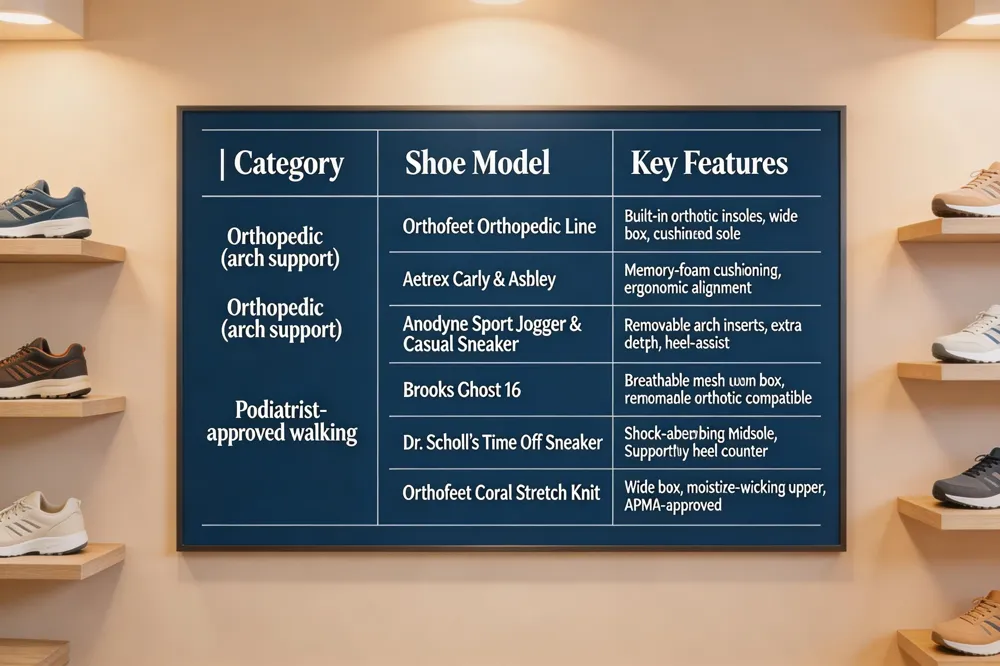
| Category | Shoe Model | Key Features |
|---|---|---|
| Orthopedic (arch support) | Orthofeet Orthopedic Line | Built‑in orthotic insoles, wide toe box, cushioned sole |
| Orthopedic (arch support) | Aetrex Carly & Ashley | Memory‑foam cushioning, ergonomic alignment |
| Orthopedic (arch support) | Anodyne Sport Jogger & Casual Sneaker | Removable arch inserts, extra depth, heel‑assist |
| Podiatrist‑approved walking | Brooks Ghost 16 | Breathable mesh upper, roomy toe box, removable orthotic compatible |
| Podiatrist‑approved walking | Dr. Scholl’s Time Off Sneaker | Shock‑absorbing midsole, supportive heel counter |
| Podiatrist‑approved walking | Orthofeet Coral Stretch Knit | Wide toe box, moisture‑wicking upper, APMA‑approved |
 When choosing shoes, start by measuring both feet while standing in the late afternoon—feet swell throughout the day, and a half‑inch (≈13 mm) gap between the longest toe and the toe‑box front ensures natural toe splay and prevents crowding. Aim for a heel height of no more than 1½ inches (≈38 mm) and a snug, stiff heel counter to keep the foot from sliding forward and to reduce ankle instability. Breathable uppers made of mesh, leather, or engineered fabrics, combined with moisture‑wicking, seamless socks, help keep feet dry and lower the risk of blisters or fungal infections.
Best orthopedic shoes for women with arch support Women who need reliable arch support should consider Orthofeet’s stylish orthopedic line (built‑in orthotic insoles, wide toe boxes, cushioned soles), Aetrex’s Carly and Ashley arch‑support sneakers (memory‑foam cushioning, ergonomic alignment), or Anodyne’s Sport Jogger and Casual Sneaker (removable arch inserts, extra depth, heel‑assist). All three brands prioritize pressure‑free fits, slip‑resistant outsoles, and feminine designs suitable for casual or professional wear.
Women podiatry recommended shoes Podiatrists favor APMA‑approved walking sneakers such as the Devotion X 2 Walking Sneaker, Echo Knit Slip‑On, and Resorb Max Walking Sneaker, which feature breathable uppers, supportive midsoles, and roomy toe boxes. Orthotic‑friendly options like Brooks Ghost 16, Dr. Scholl’s Time Off Sneaker, and Orthofeet Coral Stretch Knit Shoe offer proven shock‑absorption and wide‑fit choices for bunions or swelling.
Casual orthopedic shoes for women Casual orthopedic footwear combines everyday style with medical support: built‑in orthotic insoles, cushioned shock‑absorbing soles, extra‑deep wide toe boxes, breathable soft interiors, and adjustable closures (elastic laces or hook‑and‑loop straps). Slip‑resistant outsoles and sturdy heel counters add stability for errands or light work. Reputable brands like Orthofeet, Drew Shoe, and Anodyne provide all‑day comfort, support, and a modern aesthetic that fits seamlessly into any wardrobe.
Men’s Foot Health and Long‑Term Comfort Strategies
| Category | Shoe Model | Key Features |
|---|---|---|
| Cushioned midsole (EVA/gel) | Brooks Ghost 16 | MetaRocker foam, 5‑8 mm heel drop, neutral cushioning |
| Max‑cushion (HOKA) | HOKA Bondi 7 | Thick midsole, firm arch support, slip‑resistant outsole |
| Max‑cushion (HOKA) | HOKA Clifton 10 | Meta‑Rocker sole, breathable upper, roomy toe box |
| Slip‑resistant work | Skechers Work Sure Track | Rubber textured tread, hook‑and‑loop strap, removable insole |
| Orthotic‑friendly walking | Rykä Devotion X 2 | Neutral cushioning, wide toe box, removable orthotic compatible |
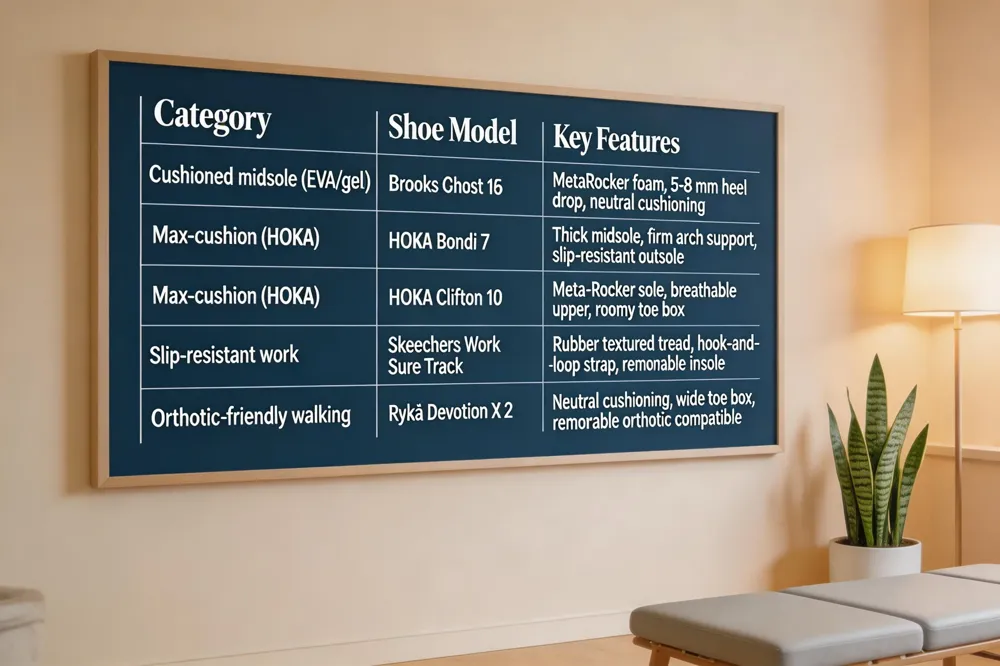 Effective foot care for men who stand or walk for many hours combines proper fit, cushioning, and safety features. A cushioned midsole made of EVA, gel, or HOKA’s MetaRocker foam absorbs impact and distributes forces across the heel, arch, and metatarsals. For all‑day wear, a heel‑drop of 5‑8 mm (≈0.2‑0.3 in) provides enough forward tilt to reduce forefoot pressure without compromising gait stability. Slip‑resistant outsoles, often featuring rubber compounds with textured tread, protect against falls on wet or polished floors and are a must for healthcare, food‑service, and retail environments. Rotating shoes every 2‑3 weeks allows midsoles to recover their shape, prolonging cushioning performance and preventing repetitive‑stress injuries.
Long‑term foot comfort footwear for men – Choose orthotic‑friendly, APMA‑approved shoes with a deep, cushioned footbed, firm heel counter, and a roomy toe box (≥½ in space). Breathable uppers (mesh or leather) keep feet dry, while removable insoles let you tailor arch support and replace worn midsoles.
Podiatrist‑recommended shoes for walking – Look for neutral‑cushion models like Brooks Ghost 16 or Rykä Devotion X 2 which provide balanced arch support, a wide toe box, and a stable mid‑foot. Orthotic‑friendly designs and slip‑resistant outsoles add safety and flexibility for daily wear.
Best shoes for standing all day on concrete – Prioritize thick midsoles and firm arch support; top picks include Brooks Ghost 16, HOKA Bondi 7, and HOKA Clifton 10. Slip‑resistant options such as Skechers Work Sure Track offer budget‑friendly durability.
Most comfortable shoes for standing all day – The Brooks Ghost 16 consistently ranks highest for cushioning and stability; HOKA Bondi 7 delivers maximum shock absorption, while Skechers Work Sure Track balances comfort and slip resistance for demanding work environments.
Special Conditions: Arthritis, Plantar Fasciitis, Flat Feet, and More
| Condition | Shoe Model | Design Feature |
|---|---|---|
| Arthritis / plantar fasciitis | Hoka Clifton 10 | Rocker‑bottom sole, high cushioning, low heel drop |
| Arthritis / plantar fasciitis | Brooks Ghost Max 3 | Curved outsole, soft midsole, roomy toe box |
| Flat feet | Kuru Atom 2 | Firm medial post, contoured arch cushion |
| Flat feet | New Balance Fresh Foam X 880v15 | Wide fit, supportive midsole, breathable mesh |
| Flat feet | ASICS Gel‑Kayano | Stability platform, medial post, cushioned heel |
| Wide toe box (bunions, swelling) | Skechers Slip‑Ins Work Summits | Extra depth, breathable upper, slip‑on closure |
| Wide toe box | Orthofeet Coral | Wide ergonomic toe box, stretchable upper |
| Wide toe box | Vionic Walker | Orthaheel footbed, roomy toe box, arch support |
| Arch support for scoliosis | HOKA Bondi 9 | Thick midsole, stable arch, rocker sole |
| Arch support for scoliosis | Arahi 8 | APMA‑approved, firm heel counter, supportive arch |
| Arthritic comfort | Birkenstock cork‑latex footbed | Natural cork footbed, shock absorption, roomy toe box |
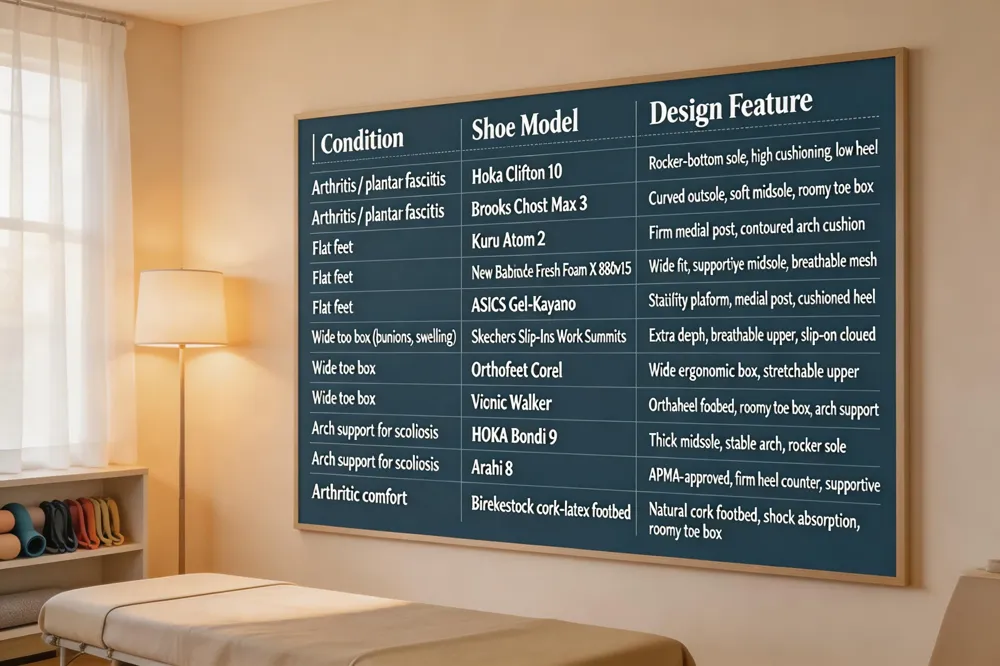 Rocker‑bottom soles shift weight away from the forefoot, lowering pressure on metatarsal heads and helping conditions such as plantar fasciitis, arthritis, and metatarsalgia. Shoes like the Hoka Clifton 10, Brooks Ghost Max 3, and Dansko XP 2.0 clogs use rocker or curved outsoles to promote a smoother heel‑to‑toe roll and reduce strain on the plantar fascia.
A roomy toe box prevents crowding of the toes, which is essential for bunions, hammertoes, and swollen feet. Models with a wide forefoot—such as Skechers Slip‑Ins Work Summits, Orthofeet Coral, and Vionic Walker—provide ample space for natural toe splay, minimizing callus formation and friction‑related blisters.
Flat (low‑arch) feet benefit from targeted arch support that distributes load evenly. Shoes featuring firm medial posts or contoured arch cushions—like the Kuru Atom 2, New Balance Fresh Foam X 880v15, and Asics Gel‑Kayano—stabilize the foot and reduce overpronation, protecting the knees and lower back.
Best walking shoes for scoliosis: HOKA Bondi 9, Arahi 8, and Clifton 10 offer thick midsoles and stable arch support that help maintain spinal alignment; Birkenstock cork‑latex footbeds and Dansko rocker‑bottom clogs also promote a neutral gait.
Long‑term foot comfort footwear for walking: Choose maximal‑cushion, low‑drop shoes with removable orthotic‑compatible insoles—e.g., HOKA Bondi SR, On Cloud 6, or Orthofeet designs—paired with a wide toe box and breathable uppers. Replace every 6‑12 months.
Long‑term foot comfort footwear for women: Opt for orthopedic‑style shoes with cushioned midsoles, extra depth, and seamless interiors; brands like Vionic, Propet, and Orthofeet provide these features while maintaining a stylish look.
Best arthritis shoes for women: Look for firm, cushioned midsoles, a stable heel, and a roomy toe box; top picks include Vionic Walker, Brooks Addiction Walker 2, and Propet Stability Fly—all of which are orthotic‑friendly and feature rocker or slightly curved soles to offload inflamed joints.
Plantar Fasciitis, Orthotics, and Brand‑Specific Insights
| Shoe Model | Key Feature |
|---|---|
| Hoka Bondi 9 | Slightly elevated heel, rigid heel cup, APMA seal |
| Brooks Adrenaline GTS | Structured support, cushioning, heel counter |
| ASICS Gel‑Kayano | Medial post, responsive midsole, heel stability |
| New Balance 990v5 | Dual‑density midsole, supportive heel, roomy toe box |
| Saucony Omni Walker | Slip‑resistant outsole, cushioned footbed, orthotic friendly |
| Dr. Scholl’s Feel Well (slip‑on) | Heel cup, breathable upper, easy on/off |
| Teva Tirra (sandals) | Adjustable straps, arch support, cushioned footbed |
| Vionic (Orthaheel) | Built‑in arch support, APMA approved, breathable mesh |
| Orthofeet (mild rocker) | Mild rocker sole, wide toe box, removable orthotic |
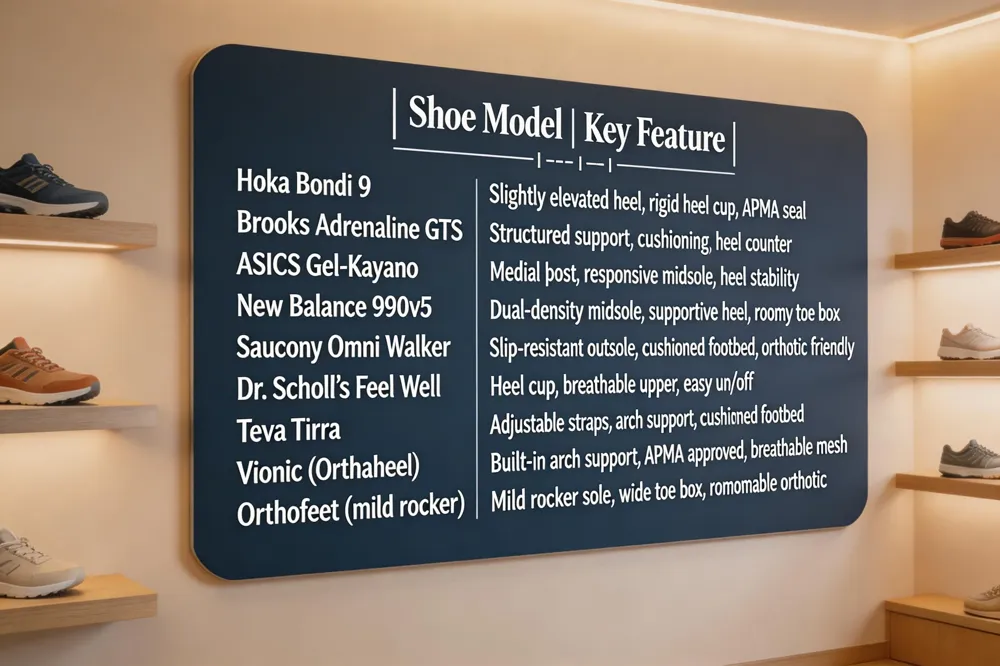 A firm heel cup and rigid heel counter keep the foot from sliding forward, reducing forefoot strain and blister risk—key for plantar fasciitis and extensor tendonitis. Modern rocker‑sole designs, such as Hoka’s Meta‑Rocker and Orthofeet’s mild rocker, promote a smoother heel‑to‑toe transition and lower tension on the plantar fascia and Achilles tendon. Shoes bearing the APMA Seal of Acceptance (e.g., Hoka Bondi 9, Brooks Ghost Max 3, New Balance Fresh Foam X 880v15) meet podiatric standards for arch support, cushioning, and stability.
Podiatrist recommended shoes for plantar fasciitis: Models with a slightly elevated heel, supportive heel counter, and responsive midsoles—Hoka Bondi 9, Brooks Adrenaline GTS, ASICS Gel‑Kayano, New Balance 990v5, Saucony Omni Walker—provide the needed shock absorption and arch stability. Slip‑ons like Dr. Scholl’s Feel Well and Teva Tirra sandals are also approved.
Vionic orthopedic shoes: Engineered with an Orthaheel footbed, Tri‑Planar Motion Control, and APMA approval, Vionic footwear offers built‑in arch support, cushioned midsoles, and breathable uppers for heel pain, plantar fasciitis, and pronation.
Orthopedic shoes near me: Visit local podiatry clinics (e.g., Advanced Footcare) or use Orthofeet’s retailer locator for custom‑fit options. Bring recent imaging for precise fitting.
Best shoes for extensor tendonitis: Look for cushioned, low‑drop, roomy‑toe models with stable midsoles—Brooks Glycerin, ASICS Gel‑Nimbus, New Balance Fresh Foam 1080, Saucony Guide—paired with orthotics if needed.
Women’s Foot Health: Everyday, Work, and Specialty Shoes
| Use | Shoe Model | Notable Attributes |
|---|---|---|
| Healthcare / work | Dansko XP 2.0 | Rocker‑bottom, spacious toe box, slip‑resistant outsole |
| Healthcare / work | Hoka Bondi 9 | Cushioned midsole, firm heel counter, slip‑resistant |
| Healthcare / work | Skechers Work Sure Track | Rubber tread, antimicrobial lining, adjustable strap |
| Everyday casual | Vionic | Orthaheel footbed, modest heel ≤1½ in, breathable mesh |
| Everyday casual | Clarks | Classic dress silhouette, built‑in arch support, leather upper |
| Everyday casual | ECCO | Flexible leather, supportive footbed, low heel |
| All‑day standing | Brooks Ghost 16 | Soft cushioning, mild heel‑drop, wide fit option |
| All‑day standing | Hoka Clifton 10 | Max‑cushion, roomy toe box, breathable upper |
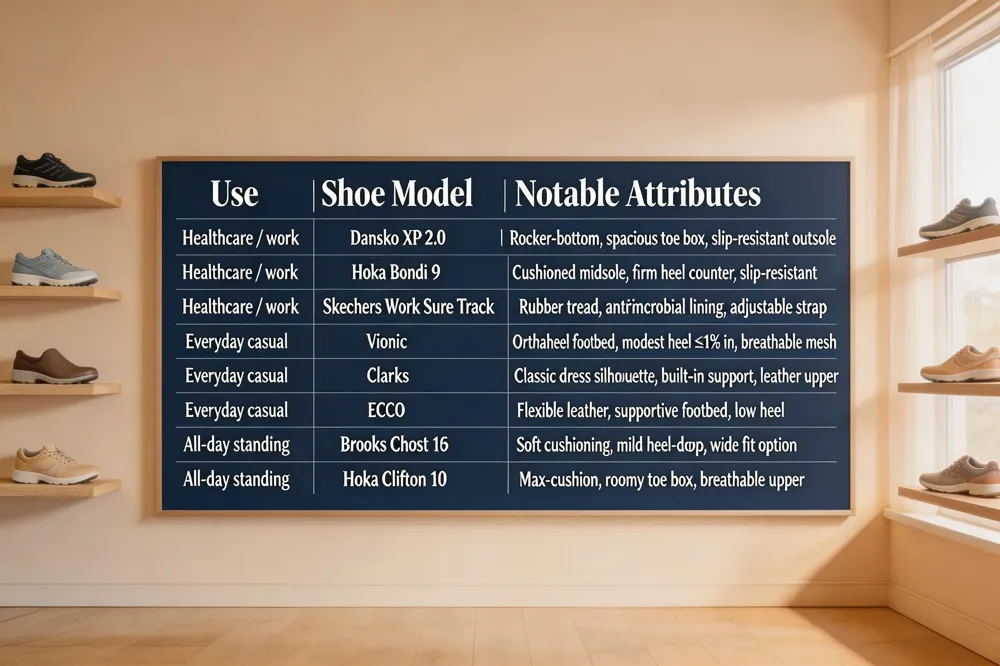 Rocker‑bottom clogs such as the Dansko XP 2.0 and Hoka Bondi 9 provide a gentle forward‑roll that eases forefoot strain during long shifts, while a firm heel counter prevents slippage and supports the ankle. For healthcare settings, slip‑resistant outsoles—found on models like the Skechers Work Sure Track and the Atoms Model 001—offer reliable traction on polished floors and often include antimicrobial linings to keep feet dry and infection‑free.
Stylistic options need not sacrifice support. Brands such as Vionic, Clarks, and ECCO blend classic dress silhouettes with built‑in arch‑support footbeds, breathable mesh or leather uppers, and modest heel heights (≤1½ in) that distribute weight evenly.
Women footwear choices that promote long‑term foot health and comfort – Choose shoes with ample shock‑absorbing midsoles, built‑in arch support (or compatible orthotics), a roomy toe box, and breathable materials. Low, broad heels or block‑heel styles reduce metatarsal pressure, while specialty orthopedic collections add extra depth and stretch uppers for swelling.
Best shoes for sore feet standing all day – Look for plush cushioning, stable arch support, and a rigid heel counter. Top picks include the Brooks Ghost 16, Hoka Clifton 10, and slip‑resistant Skechers Work Sure Track, all offering mild heel‑drop (≈8‑10 mm) and wide‑fit options.
Podiatrist‑recommended shoes for flat feet – Shoes with strong arch support and motion‑control midsoles, such as the Brooks Addiction Walker, New Balance 847v4, Vionic Walker Classic, and Hoka Gaviota 5, help control overpronation while providing a roomy toe box.
Best orthopedic shoes for walking – Orthofeet’s multi‑layer cushioned walkers and Hoka Bondi 1 (Meta‑Rocker) combine a mild rocker, wide ergonomic toe box, and stretch uppers for diabetic or neuropathic feet, delivering all‑day comfort and joint protection.
Brands, Work Shoes, and Style‑Friendly Orthopedic Options
| Brand | Model(s) | Key Benefits |
|---|---|---|
| New Balance | 928v3, Fuel Cell Walker Elite | Extra depth, removable insoles, APMA seal |
| Vionic | Walker Classic, Dress Collection | Built‑in arch support, stylish silhouette |
| Orthofeet | Multi‑layer cushioned walkers | Wide toe box, stretch upper, diabetic‑friendly |
| Hoka One One | Bondi 1 (Meta‑Rocker) | Mild rocker, cushioned sole, slip‑resistant |
| Cole Haan | Nike‑Air hybrids | Low heel, cushioned footbed, fashionable design |
| Naturalizer | Dress shoes | Seamless interior, breathable upper, roomy toe box |
| On Cloud | Cloud 6 | Easy on‑off, cushioned midsole, breathable mesh |
| Skechers | Slip‑Ins | Hands‑free entry, removable orthotic compatible, supportive outsole |
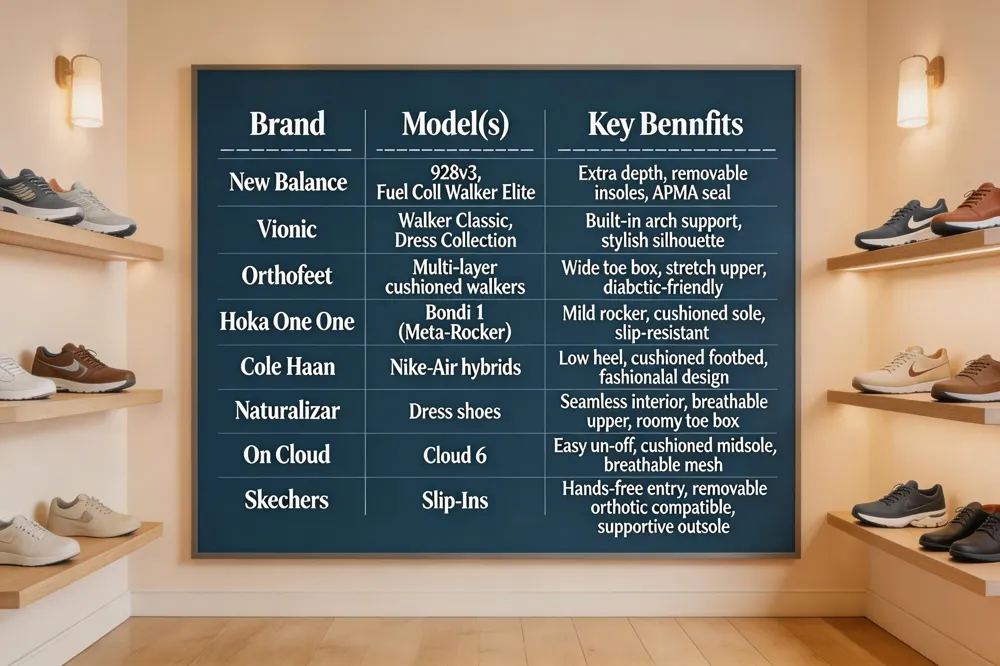 The American Podiatric Medical Association (APMA) Seal of Acceptance signals that a shoe meets podiatric standards for arch support, heel‑counter stability, cushioning, and toe‑box space—features shown to reduce plantar‑fasciitis, bunions, and joint strain. Industrial‑grade slip‑resistance is essential for professionals who stand on polished or wet floors; a rubber or textured‑leather outsole with a tread pattern (e.g., the APMA‑approved Hoka Bondi 9 or Brooks Ghost Max 3 helps prevent falls while still delivering shock‑absorbing midsoles. Fashionable dress shoes with built‑in support now combine sleek silhouettes with clinical‑grade features such as firm heel counters, cushioned footbeds, and wide toe boxes, allowing wearers to look professional without compromising foot health.
New Balance orthopedic shoes – Models like the 928v3 and Fuel Cell Walker Elite provide extra depth, a roomy toe box, and removable insoles that accommodate custom orthotics. Their cushioned midsoles and stable heel counters help distribute weight evenly, easing fore‑foot pressure and improving gait.
Ladies work shoes for standing all day – Ideal options include shoes with built‑in arch support, memory‑foam footbeds, breathable mesh or leather uppers, a modest ½–1 inch heel, and slip‑resistant rubber outsoles. A wide toe box and removable footbed allow customization for swelling or orthotics.
Stylish orthopedic shoes for women – Modern designs (e.g., Vionic, Orthofeet, or Cole Haan athletic‑hybrids) offer arch‑supportive footbeds, firm heel counters, stretchable uppers, and slip‑resistant soles while maintaining a fashionable silhouette such as sneakers, Mary Jane flats, or low‑profile boots.
Best long‑term foot comfort footwear – For sustained comfort, choose shoes that combine generous cushioning (Hoka Clifton 10, Brooks Ghost Max 3, a stable arch, a roomy toe box, and easy on‑off features (On Cloud 6, Skechers Slip‑Ins). Dress‑shoe hybrids (Cole Haan Nike‑Air, Naturalizer) provide low heels and cushioned midsoles, and clogs like Dansko XP 2.0 deliver rocker‑bottom support for all‑day standing.
Men’s Foot Health, Common Mistakes, and Practical Recommendations
| Common Mistake | Why It’s Harmful |
|---|---|
| Flat‑solled sneakers (e.g., Converse) | Lack cushioning → increased heel‑strike forces |
| Narrow toe boxes | Crowding → bunions, hammertoes, metatarsalgia |
| Flip‑flops & ballet flats | No arch/heel support → plantar fasciitis, Achilles strain |
| Non‑breathable rain boots | Traps moisture → fungal infection, blisters |
| Recommendation | Shoe Model |
|---|---|
| Orthotic‑friendly, supportive | Brooks Adrenaline GTS |
| Stability & cushioning | ASICS Gel‑Kayano |
| Max‑cushion, low drop | HOKA Clifton 10 |
| Slip‑resistant work | Skechers Arch Fit 2.0 |
| Wide‑fit options | New Balance 847v4, Dr. Comfort, Apex (up to 6E) |
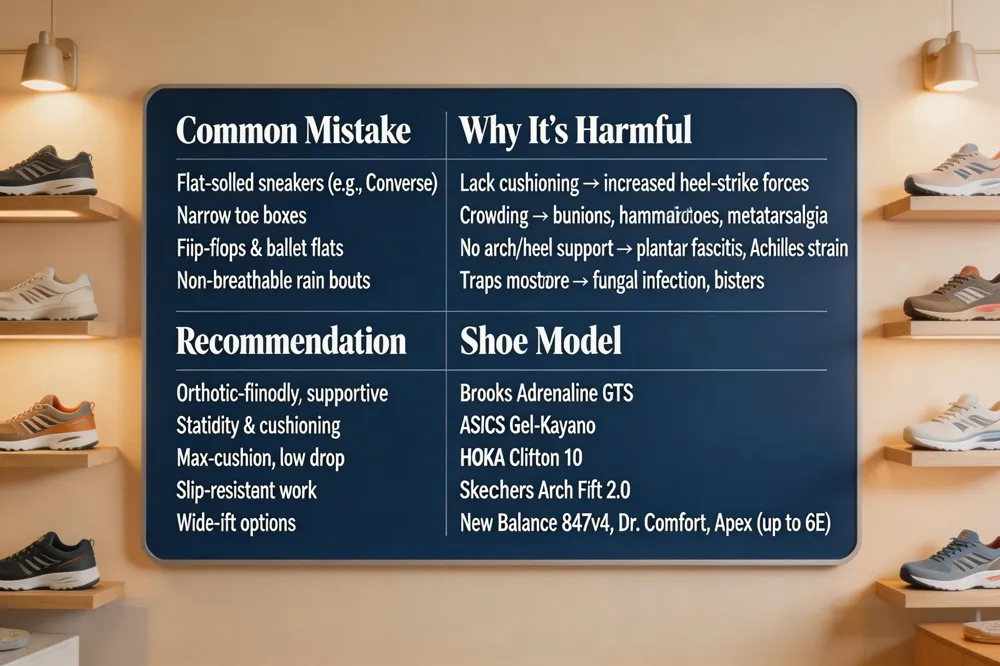 Footwear for knee pain and overpronation
Men’s knee pain is often linked to excessive pronation and poor shock absorption. Shoes that combine firm arch support, a sturdy heel counter, and ample cushioning help keep the tibia from rotating inward, reducing stress on the knee joint. Top podiatrist‑approved models include the Hoka Bondi (max‑cushion, Meta‑Rocker), Brooks Ghost Max 3 (DNA Loft v3 foam), and New Balance Fresh Foam X 880v15 (wide‑fit, breathable mesh). These shoes also feature a slight heel drop (≈5‑8 mm) that promotes a smoother gait.
Footwear for knee pain and overpronation
Men’s knee pain is often linked to excessive pronation and poor shock absorption. Shoes that combine firm arch support, a sturdy heel counter, and ample cushioning help keep the tibia from rotating inward, reducing stress on the knee joint. Top podiatrist‑approved models include the Hoka Bondi (max‑cushion, Meta‑Rocker), Brooks Ghost Max 3 (DNA Loft v3 foam), and New Balance Fresh Foam X 880v15 (wide‑fit, breathable mesh). These shoes also feature a slight heel drop (≈5‑8 mm) that promotes a smoother gait.
Footwear mistakes podiatrists advise to avoid
- Flat‑soled sneakers (e.g., Converse) that lack cushioning and increase heel‑strike forces.
- Overly tight or narrow toe boxes that crowd the toes, leading to bunions, hammertoes, and metatarsalgia.
- Flip‑flops, ballet flats, and soft‑sole Uggs that offer no arch or heel support, predisposing to plantar fasciitis and Achilles strain.
- Non‑breathable rain boots that trap moisture, encouraging fungal infection and blister formation.
Wide‑fit and customizable options For men with bunions, hammertoes, or swelling, shoes with a roomy toe box, extra depth, and stretchable uppers are essential. Brands such as New Balance, Orthofeet, Dr. Comfort, and Apex provide width options up to 6E and removable insoles for custom orthotics. Slip‑on designs with hands‑free technology (e.g., Kizik, Orthofeet) aid those with limited dexterity while maintaining a secure heel fit.
Podiatrist answers to common questions
- Best shoes for foot health: Look for solid arch support, firm heel counters, roomy toe boxes, and cushioning. Recommended models: Brooks Adrenaline GTS, ASICS Gel‑Kayano, HOKA Clifton 10, On Cloud 6, and Skechers Arch Fit 2.0.
- Shoes to stop wearing: Flat‑soled Converse, ill‑fitting tight shoes, sheepskin‑lined Uggs, non‑breathable rain boots, flip‑flops, and ballet flats.
- Top orthopedic brands: Hoka, Brooks, ASICS, New Balance, Orthofeet, Vionic, Dr. Comfort, Dansko, Birkenstock, Acorn, Apex, and Arcopedico.
- Knee‑pain recommendations: Shoes that absorb impact (Hoka Bondi), provide stable arch support, and maintain a secure heel counter; replace every 300‑500 mi or 6‑12 months to preserve knee‑protective cushioning.
Comprehensive Recommendations for Diverse Foot Needs
| Need | Recommended Shoe | Core Feature |
|---|---|---|
| General foot pain (men) | Orthofeet | Firm arch, roomy toe box, removable orthotic |
| General foot pain (women) | Vionic | Orthaheel footbed, cushioned midsole, breathable upper |
| High impact days | Hoka Clifton 10 | Max‑cushion, low heel drop, rocker sole |
| Long‑day standing | Brooks Ghost Max 3 | Soft cushioning, stable heel counter |
| Wide‑foot support | New Balance 928v3 | Extra width, deep toe box, stable platform |
| Diabetic/neuropathic | Orthofeet Coral | Seamless interior, stretchable upper, orthotic‑friendly |
| Budget‑friendly work | Skechers Work Sure Track | Slip‑resistant outsole, cushioned footbed |
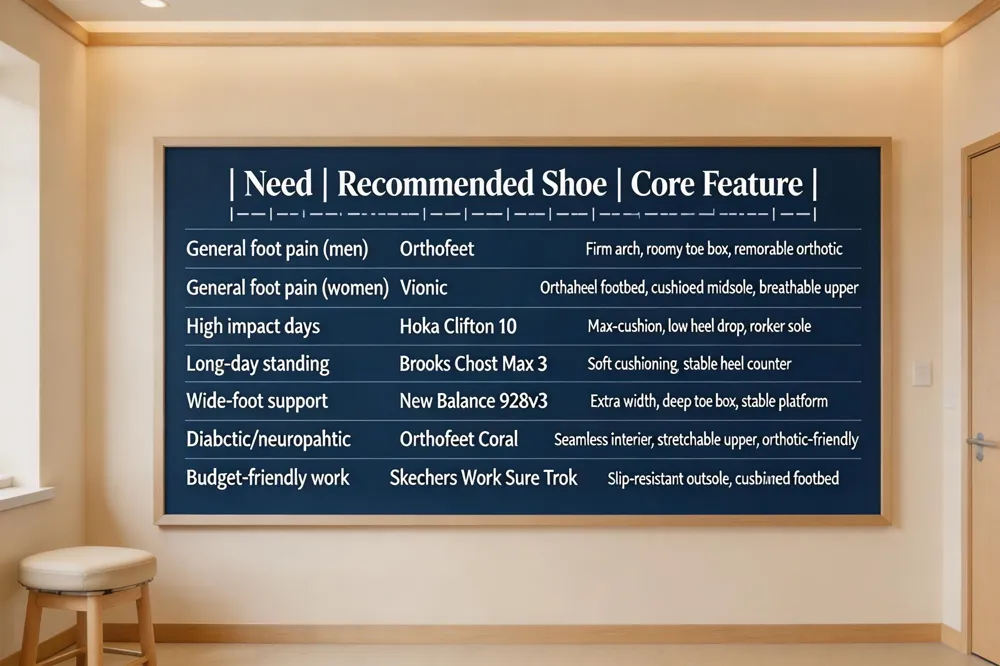 Best shoes for foot pain men – Men with foot pain should choose models that give firm arch support, a stable heel counter and generous cushioning. A roomy toe box and depth prevent pressure on bunions, hammertoes and swelling, while a mild rocker sole eases forefoot strain. Orthopedic‑focused brands such as Orthofeet, Vionic, Hoka One One, Brooks, ASICS, New Balance, Dr. Comfort and Birkenstock meet these criteria and often feature removable insoles, breathable stretch uppers and seamless interiors for diabetic or neuropathic feet. Try shoes in the socks you’ll wear, ensuring a thumb‑wide gap beyond the longest toe.
Podiatrist‑recommended shoes for wide feet – Wide‑foot wearers benefit from brands offering dedicated wide or extra‑wide options—New Balance, Asics, Dr. Scholl’s, Merrell’s Jungle Moc, and Birkenstock sandals provide roomy toe boxes, solid arch support and cushioning. Performance models such as Hoka Bondi SR and Altra Torin combine width with shock‑absorbing midsoles, while the Topo Atmos line offers a stable platform for long‑day standing. Look for breathable uppers, padded collars and removable footes to reduce blisters and plantar‑fasciitis risk.
Men footwear choices that promote long‑term foot health and comfort – Prioritize shoes that blend plush cushioning with firm arch and heel support, like Brooks Ghost Max, Hoka Clifton 9 or ASICS Gel‑Nimbus 26. Select those with a roomy toe box, removable insoles (e.g., Vionic dress shoes, Cole Haan Oxfords) for orthotics, and stability features (Brooks Adrenaline GTS 24, New Balance Fresh Foam X 880v15) to curb overpronation. Lightweight mesh or flexible leather uppers improve breathability, while adjustable closures accommodate swelling throughout the day.
Putting It All Together for Healthy Feet
A well‑fitted shoe is the foundation of foot health. Aim for at least a‑‑inch (≈13 mm) gap between the longest toe and the toe box, try shoes in the late afternoon when feet are at their largest, and ensure a snug, stiff heel counter to stop forward slippage. Select arch support that matches your foot type (low, neutral, or high) and a heel height no greater than 1½ inches (≈38 mm) for everyday wear. Breathable uppers (mesh, leather, or engineered knit) and seamless, padded linings reduce moisture buildup and friction, lowering the risk of blisters and fungal infections.
If you experience persistent pain, uneven wear, or have a deformity such as bunions or flat feet, schedule a professional gait analysis; a podiatrist can identify overpronation, supination, or other biomechanical issues and recommend motion‑control or stability shoes, or custom orthotics.
Maintain footwear by rotating pairs, inspecting midsoles for compression, and replacing shoes every 300‑500 miles or 6‑12 months for daily wear. Keep uppers clean, allow them to air‑dry, and store shoes with shoe trees to preserve shape and support, ensuring long‑term comfort and injury prevention.