Introduction
Understanding Common Foot Deformities
Bunions and hammertoes are prevalent structural foot issues that affect a significant portion of the population. A bunion, medically termed hallux valgus, is a bony bump at the base of the big toe, where the joint protrudes outward. This occurs when the first metatarsal bone shifts and the big toe angles inward toward the other toes. Hammertoes involve a deformity of the smaller toes, most often the second, third, or fourth, where the middle joint bends downward, creating a hammer-like appearance.
Together, these conditions account for a substantial number of podiatric visits. Hammertoes alone are estimated to represent up to 20% of all foot and ankle problems. Bunions are even more common, affecting around one-third of Americans at some point. Women are disproportionately affected, being up to ten times more likely to develop bunions than men.
The Functional Impact on Daily Living
While sometimes dismissed as merely cosmetic concerns, these deformities can significantly impair foot function and quality of life. The metatarsophalangeal (MTP) joint at the base of the big toe is crucial for weight-bearing and walking. A bunion can disrupt this mechanics, leading to:
- Chronic pain and stiffness
- Swelling, redness, and skin irritation
- Development of corns and calluses
- Difficulty finding comfortable footwear
- Altered gait and balance, increasing fall risk
Hammertoes cause similar discomfort, with the bent toe rubbing against shoes, often resulting in painful corns on the top or tip of the toe. Left untreated, both conditions can progress, with flexible deformities becoming rigid and fixed, further limiting mobility and comfort.
A Path Forward: Effective Treatment and Specialized Care
The progression of bunions and hammertoes is not inevitable. A wide spectrum of effective treatments exists, from conservative management to advanced surgical correction. Modern podiatry emphasizes a patient-centered approach, starting with non-invasive strategies to relieve symptoms and slow progression. For cases where these measures are insufficient, innovative surgical techniques, including minimally invasive procedures, offer solutions with reduced recovery times.
Early consultation with a foot and ankle specialist, such as a podiatrist or orthopaedic surgeon, is crucial. A proper diagnosis, often involving a physical exam and weight-bearing X-rays, allows for a personalized treatment plan. Seeking expert care at the first signs of pain or deformity is the most effective step toward maintaining healthy, functional feet.
| Deformity | Primary Location | Key Characteristics | Common Initial Symptoms |
|---|---|---|---|
| Bunion | Base of the big toe (MTP joint) | Bony bump, big toe angles inward | Pain at joint, redness, shoe-fitting issues |
| Hammertoe | Middle joint of smaller toes | Toe bends downward at middle joint | Toe stiffness, corns on top of toe, discomfort in shoes |
| Shared Contributing Factors | Genetics, improper footwear (narrow/ high heels), arthritis, certain foot structures (e.g., flat feet) | Progressive nature; can occur together, with bunions crowding toes and leading to hammertoes |
Decoding the Deformities: What Are Bunions and Hammertoes?

Anatomical Definition of a Bunion (Hallux Valgus) and Hammertoe
A bunion, medically termed hallux valgus, is a structural foot deformity involving the metatarsophalangeal (MTP) joint at the base of the big toe. In this condition, the first metatarsal bone shifts outward while the big toe angles inward toward the other toes. This misalignment creates a prominent, bony bump at the side of the joint.
A hammertoe is a distinct deformity of one of the smaller toes, typically the second, third, or fourth. It is characterized by an abnormal bend at the middle joint of the toe, known as the proximal interphalangeal (PIP) joint. This causes the tip of the toe to point downward, giving it a hammer-like or talon-like shape.
How They Physically Present and Differ
The key difference lies in the location and appearance of the deformity.
| Condition | Primary Joint Affected | Typical Appearance | Primary Toe(s) Affected |
|---|---|---|---|
| Bunion | Base of the big toe (MTP joint) | Bony bump protruding outward from the foot's inner edge | Big toe |
| Hammertoe | Middle joint of a smaller toe (PIP joint) | Toe bent downward at the center, tip pointing down | Second, third, or fourth toes |
Hammertoes are also distinguished from other toe deformities. Mallet toes involve a bend at the joint nearest the toenail, while claw toes exhibit bends at all three toe joints. Recognizing these differences helps in accurate diagnosis and treatment planning.
Key Causes and Risk Factors
Both conditions share some common risk factors, though their primary causes differ.
What causes bunions? Bunions are primarily caused by a combination of inherited foot structure and mechanical stress over time. The underlying cause is often a genetic predisposition to a foot type—such as low arches, flat feet, or an unstable metatarsal joint—that makes the big toe joint prone to misalignment. Prolonged pressure, most commonly from wearing narrow, tight, or high-heeled shoes, forces the big toe inward toward the other toes, gradually pushing the joint out of place. Occupations or activities requiring extensive standing or repetitive stress on the feet can also contribute. Additionally, inflammatory conditions like arthritis and hormonal changes, such as during pregnancy, can increase joint laxity and accelerate their development.
What causes hammer toe? Hammer toe is primarily caused by a muscle imbalance and pressure on the toe joints and tendons, often due to wearing ill-fitting footwear. Shoes that are too tight, narrow, or have high heels can force the toes into a bent position for prolonged periods. Over time, the muscles and tendons tighten and shorten, causing the toe to remain in a curled shape. Other contributing factors include foot injuries, arthritis, diabetes, and congenital conditions. Without intervention, this progressive condition can transition from flexible to rigid, becoming permanently fixed.
Common overlapping risk factors for both conditions include:
- Heredity: A family history of foot structure and mechanics.
- Footwear: Narrow toe boxes, high heels, and ill-fitting shoes.
- Arthritis: Inflammatory conditions like rheumatoid arthritis.
- Biomechanics: Conditions like flat feet or high arches that alter weight distribution.
Connection Between the Two Conditions
Bunions and hammertoes frequently occur together, with one often directly influencing the other. As a bunion grows and the big toe angles inward, it begins to crowd the adjacent smaller toes. This crowding exerts pressure on the neighboring toes, disrupting their natural alignment and pushing them upward.
Over time, this chronic pressure can lead to a muscle and tendon imbalance in the smaller toes, ultimately causing them to buckle and form a hammertoe deformity. Therefore, treating a bunion may sometimes be necessary to prevent or alleviate an associated hammertoe.
| Key Factors Differentiating Bunions and Hammertoes |
|---|
| Bunion: Primary cause is hereditary foot structure; involves the big toe's base joint. |
| Hammertoe: Primary cause is muscle/tendon imbalance from pressure; involves smaller toes' middle joint. |
| Shared Risk: Tight shoes, high heels, arthritis, and biomechanical issues can trigger or worsen both. |
| Progression: Untreated bunions can crowd toes and directly contribute to hammertoe development. |
The First Line of Defense: Conservative and Non-Surgical Treatments

Goal of Non-Surgical Care
Non-surgical treatments are the initial approach for managing bunions and hammertoes. The primary aims are to relieve immediate pain and swelling, slow the progression of the deformity, and improve daily comfort. These methods are designed to help you avoid surgery for as long as possible by effectively managing symptoms.
Footwear Modifications
Your choice of shoes is the most critical factor in conservative care. Selecting footwear with a wide and deep toe box prevents crowding and reduces direct pressure on the bunion or bent toe. Experts recommend shoes with low heels, a flexible sole, and ensuring there's about a half-inch of space between your longest toe and the shoe's end.
Protective Padding and Devices
Over-the-counter products can provide significant relief. Bunion pads, toe crests, and cushions act as buffers between sensitive areas and your shoe, preventing painful rubbing and skin irritation. For hammertoes, soft splints or toe straighteners can help realign flexible toes, while spacers can keep toes separated to reduce friction.
Role of Orthotic Devices
Orthotics, whether over-the-counter or custom-made by a podiatrist, play a key role. These inserts work by redistributing pressure across the entire foot, correcting imbalances, and providing arch support. This alleviates stress on the forefoot and can slow the worsening of both bunions and hammertoes.
Pain Management Strategies
For managing inflammation and discomfort, several options are available. Over-the-counter non-steroidal anti-inflammatory drugs (NSAIDs) like ibuprofen can reduce swelling. Applying ice packs for 15-20 minutes helps with acute flare-ups. In cases of severe inflammation, a podiatrist may administer a corticosteroid injection for longer-lasting relief.
Toe and Foot Exercises
Specific exercises can improve flexibility and strength. A commonly recommended exercise is the towel scrunch: place a towel flat on the floor and use your toes to crumple it toward you. Performing this 8-12 times per foot, twice daily, helps maintain toe mobility and strengthens intrinsic foot muscles.
Advanced Non-Surgical Therapies
Beyond traditional methods, some clinics offer advanced therapies. These may include therapeutic laser treatment to reduce inflammation and promote tissue repair or platelet-rich plasma (PRP) injections to support healing. These innovative options can be part of a comprehensive non-surgical plan.
Managing Expectations and Prognosis
It is important to understand that conservative treatments manage symptoms but do not reverse the underlying bony deformity. With consistent care, many people achieve excellent long-term symptom control. However, if pain becomes constant or interferes with daily life, surgical options may be discussed.
How can I correct a hammer toe without surgery?
Your doctor may recommend gently stretching your toes manually (using your hands) or using your toes to pick things up off the floor. They may also recommend doing 'towel curls' to strengthen the toes. To perform a towel curl, place a towel flat under your foot and use your toes to crumple (scrunch) it. Splints or toe straighteners are small devices designed to help realign crooked toes gradually. These are particularly helpful for flexible hammertoes in the early stages. Wearing splints or straighteners consistently can contribute to better toe positioning. They can also help reduce symptoms over time.
What are the treatment options for bunions?
Treatments for bunions range from conservative, non-surgical methods to surgical correction, depending on the severity and pain. Initial approaches include wearing roomy, comfortable shoes, using protective padding or cushions, and taking over-the-counter pain relievers. Custom or over-the-counter orthotic shoe inserts can help redistribute pressure and slow progression, while icing can reduce inflammation. For persistent pain that limits daily activities, surgical procedures are available to realign bones, remove tissue, or correct the joint angle. As a clinic specializing in advanced, minimally invasive techniques, we offer personalized evaluations to determine the most effective treatment plan for your specific condition.
| Treatment Category | Specific Methods | Primary Goal | Best For Stage of Condition |
|---|---|---|---|
| Footwear | Wide toe box, low heels, proper fit | Reduce pressure & prevent irritation | All stages, especially early |
| Protective Devices | Pads, cushions, splints, spacers | Cushion bones & realign toes | Flexible, mild to moderate |
| Biomechanical Support | Custom or OTC orthotics | Redistribute foot pressure | All stages, for pain management |
| Symptom Relief | NSAIDs, icing, steroid injections | Reduce pain and swelling | During flare-ups or chronic pain |
| Rehabilitative Exercise | Towel scrunches, manual stretches | Improve strength and flexibility | Early, flexible deformities |
When Surgery Is Necessary: Modern Corrective Procedures

Indications for Surgery
Surgery for bunions or hammertoes is considered a last resort, reserved for specific, functional problems. The main indicators include when extensive conservative treatments like orthotics fail to provide relief, when bunion pain or hammertoe pain becomes severe and persistent, and when a rigid, fixed deformity develops. A significant indication is when the condition impairs your mobility, making walking or wearing shoes extremely difficult. It is crucial to understand that surgery is aimed at restoring function and alleviating pain, not for cosmetic purposes alone.
Overview of Bunion Surgery (Bunionectomy)
Bunion surgery, known medically as a bunionectomy, involves procedures to correct the misalignment of the first metatarsophalangeal joint. The surgeon makes precise cuts in the bone to realign the first metatarsal and the big toe. A common step is removing the excess bony bump. To maintain the new, corrected position, internal hardware such as screws or pins is often used to secure the bones. The specific technique chosen depends on the severity of the deformity and the angles measured on X-rays.
Overview of Hammertoe Surgery
Hammertoe surgery addresses the abnormal bend in the second (middle) joint of a smaller toe. For flexible deformities, the procedure may involve a tendon release or transfer to rebalance the toe's muscles. For rigid, fixed hammertoes, surgeons may perform a joint resection (arthroplasty) to remove a small piece of bone, allowing the toe to straighten. In more severe cases, a fusion (arthrodesis) of the joint may be necessary. Like bunion surgery, small implants, pins, or screws may be utilized to hold the correction in place during healing.
Traditional Open vs. Minimally Invasive Surgery
A major advancement in foot surgery is the shift toward minimally invasive techniques. Traditional open surgery requires larger incisions, leading to more soft tissue trauma, visible scarring, and typically a longer recovery period. In contrast, minimally invasive surgery (MIS) uses very small incisions, often less than one centimeter long. Specialized instruments and real-time X-ray guidance allow the surgeon to perform the correction with precision. The benefits of MIS include less post-operative pain, reduced swelling, a lower risk of infection, smaller scars, and a faster return to daily activities. However, MIS is not suitable for all conditions, particularly very severe or complex deformities.
Recovery and Realistic Expectations
Recovery timelines and protocols vary between bunion and hammertoe surgeries, and between open and minimally invasive approaches. Patients typically wear a protective surgical boot or shoe for several weeks. Weight-bearing is often permitted soon after MIS procedures, while traditional surgery may require a longer period of non-weight-bearing. Complete recovery and the resolution of swelling can take several months. It is vital to have realistic expectations: surgery aims to reduce pain and improve function, but toes may not be perfectly straight, some stiffness may remain, and there is a small chance the deformity could recur, especially if preventative footwear habits are not maintained.
| Surgical Procedure | Typical Goal | Common Techniques | Key Hardware Used |
|---|---|---|---|
| Bunionectomy | Realign big toe, remove bone | Osteotomy, soft tissue balancing | Internal screws, pins |
| Flexible Hammertoe Correction | Rebalance toe muscles | Tendon release or transfer | Possibly temporary pin |
| Rigid Hammertoe Correction | Straighten fixed joint | Joint resection (arthroplasty) or fusion (arthrodesis) | Pin, screw, or implant |
| Minimally Invasive Surgery | Correct with minimal trauma | Small incision, burr, guided imaging | Small internal screws |
The Advanced Approach: Minimally Invasive Foot Surgery Explained
What is minimally invasive foot surgery?
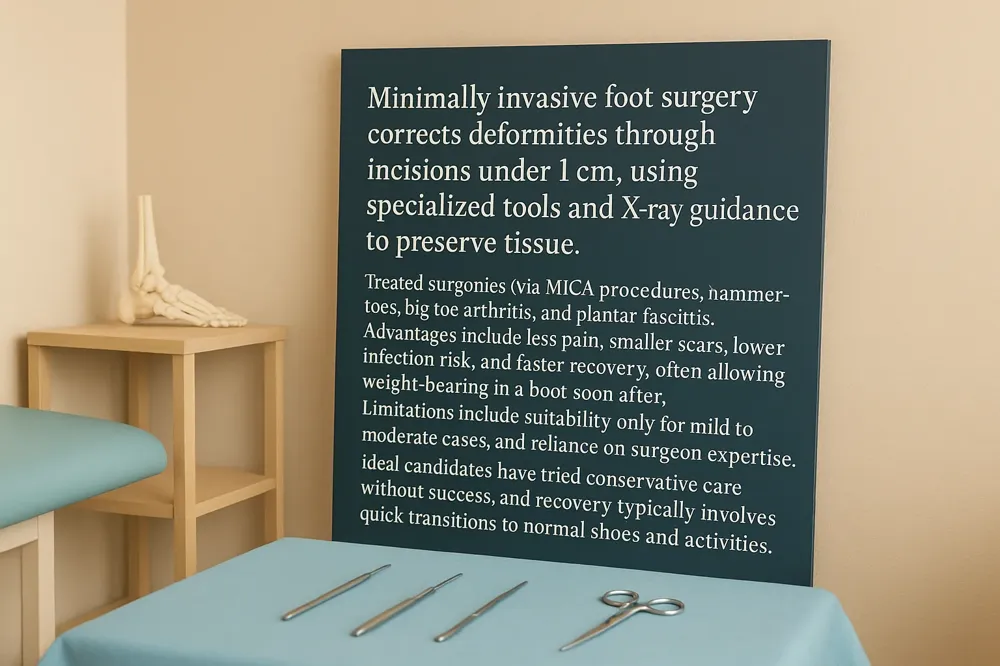
Minimally invasive foot surgery is an advanced surgical approach used to correct common foot deformities. It is performed through incisions often less than one centimeter long. Surgeons use specialized instruments and real-time X-ray guidance (fluoroscopy) to operate. This method preserves blood supply and significantly minimizes injury to muscles, tendons, and other soft tissues around the surgical site.
How the Procedure Works
The technique involves using tiny tubular retractors to gently move muscles aside. A small arthroscope provides a magnified view on a monitor. Surgeons then utilize specialized burrs and drills to precisely cut and realign bones. For conditions like bunions, screws are inserted through these small openings to secure the corrected position.
Conditions Treated with MIS
This approach is highly effective for several forefoot problems. Key treatable conditions include:
| Condition | Common Procedure Name | Key Surgical Goal |
|---|---|---|
| Bunions (Hallux Valgus) | MICA (Minimally Invasive Chevron & Akin) | Remove bony bump, realign big toe |
| Hammertoes | Lesser Toe Correction | Straighten the bent middle joint of the toe |
| Big Toe Arthritis | Cheilectomy or MIRO | Remove bone spurs or shorten bone for space |
| Plantar Fasciitis | Plantar Fascia Release | Partially cut the tight ligament to relieve pain |
What are the advantages and disadvantages of minimally invasive foot surgery?
The benefits of minimally invasive foot surgery are substantial for suitable candidates. Patients typically experience:
- Less post-operative pain and swelling
- Smaller scars and better cosmetic results
- Lower risk of wound infections and complications
- Faster recovery, often bearing weight in a protective boot sooner
- Quicker return to daily activities and work, sometimes within weeks instead of months
However, important limitations exist. Not all foot problems are suitable, especially severe, rigid deformities or cases with significant joint instability. The technique requires extensive additional training for surgeons. Due to the small incisions, there is limited direct visualization, which places greater reliance on the surgeon’s skill and imaging.
Determining if You Are a Candidate
Ideal candidates generally have mild to moderate deformities that have not responded adequately to conservative care. This includes patients who have tried shoe modifications, orthotics, padding, and physical therapy but still experience pain that interferes with daily life.
Understanding the Recovery Timeline
Recovery is notably faster than with traditional open surgery. A general timeline includes:
- First Few Days: Weight-bearing as tolerated in a surgical boot, with rest and elevation.
- 2-4 Weeks: Transition into supportive athletic shoes or wide-toe box footwear.
- 6-12 Weeks: Gradual return to most normal activities, with full recovery varying by procedure.
Our Specialized Expertise
Our clinic specializes in these advanced techniques. Our lead surgeons are fellowship-trained podiatric surgeons and have performed over a thousand minimally invasive procedures. This extensive experience is crucial for achieving optimal patient outcomes, managing the technical challenges, and ensuring safety throughout the process.
| Topic Covered | Key Details | Why It Matters for Patients |
|---|---|---|
| Core Surgical Principle | Tiny incisions with specialized tools and live X-ray guidance | Minimizes tissue damage and surgical trauma |
| Common Procedures | MICA for bunions, tendon releases for hammertoes | Provides specific, effective solutions for frequent issues |
| Primary Benefits | Less pain, faster healing, smaller scars, lower infection risk | Enhances comfort and speeds return to normal life |
| Key Considerations | Surgeon expertise is critical; not suitable for all complex cases | Highlights the importance of choosing a qualified specialist |
| Typical Recovery | Often walking same day in boot; back to shoes in 4-6 weeks | Sets realistic expectations for the healing journey |
The Broader Picture: Comprehensive Podiatric Care and When to Seek Help

The Role of Podiatrists in Diagnosis and Treatment
Podiatrists are specialists in foot and ankle medicine and surgery. Their work begins with a thorough consultation to understand your pain and lifestyle. This care model means we don't just treat a single symptom; we develop a personalized plan that addresses the root cause of your condition, whether it's a bunion, hammertoe, or a complex biomechanical issue.
The Diagnostic Process: From Observation to Imaging
Diagnosis involves a detailed physical exam, where the podiatrist checks for joint mobility and visible deformities. They will often analyze your gait to see how you walk and examine your current footwear for fit issues. To assess the bone structure and measure the severity of a deformity, weight-bearing X-rays are essential. These images allow precise measurement of angles to determine appropriate treatment for bunions or hammertoe treatment.
The Critical Importance of Early Intervention
Seeking help early is the most effective way to prevent a minor issue from becoming a major problem. Early-stage, flexible hammertoe deformities are more responsive to conservative treatments like hammertoe orthotics and targeted exercises. Left untreated, conditions like bunions and hammertoes typically worsen over time, which can affect your balance, gait, and overall mobility.
Our Clinic's Approach to Personalized Care
Our clinics offer a comprehensive, patient-centered journey. It starts with a detailed consultation and same-day diagnostics, if needed. Based on the findings, your podiatrist will explain your hammertoe diagnosis and eligibility for various treatments, from conservative bunion treatment to advanced minimally invasive bunion correction. The goal is to create a clear, tailored plan focused on restoring your comfort and function.
Strategies for Long-Term Management and Prevention
Effective long-term care is proactive. Key strategies include wearing shoes for hammertoes with a wide toe box and low heels, performing specific hammertoe exercises and arch strengthening exercises, and maintaining a healthy weight to reduce pressure on your feet. Custom orthotics for bunions can also provide ongoing support to correct biomechanical imbalances and prevent the progression of deformities.
Addressing Common Patient Concerns
Many patients worry about conditions returning after bunion surgery. While recurrence is possible, it can be minimized by adhering to post-operative guidelines and maintaining healthy foot habits. For patients with chronic conditions like diabetes, regular podiatric care is vital to prevent complications, manage wounds, and monitor for changes in foot structure.
Recognizing When to See a Specialist
You should schedule a consultation with a podiatrist if you experience persistent foot or toe pain, notice a visible bunion deformity or change in hammertoe deformity, have difficulty walking or finding shoes that fit comfortably, or develop recurring corns and calluses. These are clear signs that professional evaluation and treatment for hammertoes are needed to protect your foot health.
A Summary of Comprehensive Podiatric Care
| Care Phase | Key Components | Primary Goals |
|---|---|---|
| Consultation & Diagnosis | Physical exam, gait analysis, weight-bearing X-rays | Accurate assessment, understanding patient history |
| Treatment Planning | Personalized plan integrating non-surgical bunion treatment & minimally invasive foot surgery options | Alleviate pain, correct deformity, restore function |
| Long-Term Management | Proper footwear for bunions, custom orthotics for hammertoes, specific exercises, weight management | Prevent progression, maintain mobility, ensure health |
| Specialized Care | Diabetic foot care, post-surgical monitoring, addressing recurrence | Manage chronic conditions, optimize long-term outcomes |
Conclusion
You Can Manage Your Foot Health
Contrary to what many believe, receiving a diagnosis of a bunion or hammertoe does not mean a lifetime of pain. These common deformities are highly manageable conditions. Modern podiatry offers a comprehensive spectrum of solutions. This range begins with simple, conservative measures and extends to advanced surgical corrections designed to restore comfort and function.
A Full Spectrum of Care Options
Effective management starts with an accurate diagnosis. This is the crucial first step in creating a personalized treatment plan. Your care plan should be tailored to your specific condition, lifestyle, and goals.
Conservative and Non-Surgical Treatments For many, relief is found without an operation. This initial phase focuses on reducing symptoms, slowing progression, and improving comfort.
- Footwear Modifications: Switching to shoes with a wide, deep toe box is foundational. It relieves pressure and gives toes the space they need.
- Orthotic Devices & Padding: Custom or over-the-counter inserts can redistribute pressure. Pads, spacers, and splints protect sensitive areas and help realign toes.
- Medications & Therapies: Anti-inflammatory medications (NSAIDs) manage pain and swelling. Physical therapy and specific toe exercises can strengthen muscles and improve flexibility.
Advanced and Surgical Corrections When conservative care is insufficient, surgery provides a definitive solution. The goal is to correct the underlying bone deformity, not just the symptoms.
| Condition | Surgical Goal | Common Procedures |
|---|---|---|
| Bunion | Realign the big toe joint and remove the bony prominence. | Bunionectomy (Osteotomy), Minimally Invasive Bunion Correction |
| Hammertoe | Straighten the bent toe and restore normal alignment. | Tendon release, joint resection (arthroplasty), joint fusion (arthrodesis) |
A significant advancement is Minimally Invasive Surgery (MIS). This approach uses tiny incisions, specialized instruments, and real-time imaging. Benefits often include less post-operative pain, smaller scars, and a quicker recovery compared to traditional open techniques.
The Importance of Expert Evaluation
The success of any treatment plan hinges on expert guidance. A skilled podiatrist or foot and ankle surgeon can provide an accurate diagnosis. They determine if your deformity is flexible or rigid, a key factor in planning treatment. They will discuss all suitable options, from the simplest changes to the most advanced procedures.
Your journey to pain-free feet begins with a single, proactive step. We encourage you not to accept discomfort as normal. Schedule a consultation to receive a professional evaluation and a personalized roadmap to relief and improved foot health. Taking action today can lead to lasting comfort and mobility for years to come.